Showing posts with label Angularfruit Milkvine. Show all posts

Tuesday, September 22, 2015

Road Trip: Oglethorpe –Wilkes Counties, July 28th, 2015 (Part 2)


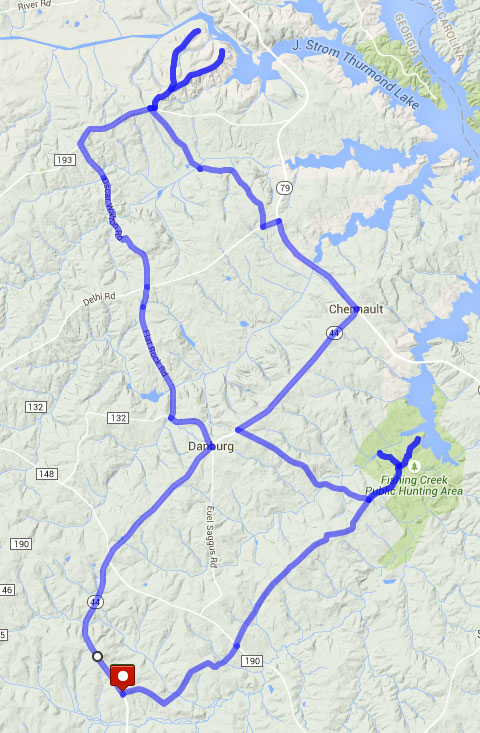
July 28th. Most of our trips over to Wilkes County, Georgia, have coincided with frog surveillance trips; they were finished for the year but we decided to make a trip just to look at wildflowers. The first part of the trip was from GA-77 in Oglethorpe County to GA-17 Wilkes County on the Saxon Mattox (Oglethorpe County) – CR113 (Wilkes County) road. From this road, we made our way over to Enoch John Rd (off GA-44) where we began our…


‘regular’ route in Wilkes County. 

On our drive down to the Anderson Mill Creek swamp, I spotted…


seed capsules on a False Aloe (Manfreda virginica) plant. I had never noticed them here before. There were several plants but only this one had fruit.


A close view of the developing seed capsules. I hope I see them when they ripen. 

At the east swamp, again we spotted the…


tell-tale pairs of heart-shaped leaves indicative of a milkvine. A single flower peaking out from under the right-hand leaf gave it away as the Angularfruit MIlkvine (Matelea gonocarpos). 

I poked around under the leaves and found …


a cluster of flowers. There were more vines on the other side of the road and I found a…


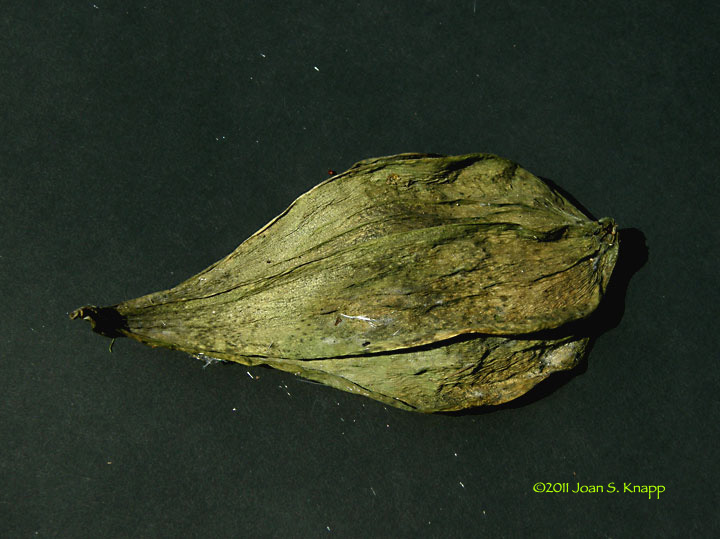
fruit. It was lying on the ground out of sight. 

Further up the road…


a Black Swallowtail (Papilio polyxenes) was feeding on flowers.


An Eastern Milkpea (Galactia volubilis) vine was climbing up a sapling nearby. 

Near the east end of Enoch John Road, we spotted several…


Bushy Seedbox (Lugwigia alternifolia) plants that had finished blooming. There were some…


flowers with withered petals and many…


seed capsules were developing.

Over at the Fishing Creek Wildlife Management Area (WMA), we found…


Clasping Milkweed (Asclepias amplexicaulis) follicles releasing seeds. It had rained just prior to our arrival and the silks looked somewhat bedraggled. When I picked a couple of seeds and let them go, they floated off on the light breeze as if they were dry. Interestingly, milkweed silks are so bouyant, they were used, during World War II, in life jackets. 

At the second site, the Clasping Milkweeds has already released all of their seeds…


 leaving intriguing sculpures atop the stalks.


Our final stop was at the Broad River WMA where we looked at the clematis seed heads that we’d seen on our previous trip in late June.


Many of the seed heads were still not ripe while…


others had ripened. I think these are from one of the small unassuming native Clematis species. Now we know where the vines are, we’ll have to figure out when they’ll be blooming and return to identify it. 

Compared with most trips that focus on flowering wildflowers, this trip was a mix of flowers and fruit. Finding the fruit can be as interesting as seeing the flowers.

Related posts:

Saturday, August 1, 2015

Road Trip: Wilkes – McDuffie Counties, June 26th, 2015 (Part 1)

June 26th. Once again, it was time for a road trip to monitor frogs. So, as usual, we used the trip to scout wildflowers.
We started the trip at the west end of Enoch John Road. On the section of road between Danburg Road and Anderson Mill Creek, I think I spent more time at the edge of, straddling, or in roadside ditches while photographing flowers.

There were the ‘usual suspects,’…


Lanceleaf Coreopsis (Coreopsis lanceolata),…


Starry Rosinweed (Silphium astericus),…


Hairy Angelica (Angelica venenosa), and


Heal-all (Prunella vulgaris).


A wild petunia, that I expected would be the Carolina Wild Petunia (Ruellia caroliniensis), turned out to be the Stalked Wild Petunia (Ruellia pedunculata); a nice surprise.

At the Anderson Mill Swamp, I found a…


Passionfruit (Passiflora incarnata) in bloom.


I was hoping that the Broadleaf Arrowhead (Sagittaria latifolia) would be in bloom, but alas not. 


A Zebra Swallowtail (Protographium marcellus) teased me for some time, flying back and forth along the road. 


From the Anderson Mill Creek swamp, we drove east to the swamp on the unnamed tributary to Fishing Creek.


The dam, repaired by the beaver, was holding. The large ‘bed’ of…


American Lotus (Nelumbo luteo) was thriving. We satisfied ourselves with admiring the…


flowers from the road. 


A small skipper, a Least Skipper (Ancyloxypha numitor), feeding on a


Bull Thistle (Cirsium vulgare). 


Then I noticed the…


leaves, and then the…


flowers of an Angularfruit Milkvine (Matelea gonocarpos). 


Then, on the other side of the road, I found another vine, climbing up a blackberry cane that had a…


Blackberry Knot Gall. This vine had even…


more flowers. 

(To be continued…)

Tuesday, October 18, 2011

Euchaetes egle (Milkweed Tussock Moth Caterpillar)

So… We were poking around the remains of the Matelea gonocarpa (Angularfruit Milkvine) vines looking for seed pods that we may have missed before the vines were mowed. We saw a couple of caterpillars that seemed a little frantic – making their way quickly along one of the vine stalks. We didn’t know what it was at the time but we took some shots…

*****
*****

A little research revealed them to be Euchaetes egle, the Milkweed Tussock Moth Caterpillar. In truth, they may have been frantically looking for matelea leaves, many of which had been destroyed by the mowing. There were some vines that were still in tact with leaves. Hopefully these little guys made it to the food.

Click on an image to view a larger image


Identification resources:
Bug Guide:

- Euchaetes egle (Milkweed Tussock Moth Caterpillar)

- Euchaetes egle (Milkweed Tussock Moth)


Related post:

- Carnage…

Sunday, October 16, 2011

Carnage…

September 25th, 2011. We’ve been following some asclpeias and matalea vines in a local wildlife management area. Unfortunately, hunting season has arrived. One of the preparations that the wildlife management folk make for the hunting season is to mow the roadsides and some meadows to allow hunters access. Mowing also lessens the chance that careless hunters, and others, will accidentally set the woods on fire, particularly since many areas are tinder-dry due to the drought we’ve endured for the last couple of years. We keep our fingers crossed that the areas we frequent won’t be mowed before plants go to seed but... Sometime between September 10th and September 25th, they mowed.

*****
It looks neat but…

We’d been following this Asclepias viridiflora (Green Comet Milkweed) plant since May or so when we first found it. 

Watching it bloom without developing seed pods until, finally...

it developed a couple of pretty pods.

This was all that was left of the plant. We hunted around and…

found the remains of just one pod.

Closer inspection showed that the mower blade had neatly sliced the pod and sheared the seeds from the silk. We only found one seed still attached to the silk. Hopefully the mower blade threw some of the seeds back into the woods where they can grow, bloom and develop seeds out of danger or the mowers.

The second group of plants we’d been watching were vines of Matelea gonocarpa (Angularfruit Milkvine) further down the road.

These vines had developed a few pods. We found a couple of pods lying on the ground under the vines. Only one had developed on a vine that had climbed up about a foot above the ground on another plant.

This pod was sliced lengthwise and thrown several meters away.

The pod had shriveled but was still slightly green

The seeds and silk seemed to be mature and ready to be dispersed in the wind.

One pod was still attached to a vine that hadn’t been cut by the mower. Hopefully, it will develop to maturity

Another pod had split so we cut it open further. A single seed with its silk lies beside the pod

Within a few minutes the silk fibers spread and the seed was ready to float away in the breeze.

The seeds arranged in the pod. The raised circular section in the middle of each seed is the actual seed. The ‘serrated’ margin on each seed certainly would help them to catch on vegetation as they blew in the wind.

Mowing roadsides is a necessary evil to help prevent forest fires and some plants pay the price. Hopefully, seeds from these plants survived and will develop into new plants
.
Click on an image to view a larger image


Distribution:

- United States Department of Agriculture Plants Database: Asclepias viridiflora (Green Comet Milkweed)

- United States Department of Agriculture Plants Database: Matelea gonocarpa (Angularfruit Milkvine)


Identification resources:

- Southeastern Flora: Asclepias viridiflora (Green Comet Milkweed)

- Southeastern Flora: Matelea gonocarpa (Angularfruit Milkvine)