Showing posts with label Eastern Pondhawk. Show all posts

Tuesday, May 12, 2015

The Swamp On Anderson Mill Creek


April 24th, 2015. We take a road trip to Wilkes County at least four times each year. W volunteers to monitor frog species diversity and numbers on a prescribed route in the county. We take the opportunity to visit different places in the county before we ‘run the frog route’ after dark. Usually, these include…


two swamps on Enoch John Road, Fishing Creek Wildlife Management Area (WMA) and the Broad River WMA; we return to the beginning of the route via Pistol Creek.

We begin the route on Enoch John Road from the Danburg Road (GA-44). This is a dirt road that may be slippery in some spots when it's wet. There are two swamps on this road. The first is on Anderson Mill Creek (the west swamp) and the second is on an unnamed tributary of Fishing Creek (the east swamp).


The approach, from the west, to the Anderson Mill Creek swamp. It looks harmless enough – just a couple of sections of the road that are under flowing water – but they are potholes and should be approached with caution in a vehicle with sufficient ground clearance to avoid taking on water. The holes have firm, gravel bottoms but we engage 4-wheel drive to cross them. (This swamp may be reached from taking Enoch John Road west from Sandtown Road and parking at the east end of the approach to the swamp and walking along the road to the bridge. There is one section of road to the east of the bridge that is usually covered by relatively shallow water; boots are recommended for this walk).

There is very little traffic on this road and we usually ‘park’ on the bridge while taking photographs. This location can be a good spot to stalk and photograph butterflies and dragonflies.


Looking north along the channel of Anderson Mill Creek.


Looking south.


The swamp is contained on the east by the road - that is a causeway - with a short bridge that allows the creek to flow south. Beaver have constructed a long, but relatively low dam parallel to the road. It’s easiest to see portions of this dam in the winter when there is limited vegetation to block the view. The water on the road has resulted from overflow over the beaver dam.


The newest addition to the dam system is on the south side of the west end of the bridge.


One of the many Green Arrow Arum (Peltandra virginica) plants growing along the edge of the swamp. There are also several sedges along the roadside.


A Viceroy butterfly (Limenitis archippus)


A Slaty Skimmer (Libellula incesta)


A male Eastern Pondhawk (Erythemis simplicollis)


Looking east on the north side of the road.


A Painted Turtle (Chrysemys picta) was basking in the sun. It’s rare to see turtles here. Previously, the only turtle we’d seen here was a Snapping Turtle swimming in the creek.


A Red Admiral (Vanessa atalanta) butterfly was constantly on the move but stopped long enough to allow photographs of the under and upper side of its wings.


The place, east of the bridge, where the water crosses the road marks where to start looking for the…


beaver lodge a little way off the road behind bushes growing in the swamp. It can be difficult to spot it in the summer. It's much easier in the winter when the vegetation has died back. Even then, we usually climb into the bed of our pickup to get a better view.

We drove east from the Anderson Mill Creek swamp towards the east swamp. On the way, we found…


several Common Blue-eye Grass (Sisyrinchium angustifolium) plants in bloom.
We saw a number of skipper butterflies on this trip and managed to photograph a couple: a…


Juvenal's Duskywing (Erynnis juvenalis), and a
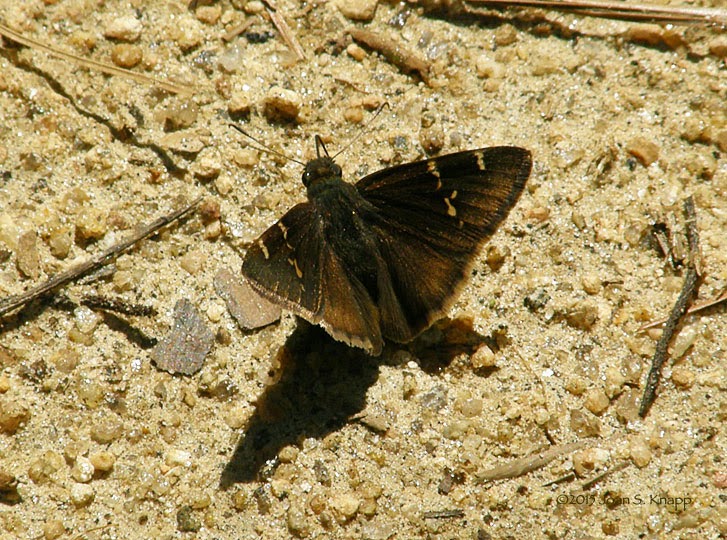
  

Southern Cloudywing (Thorybes bathyllus).


And then onto the east swamp on the unnamed tributary of Fishing Creek.
(To be continued…)

Related posts: 

Monday, August 8, 2011

Another Dragonfly Afternoon At Whitetail Lake

And yet another trip to Charlie Elliott Wildlife Center at Clybel Wildlife Management Area in Jasper County, Georgia. We weren’t checking on Clasping Milkweed (Asclepias amplexicaulis) seed pods this time. Since we’d seen a Two-striped Forceptail (Aphylla williamsoni) here last week, we thought we’d go by Whitetail Lake again and see if we could spot another one.

Again, there didn’t seem to be much activity when first drove down to the lake. Even when I walked down to the water’s edge, I didn’t see as many dragonflies as we saw last time. They were there, but in the heat of the afternoon – we measured the temperature in the shade at 94F a little later – they weren’t very active, possibly because their dinner, insects, weren’t flying either.

The first dragonfly I spotted was a Banded Pennant (Celithemis fasciata). Just one. A female. We saw Banded Pennants for the first time at the Piedmont NWR a few weeks ago. This one was perched on a twig over the water. A nice surprise.

A male Eastern Pondhawk (Erythemis simplicicollis). We’ve seen a number of females this year, but these were the first males we’ve seen.

A male Slaty Skimmer (Libellula incesta). They’ve been around the pond for months. They’re not colorful but they always seem to have a nice disposition.

Widow Skimmers (Libellula luctuosa). This one’s a male. The Banded Pennant, Eastern Pondhawk and Slaty Skimmers appear to be ‘shy’ and ‘well-behaved’ – keeping to themselves and not making waves. On the other hand, the Widow Skimmers – deliberately or inadvertently – act like the bullies of the pond. They fly purposefully and, on occasion, seem to dive at other dragonflies along their route. The large dark patches on their wings make them appear larger than they actually are, and may simply intimidate other dragonflies on the pond.

Then there are the ‘cutie pies’, the Amberwings (Perithemis tenera). They’re about one-half the size of the other dragonflies. Several males, including these, were flying unobtrusively ‘below the radar’ seeming not to want to be seen.

And then there were the ‘stars’ of the day. The dragonflies we had specifically come to see. At least two Two-striped Forceptails (Aphylla williamsoni) were on the pond. For their size, they were also well-behaved, even shy dragonflies. They flew a ‘low-profile’ path, staying out of the way of the other dragonflies. This dragon was repeatedly displaced from its perch by Widow Skimmers so it sought out a perch out of the way along the shore. it alighted on a twig close to the shore and posed prettily for quite a long time. But more of it soon.

So, despite the heat, we were rewarded with quite a procession of dragonflies again. Well worth sitting out in the hot sun to photograph.

Click on an image to view a larger image


Related posts:

- Charlie Elliot Wildlife Center: Whitehall Lake
- Dragonfly Afternoon At Whitetail Lake
- Dragonfly: Banded Pennant (Celithemis fasciata)
- Dragonfly: Eastern Pondhawk (Erythemis simplicicollis)
- Dragonfly: Slaty Skimmer (Libellula incesta)
- Dragonfly: Widow Skimmer (Libellula luctuosa)
- Dragonfly, Eastern Amberwing (Perithemis tenera)
- Dragonfly: Two-striped Forceptail (Aphylla williamsoni)

Wednesday, August 3, 2011

Hello There

This little lady, an Eastern Pondhawk (Erythemis simplicicollis) really like a patch of grass where I was photographing some Anglefruit Milkweed (Matelea gonocarpa) flowers. If I moved close, she’d fly off a little way, circle around and then return to the same area. Finally I used my ‘patented’ method of holding the camera at arms length to get close up shots.

Here she is. She blends in well with her surroundings.

Here she is again. Up close, Isn’t she sweet. As long as you're not a fly.
Click on an image to view a larger image


Identification resources:

- Georgia Dragonfly Survey: Eastern Pondhawk (Erythemis simplicicollis)

- BugGuide: Eastern Pondhawk (Erythemis simplicicollis)
[Male] [Female]

Related posts:

- Dragonfly: Eastern Pondhawk (Erythemis simplicicollis)

Sunday, September 5, 2010

Nom

We took a field trip to Charlie Elliott Wildlife Center yesterday. It was quite windy and dragonfly activity was low at most sites except at Whitetail Lake where male Eastern Pondhawks (Erythemis simplicicollis) were thick and jostling for real estate along the dam shore.

The shore along the dam at Whitetail Lake.


This male Eastern Pondhawk has caught a red and black beetle and is settling in to enjoy his meal.


A closer view. This and the following photograph were taken using a macro setting and holding the camera at arms length as I move slowly closer, focus and shoot.

And an even closer view. Nom.

It’s interesting that male Eastern Pondhawks in this area (Jasper County, GA) are uniformly gray rather than exhibiting the blue-green thorax and upper abdomen exhibited by males at home (Walton County, GA). The characteristics that differentiate the male Eastern Pondhawks from the Slaty Skimmers (Libellula incesta) which are still present in this area and look similar in bright sunlight, are the blue-green eyes, bright green ‘nose’, and clear wings with brown segments near the ends of the front side of the forewings.

Click on an image to view a larger image


Identification resources:

- Bug Guide: Eastern Pondhawk (Erythemis simplicicollis) [male] [female]
- Dragonflies of Georgia: Eastern Pondhawk (Erythemis simplicicollis)

Tuesday, August 25, 2009

Dragonfly: Eastern Pondhawk (Erythemis simplicicollis)

The Eastern Pondhawk is another of my favorite dragonflies. Most of the larger dragonflies that, when disturbed, fly in long circuits before returning to a favorite perch. In contrast, the Eastern Pondhawk may just calmly fly a short distance – often just a foot or so - to a new perch or even hover in the same spot and return to the same spot.


Eastern Pondhawk (Erythemis simplicicollis) - Male

I saw the male first this year - by the greenhouse. I managed to approach him within a few feet and got some shots.


Eastern Pondhawk (Erythemis simplicicollis) - Female

I didn’t see the female until about two weeks later. She was nervous the first time I saw her but, a day or so later, she let me get within a few feet of her too.

Identification resources:

- Bug Guide: Eastern Pondhawk (Erythemis simplicicollis) [male] [female]

- Dragonflies of Georgia: Eastern Pondhawk (Erythemis simplicicollis)

Click on the image to view a larger image