Showing posts with label Fishing Creek WMA. Show all posts

Saturday, May 16, 2015

Wilkes County, Georgia: Fishing Creek And Broad River Wildlife Management Areas

April 24th, 2015. We take a road trip to Wilkes County at least four times each year. W volunteers to monitor frog species diversity and numbers on a prescribed route in the county. We take the opportunity to visit different places in the county before we ‘run the frog route’ after dark. Usually, these include


two swamps on Enoch John Road, Fishing Creek Wildlife Management Area (WMA) and the Broad River WMA; we return to the beginning of the route via Pistol Creek.


We left the swamps on Enoch John Road and drove down Jones Chapel Road to Fishing Creek Wildlife Management Area (WMA).


On the way, we sighted a Red-spotted Purple (Limenitis arthemis) butterfly, and 


Yellow-sided Skimmer (Libellula flavida).


The boundary of the WMA had undergone maintenance recently. Vegetation along the boundary had been cleared and the trees marking the boundary were visible. Trees are marked with one, two, or three orange bands. A tree with one band indicates the boundary and a tree with three bands marks a ‘corner’ where the boundary changes direction; I forget what the two bands means.


A new sign had been installed at the entrance to the WMA. This WMA is intended primarily for hunting and camping is allowed only near the entrance.


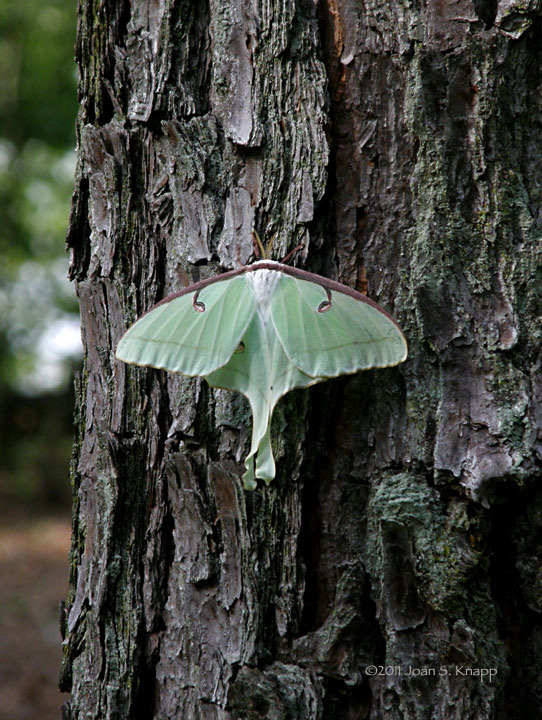
The roads wind through pinewoods. It was along this road that we found a Luna Moth.


We have visited this WMA because it is a good place to see Clasping Milkweed (Asclepias amplexicaulis) plants near a couple of the roads within the WMA.

We left the WMA and drove north on Ohara Standards Road, not expecting to see much in the way of wildflowers. However, we found more…


Common Blue-eyed Grass (Sisyrinchium angustifolium) plants in bloom.


The real ‘find’ for the day were the Narrowleaf Evening Primrose (Oenothera fruticosa) plants in bloom along Ohara Standard Road before we reached Morris Creek. (I’ll post these photographs separately.


I found a lone Violet Woodsorrel (Oxalis violacea) in bloom. 


From Ohara Standard Road, we drove north on GA-44 and GA-79, and then turned left on Delhi Road to reach Bolton Road. We have found a lot of Clasping Milkweed plants along Bolton Road, particularly north of Pistol Creek. We’ve found Monarch Butterfly caterpillars on milkweed plants at the north end of this road. From here, we turned right onto Broad Road and, then almost immediately, turned onto Anthony Shoals road into the Broad River WMA. 


We drive both of the roads – Anthony Shoals and C Johnson Road – in this WMA. Originally, we drove these roads in search of Clasping Milkweed plants. Over the years, we’ve encountered Black Rat (Elaphe [Pantherophis] obsoleta) near C Johnson Road but we were out of luck on this trip.


We found a patch of…


Needle-tipped Blue-eyed Grass (Sisyrinchium mucronatum) blooming on Anthony Shoals Road. 


Interestingly, there are two WMA border corners near Anthony Shoals Road. The corners are marked with four trees, each with three orange bands. The marker for the boundary corner is in the ‘center’ of the area surrounded by the trees. 


The marker is usually attached to the top of a concrete block.


The marker. It reads 

U. S. ENGINEERING DEPARTMENT 

SAVANNAH ENGINEERING DISTRICT 

$250 OR IMPRISONMENT 

FOR DISTURBING THIS MARKER 

PROPERTY LINE MARKER 


In the clear-cut near the end of Anthony Shoals Road.


The pine forest re-growing in 2015. It’s impressive how high these trees have grown, compared with..


the view, to the east, from this road towards the Broad River that I took in 2011 when the trees were only a couple of feet tall and you could see the Broad River in the distance.


Having completed our tour of both the Fishing Creek and Broad River WMAs, we made our way back to the starting point of our route on Oscar Walton Road which crosses…


Pistol Creek; upstream (top) and downstream (bottom). This is, without doubt, the most scenic creek in the area and always a favorite stopping point on our tour. 


Related posts: 

- The East Swamp On Enoch John Road: Death And Rebirth

- The Swamp On Anderson Mill Creek


- Clasping Milkweed (Asclepias amplexicaulis):Flowers

- Black Rat Snake (Pantherophis obsoleta): Broad River Wildlife Management Area, Wilkes County, Georgia

- Another Luna Moth


Sunday, August 26, 2012

Maryland Or Wild Senna (Senna marilandica)

August 11th, 2012. We’d seen this plant in the Fishing Creek Wildlife Management Area in Wilkes County previously but hadn’t stopped to take a closer look. This time we did. The plant was a little taller than 6 feet. It was in bud but with only one flower actually open. I didn’t manage to get a good shot of the entire plant but it was about 6 feet tall.


 The top of the plant with the single, open flower at the bottom right.


A closer view of the buds at the top of the stem


The compound leaves


A close-up view of the flower and buds.

*****
*****
*****

 Close views of the flower.


Ants were clustered around the base of the leaf and flower stem.


These plants have extra-floral nectaries - glands that may be dome-shaped and dark gray-purple, with or without a short stalk at their base. The gland on this plant was sessile (no stalk) and dark green in color.

Senna marilandica (Maryland or Wild Senna) is native of the United States where it’s found in states east of a line from Illinois to Kansas south to Texas. In Georgia, it’s only been documented in a few counties, including Wilkes County, in north, central and southern Georgia.

Another species, the American or Northern Wild Senna (Senna hebecarpa), has only been documented in Fulton and DeKalb counties in Georgia. The extra-floral nectaries in this species appear to be located further along the leaf stem rather and in the axil between the leaf and stem.
Click on an image to view a larger image

Identification resources:
- J. Pippen, Duke University: Senna marilandica (Maryland or Wild Senna)
- Illinois Wildflowers: Maryland Senna (Senna marilandica)

Distribution:
- United States Department of Agriculture Plants Database: Senna marilandica (Maryland Senna)

Tuesday, August 16, 2011

Luna Moth (Actias luna)

On our scouting trips, we often see things that are ‘out of place.’ On most occasions, it’s a shape that ‘doesn’t belong.’ On this occasion, I yelled, ‘Stop!’ In the instant I saw it, I knew what it was. As we backed up, I was able to follow up with, ‘Luna moth!’

Usually, our only sightings of Luna Moths (Actias luna) occur when they land on our windows in the evening. The windows are high that we can’t get up to photograph them. Seeing one, accessible in the woods, was a real treat.


From a distance.

About the actual size I saw as we drove down the road.

*****
Much closer. At first I lay on the ground a little distance away but then moved up to it.

W saw flex in the legs. This was probably a newly emerged moth which hadn’t yet developed full strength in its legs.


A close view of the ‘eye’ on the front wing. The ‘eye’ on the rear wing wasn’t visible in this pose.

A view of the head and antennae from above

A view of the body from underneath. This moth has a large body. It will have to lose much of the fluid before it can fly. The ‘eye’ on the rear wing is visible from underneath

The moth took off but didn’t make it too far. Another sign that it had probably emerged recently.

A closer view. The ‘eyes’ on both sets of wings are clearly visible.

A close up of the ‘eyes’ on the rear wings.

This one is a female; see the difference in antennae between males and females.

We relocated the moth to the trunk of a nearby pine tree.

Another close view of the head and body, and…

... the head and antennae.

We left it basking in the late afternoon sun. Farewell…

See more information on the life cycle of the Luna Moth here and here.

Click on an image to view a larger image


Identification resources:

- BugGuide: Luna Moth (Actias luna)