Showing posts with label Podophyllum peltatum. Show all posts

Tuesday, March 15, 2016

Early Spring Wildflowers At Oconee Heritage Park


March 14th, 2016. I went on a fungus hunt with a couple of mycophiles yesterday, hoping that we’d find some mushrooms after the recent rain. 


We walked along the equestrian trail to the creek and began to work our way back across county.


We explored one of the side drainages, and spent some time accessing areas to the side of one of the trails – circled in blue - that I had walked a couple of weeks ago. This area is a deciduous forest that hadn’t leafed out yet. I hadn’t expected to see many wildflowers but I was to be surprised.


Buckeyes (Aesculus sp.) were leafing and budding out throughout the area. I’m betting most of these are Painted Buckeyes (Aesculus sylvatica); this is a common species in this area. But time will tell…


As I climbed from the creek bottom to the trail running along a ridge, I almost stepped on this Mayapple (Podophyllum peltatum) plant, looking like a little, lime-green torpedo, just pushing its way out of the ground. Just two plants in this location, in a small ‘gully’ where water ran down the hillside when it rained.


Beside the trail, I found a lone Wlld Geranium (Geranium maculatum) blooming. Judging by the number of geranium leaves in this area, this may be a mini-meadow of geranium blooms before too long. 
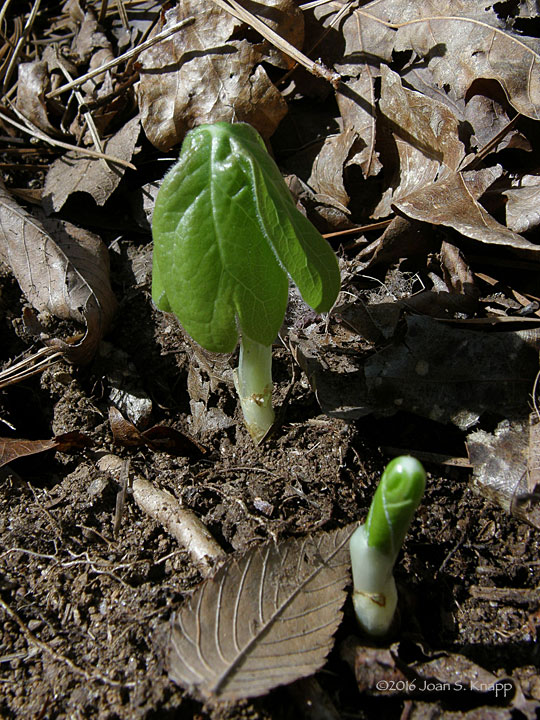

On the other side of the trail, down the hill in another small drainage gully, another pair of Mayapple plants making their appearance. 

When I first walked this trail, I’d seen a single Round-lobed Hepatica (Hepatica nobilis var. obtusa) blooming at the base of a tree. This particular plant had finished blooming, but I found…


several plants in full bloom, as well as… 


one that had new buds. 


Another surprise! One of several Bloodroot (Sanguinaria canadensis) plants in bloom along this section of trail. 


The final wildflower blooming along this section of the trail was Green-and-gold (Chrysogonum virginianum). 

We made our way from the trail back down to the main stream. As I worked my way along the steep hill above the creek, I was rewarded with finding another…


Bloodroot plant in bloom. This one looked like a ‘double.’ 


And finally, back to the main trail that led up the hill and back to the parking lot.
I was surprised by the variety of early wildflowers in this area that, a couple of weeks previously, was a forest floor covered with leaf litter with little sign of herbaceous plant life.

References:
Native and Naturalized Plants of the Carolinas and Georgia: Aesculus sylvatica 
Native and Naturalized Plants of the Carolinas and Georgia: Podophyllum peltatum 
Native and Naturalized Plants of the Carolinas and Georgia: Geranium maculatum 
Native and Naturalized Plants of the Carolinas and Georgia: Hepatica nobilis var. obtusa
Native and Naturalized Plants of the Carolinas and Georgia: Sanguinaria canadensis 
Native and Naturalized Plants of the Carolinas and Georgia: Chrysogonum virginianum

Sunday, April 22, 2012

Mayapples At Stalking Head Creek

March 24th & April 21st, 2012. We returned to the Piedmont NWR to check on plants we saw on March 10th and took the same route as on our last trip. We took Starr Road from GA-83 south on through the Oconee National Forest into the NWR. We drove through Tribble Fields to the bridge over Little Falling Creek and then north to Pond 2A. We returned the way we’d come and then took the first road on the right down to the Round Oak – Juliette Rd, drove east and then back into the NWR on the first road on the left. From there we drove north to the intersection with Sugar Hill Road, turned west and forded Stalking Head Creek. We then drove north and took the first road on the right to ford Stalking Head Creek again, east past a small pond and southeast to meet Sugar Hill Road again and then east to GA-11.


After photographing wildflowers at Allison Creek, we went on over to the ford at Stalking Head Creek to photograph the Mayapples (Podophyllum peltatum) again. Unfortunately, the patch we had photographed on our previous visit had been destroyed when this section of the NWR was burned. We made our way along the ledge to the patch that we had seen from the road above.


It was late afternoon when we arrived at Stalking Head Creek on March 24th. Although there is a hill to the west of the ledge, the sun was high enough, that the plants were lighted by filtered sunlight that reached the blooms. I didn’t have to use artificial light to photograph these flowers, unlike those I photographed at Rock And Shoals Natural Area near Athens. I used artificial light to enhance the features of the flowers in one of the photographs.


A few of the plants at the edge of the patch on the ledge above Stalking Head Creek

*****
Closer views of one of the plants in bloom

Moving in to an individual bloom

*****
Close ups of a bloom in natural sunlight

A close up of the bloom in artificial light

This bloom has lost its leaves. The ovary appears to be swelling. Mayapples require cross-fertilization to produce fruit. Time would tell if a fruit develops.

We returned late yesterday afternoon, April 21st, to see if fruit are developing. It was cloudy and the light level was very low.


A photograph of the Mayapple patch. Developing fruit are visible as light, ovoid shapes under the leaves. Four fruit are visible; only two are obvious.

*****
A closer view of one of the plants.

A developing fruit

The pattern of the remains of the stigma on the end of the fruit has an interesting pattern.

Interestingly, Podophyllum peltatum hasn’t been documented in either Greene nor Jones counties where we’ve photographed them. No doubt, we’ll be returning here to follow the development of these fruit.

Click on an image to view a larger image


Identification resources:

- Southeastern Flora: Podophyllum peltatum (May Apple)

- Native and Naturalized Plants of the Carolinas and Georgia: Podophyllum peltatum (May-apple, American Mandrake)

- Missouri Plants:
Podophyllum peltatum

Distribution
:
- University of North Carolina Herbarium: Podophyllum peltatum

- USDA Plants Database: Podophyllum peltatum (Mayapple)


Related Posts
:
- Piedmont National Wildlife Refuge: Late Winter Surprises (Part 4)

- Piedmont National Wildlife Refuge: Atamasco Lily (Zephyranthes atamasco)

- Jasper County, Georgia: Red-banded Hairstreak (Calycopis cecrops)

- Jasper County, Georgia: New Life – Bracken Fern (Pteridium aquilinum) & Green-and-gold (Chrysogonum virginianum)

- Piedmont NWR: Flowering Dogwoods (Cornus florida)

- Piedmont NWR: Bulbous Bittercress (Cardamine bulbosa)

- Piedmont NWR: A Wildflower Miscellany

- Fowler’s Toad (Anaxyrus fowleri)

- Mushrooms At Stalking Head Creek

Sunday, March 18, 2012

Piedmont National Wildlife Refuge: Late Winter Surprises (Part 4)

Continued from here…
March 10th, 2012. On our recent trip to the Piedmont NWR a couple of weeks ago, we saw Dimpled Troutlilies just beginning to bloom. We figured that they’d be full bloom now so we drove back down to photograph them.

We took a slightly different route from our last trip. We took the route from G
A-83 south on Starr Road through the Oconee National Forest into the NWR. We drove through Tribble Fields to the bridge over Little Falling Creek and then north to Pond 2A. We returned the way we’d come and then took the first road on the right down to the Round Tree – Juliette Rd, drove east and then back into the NWR on the first road on the left. From there we drove north to the intersection with Sugar Hill Road, turned west and forded Stalking Head Creek. We then drove north and took the first road on the right to ford Stalking Head Creek again, east past a small pond and southeast to meet Sugar Hill Road again and then east to Ga-11.

Wild Turkeys (Meleagris gallopavo). We almost ran down this pair of wild turkeys – Mum and Dad – following the kids who were already making their way down the slope from the road and up the hill on the other side of the gully. Interestingly, they seemed totally unfazed by our suddenly coming up on them. They simply sauntered off down the slope. Not the hustling to get off the road and into the woods that is their usually behavior. In spite of their leisurely pace, always, by the time we got the truck stopped, turned on the camera, got into position for a shot, I could only get a view of their backs. Ah, well…

One of the kids making its way up the hill on the other side of the gully

Further along the road, we reached one of the areas where…

Red-cockaded Woodpeckers (Picoides borealis) nest. The red-brown spot at the bottom of the trunk is a metal plate that has been placed to protect a nest box entry. Woodpeckers have been working the holes above recently but we’ve yet to see the birds in person. It’s coming up on breeding season so, maybe, this year.

We turned west on Sugar Hill Rd and made our way down to Stalking Head Creek. On the way, we ran across another family of Wild Turkeys.


This isn’t a great shot but if you enlarge it – click on it – you might be able to see the tom displaying. These turkeys were also heading in the same general direction as the first family – towards the hunting-free zone near Allison Creek. I joked that they were going there to find sanctuary in the hunting-free zone around the woodpecker nesting area ahead of the turkey hunting season scheduled for a few weeks from now.

Last year, we saw Mayapple (Phodophyllum peltatum) plants at the edge of the road after we climbed out of Stalking Head Creek. Since there was a wide ledge on the north side of the road at the creek, it seemed worthwhile looking around here.


I looked down the slope from the road and spotted a small patch of Mayapple plants. All were single stalked – not going to bloom this year.

From above… There is a single, ‘circular’ leaf, indicating that the stalk is not forked.

At about the same time, W spotted a larger patch of plants on the other side of the road.


These were older plants and were setting blooms. (The leaves of this plant are a little the worse for wear; they may have suffered from dehydration)

There are two leaves – two halves of the ‘circular’ leaf - when the stalk is forked. The developing bloom is just visible.

The bud has developed from the fork.

A closer view of the bud in profile
. We'll be following these plants.

We found trilliums here too.

We didn’t go down onto the ledge above the creek but as we drove up the hill, we saw a larger patch of May Apples further along the ledge. This area will be worth walking when we have more time. In addition, we had seen a large patch of green – possibly covering an acre or so - east of the road up to Pond 2A. We had wondered if they were May Apples but thought it was too early for them. Looks like we’ll be coming back to follow these plants.
To be continued…
Click on an image to view a larger image


Identification resources: 


- Southeastern Flora:
May Apple (Podophyllum peltatum)
- Name That Plant. Native and Naturalized Plants of the Carolinas and Georgia:
Podophyllum peltatum (May-apple, American Mandrake)


Distribution:

- University of North Carolina Herbarium: Podophyllum peltatum

- USDA Plants Database:
Podophyllum peltatum (Mayapple)

Related Posts
:
- Piedmont National Wildlife Refuge: Late Winter Surprises (Part 3)

- Piedmont National Wildlife Refuge: Late Winter Surprises (Part 2)

- Piedmont National Wildlife Refuge: Late Winter Surprises (Part 1)


- Piedmont NWR: The First Dimpled Troutlily (Erythronium umbilicatum) Of Spring

- 2010: Year Of The Wildflower – Wildflower Index

Monday, May 9, 2011

Mayapple (Podophyllum peltatum)

Podophyllum peltatum is called by the common names Mayapple, May-apple, American Mandrake, Devil's Apple, Hog-apple, and Indian Apple. We saw a ‘grove’ of Mayapples on the creek side of the trail at the Rock and Shoals Natural Area on March 19th. I’d never seen Mayapples before so I was looking forward to looking for blooms.

The plants were just emerging from their Winter hibernation in mid-March.

Just out of the ground; leaves are folded against the stalk

Leaves are just starting to unfold

Leaves are starting to open out

Leaves are fully opened. These plants are easy to recognize.

The grove was well-developed in mid-April

In natural light, we could just spot one or two plants that had bloomed.

Some artificial light made them easier to see.

A close view of the bloom in profile. The delicate veins in the petals are visible.

A close view of the younger of two flowers. Flowers last for only a day or two.

A close view of a slightly older flower. The ovary is already enlarged indicating that this flower was probably fertilized. We will have to check back to see if the fruit, called a Mayapple apple or an ‘Ozark’ lime, develop.

Podophyllum peltatum
(Mayapple) is native to North America and is found in open woods in the eastern United States and Canada
.
Click on an image to view a larger image


Distribution Map:

- United States Department of Agriculture Plants Database: Podophyllum peltatum (Mayapple)

- University of North Carolina Herbarium: Podophyllum peltatum


Identification resources:

- Southeastern Flora: Mayapple (Podophyllum peltatum)

- Natural and Naturalized Plants of the Carolinas and Georgia: May-apple, American Mandrake (Podophyllum peltatum)

- Missouri Plants: Mayapple (Podophyllum peltatum)


Related posts:

- 2010: Year Of The Wildflower – Wildflower Index

- Rock and Shoals Outcrop Natural Area; Part 1, Blue Trail

- Rock and Shoals Outcrop Natural Area: Plants Along The Stream

- Rock and Shoals Outcrop Natural Area: Mid-April Wildflowers