Showing posts with label Matelea gonocarpos. Show all posts

Sunday, May 29, 2016

Wilkes County Wildflowers: Late Spring


May 26th, 2016. I happened to be near Elberton last Wednesday and decided to spend a day in Wilkes County visiting some favorite locations in search of wildflowers. I didn’t have high hopes because it had been so dry. But I did have some luck. 

My first stop was at the Broad River Wildlife Management Area where I found…


a couple of Clasping Milkweed (Ascelpias amplexicaulis) still blooming.


just one Racemed Milkwort (Polygala polygama).
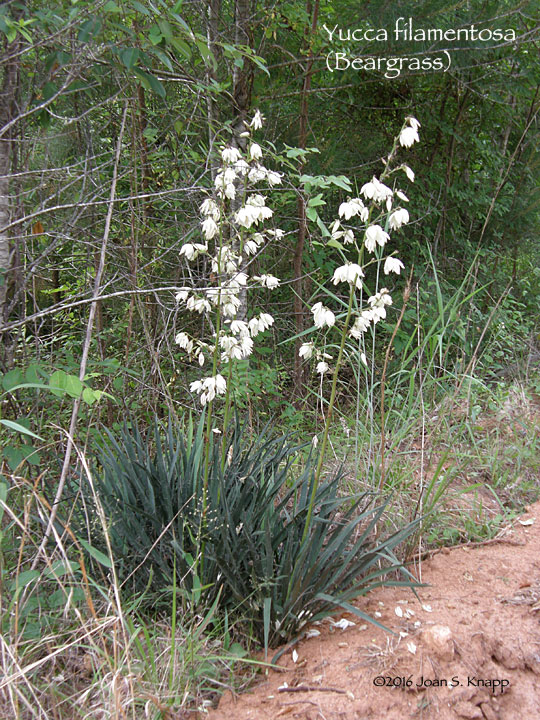

A single Beargrass (Yucca filamentosa) plant was blooming. It flowers were covered with…


Eastern Leaf-footed bugs (Leptoglossus phyllopus) that flew off when I disturbed them.


Butterfly Milkweed (Asclepias tuberosa) were blooming in several locations. Of all the wildflowers I saw, these seemed the most comfortable with the dry conditions. 

My next stop was at a swamp on Enoch John Road where I found…


Anglefruit Milkvine (Matelea gonocarpos) just starting to bloom. This is one of my favorites. 

At the Kettle Creek Battlefield, I found a few more wildflowers.


Southern Sundrops (Oenothera fruticosa) were flowering along the road embankment. I had hoped to find them on the road down to Enoch John Road but was glad to find them here.


This is the nicest Redring Milkweed (Asclepias variegata) flower head I’ve seen this year. The florets were slightly off-white compared with the pure white flowers I’ve seen in shaded areas.


A little further along the road, I found Fire Pinks (Silene virginica) flowering at the edge of the woods.


My final find for the day was another Beargrass with a few flowers that were completely open.

Not a bad ‘haul’ in an area that was so dry. 

References:
Native and Naturalized Plants of the Carolinas and Georgia: Ascelpias amplexicaulis
Native and Naturalized Plants of the Carolinas and Georgia: Polygala polygama
Native and Naturalized Plants of the Carolinas and Georgia: Yucca filamentosa
Native and Naturalized Plants of the Carolinas and Georgia: Asclepias tuberosa
Native and Naturalized Plants of the Carolinas and Georgia: Matelea gonocarpos
Native and Naturalized Plants of the Carolinas and Georgia: Oenothera fruticosa
Native and Naturalized Plants of the Carolinas and Georgia: Asclepias variegata
Native and Naturalized Plants of the Carolinas and Georgia: Silene virginica

Saturday, August 1, 2015

Road Trip: Wilkes – McDuffie Counties, June 26th, 2015 (Part 1)

June 26th. Once again, it was time for a road trip to monitor frogs. So, as usual, we used the trip to scout wildflowers.
We started the trip at the west end of Enoch John Road. On the section of road between Danburg Road and Anderson Mill Creek, I think I spent more time at the edge of, straddling, or in roadside ditches while photographing flowers.

There were the ‘usual suspects,’…


Lanceleaf Coreopsis (Coreopsis lanceolata),…


Starry Rosinweed (Silphium astericus),…


Hairy Angelica (Angelica venenosa), and


Heal-all (Prunella vulgaris).


A wild petunia, that I expected would be the Carolina Wild Petunia (Ruellia caroliniensis), turned out to be the Stalked Wild Petunia (Ruellia pedunculata); a nice surprise.

At the Anderson Mill Swamp, I found a…


Passionfruit (Passiflora incarnata) in bloom.


I was hoping that the Broadleaf Arrowhead (Sagittaria latifolia) would be in bloom, but alas not. 


A Zebra Swallowtail (Protographium marcellus) teased me for some time, flying back and forth along the road. 


From the Anderson Mill Creek swamp, we drove east to the swamp on the unnamed tributary to Fishing Creek.


The dam, repaired by the beaver, was holding. The large ‘bed’ of…


American Lotus (Nelumbo luteo) was thriving. We satisfied ourselves with admiring the…


flowers from the road. 


A small skipper, a Least Skipper (Ancyloxypha numitor), feeding on a


Bull Thistle (Cirsium vulgare). 


Then I noticed the…


leaves, and then the…


flowers of an Angularfruit Milkvine (Matelea gonocarpos). 


Then, on the other side of the road, I found another vine, climbing up a blackberry cane that had a…


Blackberry Knot Gall. This vine had even…


more flowers. 

(To be continued…)

Saturday, July 14, 2012

Scull Shoals Experimental Forest: Just Checking In


July 6th, 2012. We made our almost-weekly stop at Scull Shoals Experimental Forest. Usually, we can drive to the end of the road to a turn-around and drive back out. But on the 6th 


we found the road blocked by a fallen tree trunk. It was a snag and much of the wood was rotten. But the trunk was probably about 18 inches in diameter and too large to move. So we satisfied ourselves by climbing over it and walking a little way up the road. We could check a couple of plants we have been following and were treated to a variety of wildflowers and insects.


We’d just had rain after a long drought and ants had to clear their tunnels of sand that had washed into them. There weren’t any ants in sight; just the evidence of their housekeeping.


This Jack-in-the-pulpit (Arisaema triphyllum) is about three feet high now and had five suckers this year. It’s long since finished blooming for the year and one of its suckers is developing seeds.

*****

Passionflowers vines (Passiflora incarnata) are blooming. Insects are feeding and inadvertantly fertilizing the blooms.

*****

Angularfruit milkvines (Matelea gonocarpos) vines are blooming. It’ll be interesting to see if any develop seedpods this year.


A Hoary Edge (Achalarus lyciades) skipper was flitting from bloom to bloom, feeding on the last of the Heal All (Prunella vulgaris) plants still blooming. This butterfly wasn’t posing for photos and wouldn’t let me get a good shot of the top of its wings; I’ve posted some photos of this butterfly previously.


Six-spotted Tiger beetle (Cicindela sexguttata). Several of these beautiful beetles were scurrying around the road and they weren’t posing for photos either. I had to make do with a zoom shot which I’ve enlarged here.


A robber fly. I don’t know what species this is. It, also, was nervous about being approached but allowed me to get this photo.


One of several Eastern Tailed-blue (Cupido comyntas) along the road was folding its wings as soon as it landed. And last, but not least, a…


Slaty Skimmer (Libellula incesta) had a favorite perch just where we parked the pickup.

All-in-all, it was a fruitful stop even if we couldn’t get to the end of the road. Hopefully next time we visit, the snag will have been cleared from the road. It’s a long walk to the Green Comet Milkweed (Asclepias viridiflora) flowers we’re following.
Click on an image to view a larger image

Identification resources: 
 Southeastern Flora:

Bug Guide:
- Slaty Skimmer (Libellula incesta)

Related post:

Monday, May 7, 2012

First Angularfruit Milkvine (Matelea gonocarpos) Flowers Of The Season

May 5th, 2012. After we’d completed our run from Saxon to Broad yesterday, we headed down to Clark Hill Wildlife Management Area in McDuffie County to look for wildflowers in general and for milkvines (Matelea sp.). We didn’t see many on our run to the end of the road, but spotted a number on the way back out. The leaves on one of the vines we saw had slightly ‘frilled’ margin (which I forgot to photograph) so I walked over to take a closer look. The vines were matelea vines and as I looked more closely I spotted…

a cluster of buds. The buds of the Angularfruit Milkvine are glossy and concave in profile compared with those of the…

Buds. Maroon Carolina Milkvine (Matelea carolinensis)

Maroon Carolina Milkvine (Matelea carolinensis). It’s easy to identify Angularfruit Milkvine plants in this area when buds begin to develop.

*****
Clusters of flowers. We have always found green flowers with purple centers. In some areas, flowers are green with no purple color.

A closer view of one of the flowers. These flowers have a matte surface. Newly opened flowers we have found in Greene County…

have a glossy surface.

Matelea gonocarpos seed pod. If a flower is pollinated, a seed pod will develop in 4 to 5 months.

The seed pod gradually develops a wrinkled surface as the seeds ripen

*****
A ripe seed pod has split open to release seeds.

The seeds - enlarged many times here – are about ¼-inch in diameter.

An empty seed pod we spotted in the Piedmont National Wildlife Refuge in April. The ribs of the angularfruit pod are clearly visible. It’s easy to distinguish these pods from the spiny pods of milkvines like the Maroon Carolina Milkweed (Matelea carolinensis).

Matelea gonocarpos is known as the Angularfruit Milkvine or Eastern Anglepod. It is native to the United States where it may be found from Maryland to Illinois, west to Kansas and south to Texas. In Georgia, it has been documented in several counties not including Greene or Jones counties where we have found it; it occurs in several sites in the Piedmont NWR.

The Integrated Taxonomic Information System (ITIS) lists Matelea gonocarpos and Matelea gonocarpa as accepted names but lists Matelea gonocarpos with the common name Angularfruit Milkvine. Both names appear in different plant lists.

Click on an image to view a larger image


Identification resources:

- Southeastern Flora: Matelea gonocarpa (Angularfruit milkvine)

- Name that Plant. Natural and Naturalized Plants of the Carolinas and Georgia: Matalea gonocarpos (Eastern Anglepod)

- Missouri plants: Matelea gonocarpa


Distribution
:
- USDA Plants Database: Matelea gonocarpos (Angularfruit Milkvine)


Related Posts
:
- Maroon Carolina Milkvine (Matelea carolinensis)

- Zen: Angularfruit milkvine (Matelea gonocarpa)