Showing posts with label Lichen. Show all posts

Saturday, August 8, 2015

Summer On A Fort Yargo State Park Trail: Section B To The Dam, June 30th (Part 2)


June 30th. (Continued from…) When I visited Fort Yargo State Park in mid-February, there were few signs of Spring. The only wildflower plants that were obvious were the leaves of Cranefly Orchids (Tipularia discolor) that I found in many places.


The route… I’ve described it here, here, here, and here This walk doesn’t have the variety of wildflowers as my other walk from the Group A Shelter to the Old Fort but it does have some gems. One of the Smallflower Pawpaw (Asimina parviflora) had developed fruit that, unfortunately, it had lost; the Pink Lady’s Slipper (Cypripedium acaule) Orchids had bloomed, and some Green Adder’s-mouth (Malaxis unifolia) Orchids had bloomed and two were setting seeds. The occurrence of slime mold fruiting bodies added a new focus of interest for this walk.


The main flower head on the Hairy Angelica (Angelica venenosa) had finished blooming. The smaller flower head was in full bloom. It would be interesting to see if these set seed.


I stopped to check the mystery galls on the Blackjack Oak (Quercus marilandica) sapling. They were drying and hardening.


One of the leaves of the oak had been pierced by a pine needle. It’s amazing how these pine needles develop the force with to pierce a strong oak leaf when they fall.

I made my way off the trail and down into one of the gullies by the lake were a Green Arrow Arum (Peltandra virginica) had bloomed.

Several of the flower stalks had swollen at the tips, indicating that they were developing seeds.


One had been damaged and the developing seeds were visible through the wound. 


Indian Woodoats (Chasmanthium latifolium) were developing fruit along this section of the trail.


Further along the trail I found some Coral Slime (Ceratiomyxa fruticulosa vaar. fruticulosa) that had fruited on a fallen log.


For once, the Perfoliate Bellwort (Uvularia perfoliata) plant was bathed in sunlight.


The seed capsule was still developing


The Green Adder’s Mouth Orchids (Malaxis unifolia) was developing seed capsules.


Pipsissewa (Chimaphila maculata) plants were also developing seed capsules.


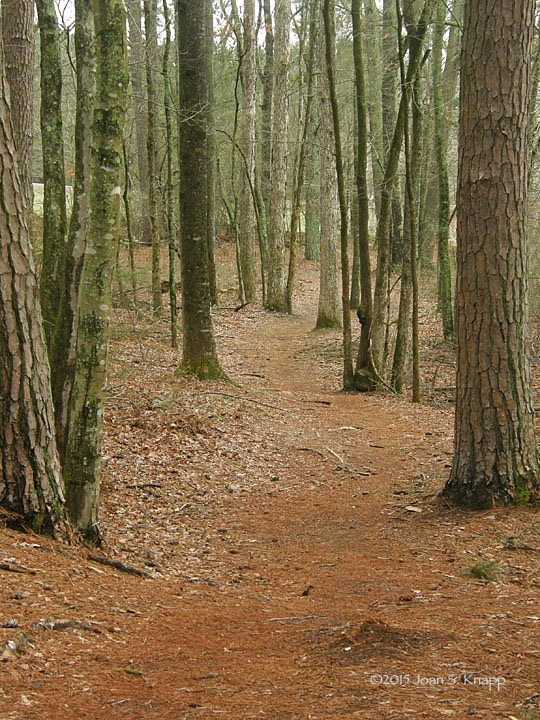
The trail just before the hill climb; it looks deceptively cool. 

I found a couple of lichens on a recently fallen branch.


The fruiting bodies on this lichen are in pristine condition;…


these fruiting bodies have ‘aged;’ the margins on these are worn compared with those on young fruiting bodies.


This fungus is a Brown-toothed Crust fungus (Hydnochaete olivacea). It’s dry and worn with time. It's fairly common but often overlooked.


Near the end of the trail, the Hoary Mountainmint (Pycnanthemum incanum) was still blooming.


Spurred Butterflypea (Centrosema virginianum) had just started to bloom on this trail; this was the first flower for this season.


The final sighting on this walk was some Aligatorweed (Alternanthera philoxeroides). A small patch of weed was growing just west of the bridge to the parking lot.

Related posts:
- Spring Is In The Air: Fort Yargo State Park, Section B To The Dam, May 1st (Part 2)

Tuesday, March 31, 2015

Spring Walk At Fort Yargo State Park: Shelter A To The Old Fort, 20th March, 2015 (Part 2)


March 20th. (Continued from…) I’ve started to walk at Fort Yargo State Park in Winder, Georgia. One of my walks is from the Group Shelter A to the Old Fort and back. This is a rewarding walks for viewing wildflowers.
 

The route which I described here. It was still early in the season and I didn’t expect to find much in the way of plants but the weather forecast was for fog and I wanted to take some photographs along the lake shore in the fog. 

A small, but striking shield lichen. 


This was one of the most intriguing lichens on the rocks. The fruiting cups were quite shallow, like little dishes rather than deeper cups. 


One of the few boulders covered with Resurrection Fern (Pleopeltis polypodiodes). 


At first glance, this lichen looked more like a mold. I photographed it but… 


it wasn’t until I got home and processed the image, that I could see that it was covered with flat, irregularly shaped gray fruiting bodies. It was clear that I was going to have to come back better prepared to photograph the many lichens on the rocks in this area. 

The challenge will be identifying them. There is a reference text, Lichens of North America, and a website contains illustrations of approximately 1,275 species of lichens. The lichens on the website are organized alphabetically rather than e.g., by whether they grow on wood or rock. Sounds like I will spend many happy or frustrating hours browsing in an attempt to identify the lichens I’m photographing.


I found the patch of Cranefly Orchid (Tipularia discolor) leaves near the end of the Rock Garden trail. The leaves were still in good condition. 


Then on down the trail to the Old Fort. 


Along the way, I found several trees – one in particular – with a lichen with black fruiting bodies. 


One intriguing sighting was a fallen log covered with orange ‘growths’ which may be a lichen. Only one log showed these growths. 


Turning around, I walked back along the upper trail.


I examined the trunks of several trees by the trail that had shield lichens and found one that had fruiting bodies. This was an unusual find. Many trees have lichens but few of these have fruiting bodies. 


Back at the fishing area and looking south. There was still a hint of fog, adding atmosphere to my walk. 


Back in the fishing area, I found Elliott’s Blueberry (Vaccinium elliottii) stems with blooms. 


To my shame, I thought the green color on the water was due to an algal bloom. Only, when I returned a week or so later, did I realize that this was the beginning of the annual pine pollen season. 


Back down to the trail above the cliff, and...


towards the first bridge.


Then I saw these big buds but, since I’m not too familiar with trees, I’d have until my next walk to identify this tree. 


Finally, back to the disc golf course, and...


the final section of trail to the parking lot. 

As expected, I didn’t see too much in the way of wildflowers but the signs of Spring and new life were there. I did find that the Rock Garden is a wonderful source of lichens that I had not appreciated fully previously.

Related posts: 

Monday, March 30, 2015

Spring Walk At Fort Yargo State Park: Shelter A To The Old Fort, 20th March, 2015 (Part 1)


March 20th. I’ve started to walk at Fort Yargo State Park in Winder, Georgia.
One of my walks is from the Group Shelter A to the Old Fort and back. This is a rewarding walk for viewing wildflowers 


The route which I described here. It was still early in the season and I didn’t expect to find much in the way of plants but the weather forecast was for fog and I wanted to take some photographs along the lake shore in the fog. 
  

Looking north along the shore. There wasn’t much fog but the atmosphere was quite gloomy. 


Along the trail. The brown colors provided a sense of warmth. 

The lake was full; no sign of the ‘beach’ I saw on my previous walk. 

I crossed the bridge. 

I checked the oak that was still holding onto its leaves.


An acorn was still attached but, when I checked it, I found a tiny hole that indicated that an insect had gotten there first. No wonder it was still attached. No squirrel was interested in it. 


Upon closer examination, I found shoots.
  

Next to the fence above the cliff. 


Rattlesnake weed (Hieracium venosum) plants were starting to grow along the embankment. 


As I came down into the fishing area, I found a Red Maple (Acer rubrum) flower in a branch that had fallen during the recent ice event but which had hung up on another tree branch. 


On checking some small shrubs along the shore in the fishing area, I noticed this mantis egg case. 
  

The fertilized female flowers of the Hazel Alder (Alnus serrulata) were starting to swell. 


Last years cones still clung to some branches. 


Leaves of the Green Arrow Arum (Peltandra virginica) were pushing up in the shallow waters around the fishing area.


Looking along the ‘Rock Garden’ shore north of the fishing area. On my previous visit, I had to shuffle my way through dead leaves. There was no sign of the path. If I hadn’t known that the path was there, I wouldn’t have walked there. On this visit it was apparent that a few people, probably fishermen, had ventured along the path. 
  

Looking back along the shore to the point at the fishing area.


Old Turkey Tail-like bracket fungi that had been colonized by algae. 


More signs of new growth. A leaf bud of the Southern Magnolia (Magnolia grandiflora). 


Some of the larger boulders in the Rock Garden.


A particularly bright green lichen growing on one of the boulders. 


Resurrection Ferns (Pleopeltis polypodiodes) grow on trees and rocks in a very limited area in the Rock Garden. These colonies are at the base of a tree and the rocks nearby. 


A closer view of the smaller colonies on the rocks. The lower colony is just getting started. 


Another colony was growing in the crevice between the split trunk of the tree.
To be continued…

Related posts: