May 11th, 2012. We were happily making our way back down the Oconee River towards the dock at Dyar Pasture when we noticed a number of dark red flowers drifting down the river. They weren’t there when we went up so we came around and went back to take a closer look. They were Trumpet Vine (Campsis radicans) flowers. We hadn’t seen them on the way up either. After poking around, finding the vines and a hummingbird that wasn’t posing for photographs today thank you very much, we continued our way downstream.
It was then we saw a flash of bright yellow streak from a snag in the river to a tree on shore. There is only one bird in this area that is as yellow as that - the Prothonotary Warbler (Protonotaria citrea). So, although it was really getting too dark to take good photographs, we had to turn around for another look.
We settled in upstream of the snag, turned off the motor and drifted. Fortunately, the current was almost nonexistent near this shore. And we watched.
 Approaching the snag from the south. This photo was taken on our way up river. The snag in question is just a little to right of the center of the photo. This location is not readily accessible from land; there are no roads in the immediate area.
 The snag. From its northern side.
 A closer view of the snag. The male is building the nest in the bottom cavity. According to the Cornell ornithology lab, ‘… trees used for nesting and cavities tend to be in trees located near or over standing water.’
 The nesting material is visible in the lower section. If you look closely you can see moss.
Then the action began…
 The male is entering the cavity.
 Having deposited the nesting material, he exited through another hole further up the snag. There must be another hole a little further around the snag because he exited out of sight on one of his passes to the nest. Thankfully though, he used this hole most of the time.
 W caught him harvesting moss from the trunk of this tree at the edge of the river.
 *****
***** Returning to the nest with more material (W got the lower photo). He would land here directly above the nest hole before entering, and then...
 hop down to the side of the hole before entering to deposit another load of nest material. He repeated this process several times while we watched.
I've read posts in which the authors have raved about the return or sightings of the Prothonotory warbler. It looked striking but it wasn’t until I saw this bird that I realized why these authors were so excited. Now I ‘get it.’ This bird would look striking at any time, but even more so in the fading daylight.
According to the Cornell Lab of Orthithology, the Prothonotary Warbler is one of only two warblers that build nests in cavities. They may raise 2 to 3 broods each year. We were particularly fortunate to happen upon this nesting site. Know that we know that Prothonotary warblers use this site, we’ll check here from time to time.
Click on an image to view a larger image
Identification resources:
- Cornell Lab of Ornithology: Prothonotary Warbler, Protonotarea citreaRelated post:
- Running The Oconee River: North from Dyar Pasture
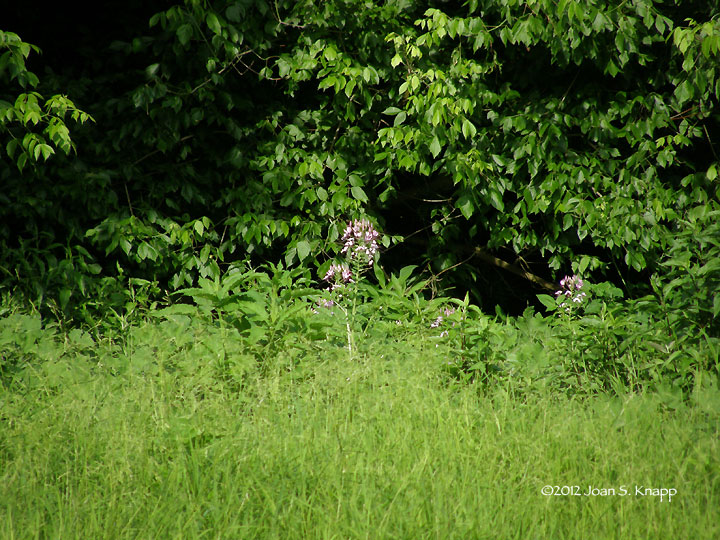
Last year, we spotted a Pink Queen (Cleome hassleriana) plant in bloom across Fishing Creek from a trail off the end of Forest Service road FS1245B. W managed to get a reasonable photograph but there was no way that we could get across to get close-up photos. Incidentally, this was probably the final straw contributing to our decision to get a small, shallow draft boat to allow us to get access to remote areas from the water. Anyway. We were making our way up the Oconee River when we spotted plants that were starting to bloom. A couple were at a spot where we could step out of the boat to get closer views.
 From a distance. We spotted plants on the shore but couldn't reach them.
 A closer view.
 The plants we could reach.
 In profile. Before going ashore. We still didn’t know if the river bottom was solid or if we’d sink knee-deep in mud as is often the case along these rivers.
 It has a compound leaf.
 A flower head with no flowers open
 *****
***** Flower heads with a couple of opened flowers.
 *****
***** Individual opened flowers. I focused on the petals but it is possible to make out the stamen and stigma in each of the photos.
Cleome hassleriana (Pink Queen) is a native of South America, from Argentina to Brazil. In the United States, it’s found in states east of a line from Wisconsin, Ohio, Kansas, Oklahoma and Texas with the exception of the New England state. It may also been found in Ontario, Canada.
It’s an unusual find. According to the USDA Plant Database, this plant has been documented in only three counties in Georgia - White, Harris, and Lowndes counties. It hasn’t been officially documented in Greene County The most probable explanation for finding it here was that it was planted in a garden upstream - the Oconee River flows through Athens, Georgia, and seeds floated downstream and took root on this shore line. Although it’s an intriguing flower, I hate to see non-native plants take a hold beyond the domestic garden.
Click on an image to view a larger imageIdentification resources:
- Southeastern Flora: Pink Queen (Cleome hassleriana)
Distribution:
- United States Department of Agriculture Plants Database: Cleome hassleriana (Pink Queen)
- University of North Carolina Herbarium: Cleome hassleriana
Related post:
- A Lonely Traveler: Pink Queen (Cleome hassleriana)
 The route
 *****
***** A single Rose of Sharon (Hibiscus syriacus) tree directly opposite the boat launch. This is a non-native species from east Asia that is cultivated in gardens. This one got loose.
 The Oconee River is wide and deep as it flows southwest immediately south of Dyar Pasture.
 We saw several Great Blue Herons along this stretch of the river
 We went south as far as we could but couldn’t find a way into Lake Oconee. The river was very shallow and the openings to the lake were blocked by snags. We retraced our route and turned west into another bay at the north end of the lake. The water was shallow. We might have been able to make our way south into the main lake from this side but were running out of time. On our way back to Dyar Pasture, we saw this…
 Double-crested Cormorant (Phalacrocorax auritus) that didn’t seem to be bothered by the heat. It seemed to be enjoying the heat. And look at that intense turquoise eye.
 This Great Blue Heron didn’t like the heat at all. It had opened its wings to catch the breeze. Others have also seen this cooling method: here and here. This is the first time I’ve seen a Great Blue Heron using this method to cool itself. I’ve seen one use this method in the Fall to catch the early morning sun in an effort warm itself.
 By the time we got back to the boat launch, the Rose of Sharon flowers were starting to close for the evening.
 An American Snout (Libytheana carinenta) joined me while I waited at the boat launch to bring the boat in, and a…
 Blue Dasher (Pachydiplax longipennis) was obelisking to avoid absorbing the full heat of the suns rays.