Showing posts with label The Best Of. Show all posts

Wednesday, December 31, 2014

2014: The Best Of…


December 31st, 2014. I was browsing some posts a few days ago and realized how many wonderful things I’d seen this year and wanted to share again. 

January 

Birdwatching. I did a lot of that this year. I joined the Cornell Lab of Ornithology – Audubon Project Feederwatch and spent a lot of time watching the birds around our feeders. Identified 20 different species that came to the feeder area… and they didn’t include the Brown Thrashers, Eastern Bluebirds, Yellow-bellied Sapsuckers, and Mockingbirds that stay out in the field. 

Several White-throated sparrows (Zonotrichia albicollis) would make one or two trips daily to feed on the ground below the feeders. 

February 


We installed a couple of log feeders that I’d seen (on a webcam) attracting Pileated woodpeckers successfully. Within 24 hours, we had our first Downy Woodpecker (Picoides pubescens). It took a while before the first Red-bellied Woodpeckers (Melanerpes carolinus) found the feeder but, once they did, they came through several times each day.


This possum (Didelphis virginiana) came through several times. We’d seen them an night but this was the first time one came through in daylight. 


One of my favorite photographs of the year; a feast of colors. On the log feeder (from top to bottom) Chipping Sparrow (Spizella passerina), male Downy Woodpecker, Pine Warbler (Setophaga pinus), Chipping Sparrow. On the branch, male Northern Cardinal (Cardinalis cardinalis) and a Chipping Sparrow.

March 
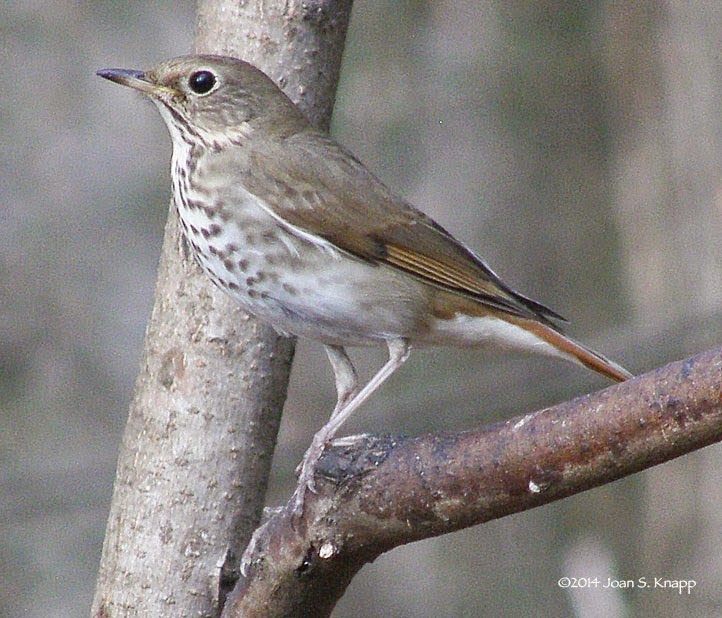


A Hermit Thrush (Catharus guttatus). Not a colorful bird but it looks so wide-eyed and innocent. Looks. I watched it steal food that a Yellow-rumped Warbler had fetched from the log feeder and deposit on a branch to eat leisurely. The only thing I can say in its defence is that it had a lot of trouble getting food from the log feeder.


A Pine Warbler. This bird only came to the feeder for a few weeks but it was thrilling to see it. 

April

We made a trip over to Oconee Bells State Park in South Carolina specifically to look for two wildflowers: Oconee Bells (Shortia galacifolia) and Pygmy Pipes (Monotropsis odorata). It was late in the season but we did find… 

some nice Oconee Bells flowers. 


Pygmy Pipes proved more elusive. They announce their presence with an intense fragrance. We smelled them once but couldn’t find them search as we might. We spoke with some fellow hikers who placed a flag on the trail to point us to a patch. It still took some effort to find them but we did. 


On a hike to nearby Station Cove Falls, I spotted this Luna Moth (Actias luna) ‘drying out’ before going in search of a mate. I’ve seen several Luna moths but it’s always a treat to see another one.


On the way home, we detoured and drove up to the headwaters of the Tallulah River. We found some embankments ‘covered’ with Bloodroot (Sanguinaria canadensis) in bloom; others thick with Rue Anemones. I have to confess that I had never seen Bloodroot in bloom in the wild; I’d only seen plants with seedpods later in the season. Sweet Little Betsy trilliums – purple and green variants – were also thick in some areas. 

May

And then came May. I broke my arm when I tried to climb an embankment. I launched myself up the embankment – or that was my intention. I did go up, but then backwards and free fell about six feet to the road below. I landed on my right shoulder. Not good. I did avoid surgery but spent a couple of weeks in a hanging cast (a tool of the devil) and then six weeks in a sling. 
At that point my orthopedist sent me to physiotherapy for a month to regain the range of motion of the shoulder and recommended that I start to ‘do the things I liked to do’ that didn’t involved strength. ‘Taking photos’ was good.
But that’s when I learned in no uncertain terms that cameras are right-handed. I’m left-handed but taking photos with a right-handed camera is quite challenging. I did try holding the camera upside-down so that I could see through the viewfinder but trying to focus and take a photo was more than it was worth. So… I ‘retired’ from photography until mid-July when the fracture had healed sufficiently that I could start regaining strength in the arm again. 

July
 
In July, we made one of our pilgrimages to the Piedmont Wildlife Management
Area where… 


we found one of my favorite wildflowers, Rosepink (Sabatia angularis), in bloom. At the same location, 


I saw my first Golden-winged Skimmer (Libellula auripennis). 


Back home, we were treated to a White-tailed Deer (Odocoileus virginianus) that browsed her way across the area in front of the house early in the morning. She browsed on a few things that we would have preferred she hadn’t but… 

August 


I noticed an unusual gall on a blackberry near the mailbox. A little bit of sleuthing determined that it was a blackberry knot gall produced by a small wasp. 


Another treat was regular visits by a Raccoon (Procyon lotor) mum and her kits. They started coming by the feeders in the late afternoon and, then, earlier in the day. We’ve seen the kits becoming more independent with time, often coming by themselves. Mum was adept at getting onto the platform feeder and helping herself to seed and suet cakes. So now I bring the suet cakes and the log feeders in at night. 

September 

A late-season visit to Boggs Creek Recreation Area found a Great Spangled Fritillary (Speyeria cybele) feeding on ironweed flowers. These fritillaries are impressive; about two to three times the size of the Variagated or Gulf fritillaries we see locally.

October 

I resumed riding a recumbent trike which doesn’t require arm strength and have spent many hours exploring road in the eastern part of Walton County as well as some road in Oconee and Barrow counties. Being so close to the ground allows me to see a lot more and even take photographs without having to get off the trike. Yes, I’m spoiled. Among the treasures I found were several mushrooms including Old Man Of The Woods and…


the delicate Fragile Dapperling (Leucocoprinus fragilissimus).

I found a couple of wildflowers I hadn’t seen before – Rough Mexican Clover/Florida Pusley (Richardia scabra) and… 


Tievine (Ipomoea cordatotriloba). Morning glories are fairly common here but this species is really a coastal plain native and unusual here. 


We had seen a male and female Rose-breasted Grosbeak (Pheucticus ludovicianus) at the feeders during their migration north in Spring. We were treated to the sight of two juvenile grosbeaks as they migrated south for the Winter. They stayed around for a couple of days and then were gone. 


I found a partial ‘fairy ring’ of the American Eastern Yellow Fly Agaric (Amanita muscaria var. guessowii) and followed them daily for a week or more. 

November 


We occasionally see Monarch (Danaus plexippus) butterflies out in the woods but rarely at home. We were treated to approximately half a dozen feeding on Thorny-olive (Elaeagnus pungens) as they migrated south. 


I’m one of the many people who stop and move turtles off the roadway into the grassy verges to the side of the pavement. The only turtle I saw on the road this year was this beautiful Eastern Box turtle (Terrapene carolina carolina) that was sunning on the roadway. Needless to say I moved it off the pavement. 


Red-shouldered Hawks (Buteo lineatus) are common around here and we hear the youngsters calling as they learn to fly. Rarely, however, are we treated to close-up views of these birds. At least one decided it would try its luck at our bird feeders. I don’t think it had much luck but we were lucky enough to get some photos when it stopped by. A rare treat.

December

It’s bird-watching time again. 


This year, the Purple Finches (Carpodacus purpureus) not only changed their name (formerly Haemorhous purpureus) but showed up at the feeders early this year and, it appears, in larger numbers. 

In spite of having to sit out a couple of months, all in all it’s been a very good year. Looking forward to another great year in 2015.

Monday, December 31, 2012

2012: The Best Of... (Part II: June - December)

December 31st, 2012. Continued from… I’ve never done a year-end review of the year’s posts before but we’ve had some interesting finds and it’s fun to look back on them. So here goes… 

June
 
Swamp. There are two swamps on Enoch John Road in Wilkes County, Georgia. We visit them every time we go to Wilkes County. This photograph of the easternmost swamp was taken late afternoon. What you can't see is a beaver lodge to the right behind the trees. More of this in 2013.

Gray Petaltail (Tachopteryx thoreyi). I still remember this Gray Petaltail lumbering towards me like an overloaded cargo plane. I had just one shot, and this is it.

 
White Cabbage Moth (Pieris rapae). There are puported to be a ‘dime a dozen’ but we don’t see many. This one posed, and who could resist it. Even the 'ordinary' is beautiful.


Sunset at Margery Lake. Whenever we visit the Charlie Elliott Wildlife Center in the Clybel Wildlife Management Area, we try and get to the dam at Margery Lake at sunset just in case…


Halloween Pennants (Celithemis eponina) never disappoint. We stop at a couple of ponds in the Piedmont NWR to see if the Halloween Pennants are putting on a performance. If they’re there they can be depended on to entertain us.
 
Pippsissewa (Chimaphila umbellata). This is the first time I’ve seen this flower outside Fort Yargo State Park where I had photographed a series. It was surprising how easy it was to spot them from quite a distance as we drove along the Saxon-Norman-Board road in Oglethorpe and Wilkes counties.


July
 
Tiny damselflies. We found two color forms of the Fragile Forktail (Ischnura posita) hunting for lunch in the Scull Shoals Experimental Forest. They were about an inch long. We were lucky to spot them.


Rosepink (Sabatia angularis). We saw these blooming in Hancock, Greene, and Banks counties. The unfolding of the style and stigma is fascinating.


This Bee Assassin bug (Apiomerus crassipes) was just one of several insects feeding on a Hoary Mountainmint (Pycnanthemum incanum) bush late one afternoon in Banks County, Georgia.


August
 
Hummingbird Clearwing Moth (Hermaris thysbe). We had seen these in Oconee and Wilkes counties but they were always on the move. Some folks have resorted to netting them and cooling them in a refrigerator in order to be able to photograph them as they warm up again. We were lucky to be in the right place at the right time when one alit on a bush briefly. After a few seconds, it was on its way again.


Black and Gold Argiope (Argiope aurantica). These spiders were common when the weather was wetter but we haven’t seen many in the last couple of years. It was a treat to find this one in Greene County, Georgia.
 

EasternTiger Swallowtail (Papilio glaucus). A common butterfly in this area but its unusual to have one pose so prettily.


Spotted Beebalm (Monarda punctata). We found these in Greene County and found more later in Hancock County.


Timber Rattlesnake (Crotalus horridus). So far I’ve never met a Timber rattler that I didn’t like. They’ve been so well-behaved. So far.
 

Showy Rattlebox (Crotolaria spectabilis). Found in Hancock County south of GA-16 at the edge of  a pine forest. 

Septermber


Pinesap (Monotropa hypopithys). We found these late in the season. Earlier in the season, plants would be yellow-green without any red. They don’t produce chlorophyll and are parasitic on mycorhizal fungi.


Diana Fritillary (Speyeria diana). It was late in the season and we saw only females. These are large butterflies – much larger than the Variagated and Gulf Fritillaries we see at home. Hopefully we’ll see the male next year.

 
Great Spangled Fritillary (Speyeria cybele). Another very large fritillary that has silver, reflective patches on the underside of the wings.

 
Great Swallowtail (Papilio cresphontes). A teaser. I’ve seen these fly by the house but they don’t settle. This one, in Hancock County, was feeding on flowers on a high embankment – too high to climb. Next year, maybe…


Indianpipe (Monotropa uniflora). Another parasitic species that gets energy from mycorhizal fungi. Early in the season, they plants are white; late-seaon plants are tinged pink.


Honey mushrooms (Armillaria mellea). We found a couple of large stands of these mushrooms on Plum Orchard Road in Rabun County, Georgia.

 
Curtiss’s Milkwort (Polygala curtissii). We’ve seen these in Athens-Clarke, Banks, and Rabun counties. These, in Rabun County, have been the best that we’ve seen.

 
Striped Gentian (Gentiana villosa). This is my favorite gentian. We’ve found only two plants; hopefully we’ll find more in the future.


All in all a very good year. Looking forward to another great year in 2013.
Click on an image to view a larger image

Related post:; 
- 2012: The Best Of (January – November)

2012: The Best Of... (Part I: January – May)


December 31st, 2012. I’ve never done a year-end review of the year’s posts before but we’ve had some interesting finds and it’s fun to look back on them. So here goes…
 
January


A Dimpled Troutilly (Erythronium umbilicatum) was blooming at the Piedmont National Wildlife Refuge in Jones County, Georgia. It has been a dry year and we didn’t see many lilies here.


February

Roundleaf Hepatica (Hepatica nobilis var. obtusa) flower on the embankment above Mill Road in the Dawson Forest Wildlife Management Area in Dawson County, Georgia. We spotted the leaves in the Fall of 2011 and returned to photograph the flowers. We almost missed them.


March


A  Zebra Swallowtail (Protographium marcellus). We see a lot of these in the Spring but they rarely settle. This butterfly was getting trace metals from the sand and stopped long enough for me to get a good shot. It was early in the season and its colors were still brilliant.


Rue Anemone (Thalictrum thalictroides). We found these plants blooming in the full afternoon sun in the Piedmont NWR. This was the first time I’d seen the Rue Anemone and I was surprised to see it blooming in the full afternoon sun. I had expected only to see it blooming in shaded areas.


Devil’s Urn or Black Tulip fungus (Urnula craterium). We found a couple of patches of these growing on fallen branches above Stalking Head Creek. Another first for us this year.

Little Sweet Betsy (Trillium cuneatum). We found these at the Scull Shoals Experimental Forest wehre they were blooming on the hillside above Sandy Creek swamp. We also found them at a couple of spots in the Piedmont NWR.


April


Pink Lady’s Slipper Orchid (Cypripedium acaule). I visit this particular Pink Lady’s Slipper Orchid each year. It’s growing by the trail south from the Fishing Area in Fort Yargo State Park in Barrow County, Georgia. And I mean right by the trail. There are two orchids only a few inches apart but they are unimposing and I suspect that few people see them.


Atamasco lillies (Zephyranthes atamasco). Therse were growing in a wet area where we turned from GA-83 onto Starr Road in Jasper County, Georgia, to drive south into the Piedmont NWR.


Mayapple (Podophyllum peltatum). We found a stand of plants above Stalking Head Creek in the Piedmont NWR that developed fruit later in the season. Most of the Mayapples we’ve found have been growing in deep shade that defies getting a good photograph in natural light.


These plants, however, were lit by late afternoon sun that allowed a good natural-life photograph.

I still can’t resist taking photos of these flowers wity artificial light.


This year extended a love affair with milkvines. In 2011, we stumbled upon the Anglefruit Milkvine (Matalea gonocarpos) at the Scull Shoals Experimental Forest. In late Fall, we spotted seed pods in Hancock County, Georgia.  When we returned in Spring, we found not only two different Matelea sp. but also a variant of one of these species.


Carolina Milkvine (Matalea carolinensis), 

a nonpigmented Carolina Milkvine (Matelea carolinensis), and,,,


Yellow Carolina milkvines (Matelea flavidula) growing in a small area. We found more M. carolinensis and M. flavidula vines in the Piedmont NWR and followed them through the year. 

May


Canada geese (Branta canadensis). This was one of those lucky shots. We’d driven to a bridge over Fishing Creek in Greene County, Georgia. We’d visited this crossing many times when we were recording frog calls; It’s a, among other frogs, home to Cope’s Gray treefrogs(Hyla crysoscelis), Bird-voiced treefrogs (Hyla avivoca) and to hybrids of these species.

As we were driving away, we spotted this pair of Canada geese that had found a secluded spot to build a nest. They weren’t particularly concerned by our presence as they swam in this quiet backwater.


Spiked WildIndigo (Baptisia albescens). It’s easy to overlook the Baptisia species. I’ve only seen the white-flowered species in this area but I’ve seen fascinated by the species I’ve seen in different counties. This was photographed in Hancock County, Georgia; we’ve also seen this species in Jasper County


Canada Goose goslings. On a trip up the Oconee River, we were treated to a pair of Canada Goose goslings exploring the world. Dad is standing on the top of the bank as the goslings came down the embankment into the river, swam around for a little while, and then scrambled back up to re-join Mum and Dad.

American Snout (Libytheana carinenta). Another first for me this year. These are fascinating butterflies that we've seen in Jasper, Jones, and Oconee counties.


Indian Pink (Spigelia marilandica).  We saw these in the Piedmont NWR in Jones County, and in Hancock and Wilkes counties. They ‘hide’ in the grass but their brilliant red gives them away.


A female Spangled Skimmer (Libulella cyanea) with lunch. It wasn’t a good year for dragonflies with the very dry weather we had but… We rounded a bend in the road beside Sandy Creek swamp in Greene County, Georgia and found a grassy area alive with Spangled skimmers. One female had a prime hunting spot that was accessible to us too. Hence, this wonderful opportunity to catch her munching on a katydid.


Appalachian Fameflower (Phemaranthus teretifolius). In southern Greene County, Georgia, there’s a small granite outcrop right beside the road. It’s only about 10 yard by 20 yards but has several of the small granite outcrop wildflowers: Appalachian Stitchwort (Minuartia glabra), Elf Orpine (Diamorpha smallii) and the Appalachian Fameflower. It was worth lying on my back on the rock and gravel to photograph this flower.


 Boykin’s Milkwort (Polygala boykinii). We’ve only seen these in Jasper County and in the Piedmont NWR. We saw our first flower on the Red-Cockaded Woodpecker Trail in 2011 and then spotted them on Starr Road just north of the Piedmont NWR and on the west-facing wall of the dam on Pond 2A. I’m still surprised to see these delicate flowers thriving in the full afternoon sun in 90+F temperatures..


Continued here…

Click on an image to view a larger image