We spotted a small patch of unusual plants blooming on the west side of Smyrna Church Road and, not having noticed them before during our travels, stopped to photograph them.
Sunday, July 8, 2012
Southern Jointweed (Polygonella americana)
We spotted a small patch of unusual plants blooming on the west side of Smyrna Church Road and, not having noticed them before during our travels, stopped to photograph them.
Saturday, June 23, 2012
Zen: Sunset At Margery Lake
We arrived at Margery Lake in Charlie Elliott Wildlife Center just in time to watch the sun set. Click on an image to view a larger image
Sunday, June 3, 2012
Dragonfly: Cocoa Clubtail (Gomphus hybridus)
April 28th, 2012. We stopped by Whitetail Lake in the Clybel Wildlife Management Area – Charlie Elliott Wildlife Center to see which dragonflies were out. There were the usual suspects: Common Whitetails (Libellula lydia), Slaty Skimmers (Libellula incesta) and Eastern Amberwings (Perithemis tenera). Then there were a couple of dragonflies that blended into the background of the grass along the edge of the pond. It was difficult to keep track of them but…
They had a couple of favorite places along the pond shore to which they returned repeatedly. Can you see this one? A little to the left of center. It’s pretty clear why it was difficult to keep track of them.A closer view, in the same location. It looked, at first glimpse, like an Ashy Clubtail (Gomphus lividus). Then I got a couple of good shots when one flew to…
vegetation further along the shore, and then to…
a log where I could get better shots. I finally identified this as a Cocoa Clubtail (Gomphus hybridus).
The markings on the thorax and abdomen of the Ashy and Cocoa clubtails are very similar. The colors of the Cocoa Clubtail are brighter than the Ashy Clubtail. These clubtails also differ in that the abdomen of the Ashy Clubtail taper to the terminal tip whereas the terminal end of the abdomen of the Cocoa Clubtail is swollen. Cocoa Clubtails are not common but found in counties in middle and north Georgia from late March to mid June. The relative rarity of this clubtail may be due, in part, to it not being noticed because it blends into its background so well.
Click on an image to view a larger image
Identification resources:
Dragonflies and Damselflies (Odonata) of Georgia
- Cocoa Clubtail (Gomphus hybridus)
- Ashy Clubtail (Gomphus lividus)
BugGuide:
Thursday, May 24, 2012
Cutleaf Evening Primrose (Oenothera laciniata) Blooming At Night
The flowers usually look like this when we see them during the day.
In the early morning, we might be lucky enough to see them open, but not fully open. Then I stumbled on them... in the dark when they were fully opened. I photographed these with artificial light. They are quite striking when they are fully opened.
Oenothera laciniata (Cutleaf Evening Primrose) is native to the eastern and central United States and in California. It also grows in Ontario, Canada. In Georgia, it grows in many counties throughout the state. Oenothera laciniata is one of three Oenothera species with yellow flowers that grow in this area. The others are Oenothera biennis (Common Evening Primrose) and Oenothera fruticosa (Narrowleaf Evening Primrose).
Click on an image to view a larger image
Identification resources:
- Southeastern Flora: Oenothera laciniata (Cutleaf Evening Primrose)
- Name that Plant: Native and Naturalized Plants of the Carolinas and Georgia: Oenothera laciniata (Cutleaf Evening Primrose, Cut-leaved Evening Primrose)
- Missouri Plants: Oenothera laciniata
Distribution:
- United States Department of Agriculture Plants Database: Oenothera laciniata (Cutleaf Evening Primrose)
- University of North Carolina Herbarium: Oenothera laciniata
Related post:
- Cutleaf Evening Primrose (Oenothera laciniata)
Saturday, November 26, 2011
Charlie Elliott Wildlife Center: Beaver Dam At Fox Lake – And Wood Ducks
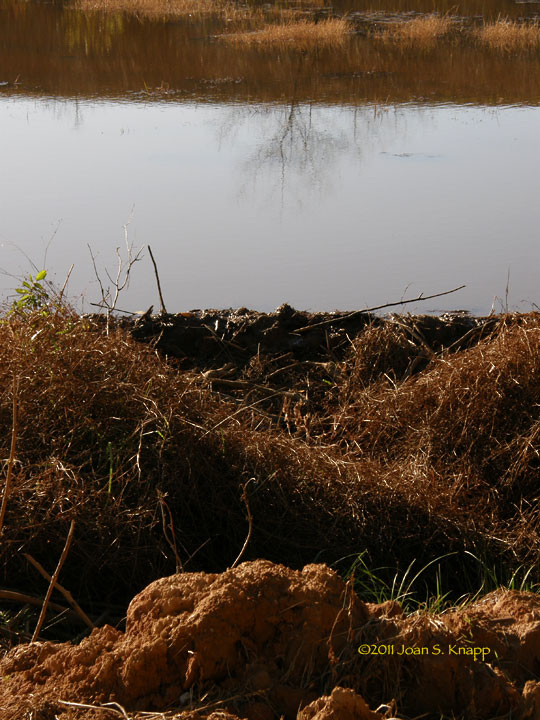
The beaver pond below the dam at Fox Lake. Looking southwest over the south end of the dam to the dam containing Fox Lake.
March 6th. A closer view of the southern end of the beaver dam where there were two short stretches of dam work.
November 18th. The southern end of the dam – the section shown in the second photograph. The growth of vegetation during the summer has covered the timbers that were laid in March. The beaver appear to have added more mud to the top of the dam. The pond seems to be a little deeper.
March 6th. The end of this section closest to the road. Some new wood has been added and mud packed onto the top of the dam.
November 18th. No sign of the timbers we saw in March but fresh mud has been packed into this section.
March 6th. The western end of this south section, the section away from the road. More new timber.
November 18th. Again. No sign of the timbers but more fresh mud has been packed onto the dam in this section.
March 6th. The north end of the beaver dam. New timber had been added to the dam. Mud had been added but it’s not visible in the photo. Looks like the rangers had been watching this activity and had added a section of pipe – we assumed the beaver didn’t add this - to the dam allow water to drain and discourage the beaver from building the dam higher. Failure of the dam would result in the release of a lot of water against the base of this raised road we were parked on and possibly damaging it.November 18th. We didn’t see any beaver activity in this section of the dam and the drainage pipe wasn’t there.
November 18th. Looking across the pond at the northern section of the dam. The pond has a Wood Duck nest box, not far from the road and facing away from the road. We’ve never seen any evidence that the box had been used.But we had another surprise in store. On our way back from Whitetail Lake on November 18th – it was late in the afternoon – we saw some ducks swimming on the pond…
From a distance, they looked different, like Wood Ducks.
An enlargement of the previous photo. It’s not a good shot but it’s clear they are Wood Ducks (Aix sponsa); two males and a female. They swam around in this area for a few minutes and then they swam…
back into the grasses and…We waited for a while in case they swam out into the open again but we suspect they were looking for a place to settle down for the night. We’ll have to plan some trips to look for them again.
Click on an image to view a larger image
Identification resource:
- All About Birds: Aix sponsa (Wood Duck)
Related posts:
- Charlie Elliott Wildlife Center: Fall Color
Thursday, November 24, 2011
Charlie Elliott Wildlife Center: Fall Color
Map: Charlie Elliott Wildlife Center
Bennett Lake. Looking south over Bennett Lake from the road over the dam for Margery Lake.
Fox Lake. The water level in the lake was lowered a year or more ago to control ‘alien’ water plants that were clogging the waters and diminishing the fish population. Owing to the droughts, the water level hasn’t risen to its original level. The area in the foreground should be under water. Instead, it is covered with a variety of grasses and wildflowers.
Fox Lake. Looking west from the parking lot. The light colored bushes on the point are Baccharis halimifolia (Eastern Baccharis) in bloom and a variety of trees in the background.
Shepherd Lake. Looking northwest to the far end of the lake where the color is.
Shepherd Lake. A closer look.
Whitetail Lake. Looking northeast across the lake from the parking lot, along the dam to the field beyond. The hay bales are now wrapped in plastic to produce silage. When we photographed this same area in December 2009, the hay was not wrapped as it is this year.
Whitetail Lake. Looking directly across the lake. Most of the deciduous trees have already dropped their leaves.Even though we aren’t treated to the stretches of intense color that occurs ‘up north,’ we are treated to diverse color throughout the woods.
Click on an image to view a larger image
Distribution:
- United States Department of Agriculture Plants Database: Baccharis halimifolia (Eastern baccharis)
[United States] [Georgia]
- University of North Carolina Herbarium: Baccharis halimifolia
Identification resources:
- Southeastern Flora: Baccharis halimifolia (Eastern Baccharis)
- Natural and Naturalized Plants of the Carolinas and Georgia: Baccharis halimifolia (Sea Myrtle, Groundsel-tree, Consumption Weed, Silverling)
Related post:
- Charlie Elliott Wildlife Center: Whitetail Lake
Wednesday, September 21, 2011
Sleepy Orange Swarms At Whitetail Lake
But there were butterflies. Several swarms of Sleepy Oranges, mostly braving the wind to drink at the lakes edge by the boat launch. A lot of Sleepy Oranges (Abaeis nicippe) and…
a few Cloudless Sulphurs (Phoebis sennae) and…
a lone Red Admiral (Vanessa atalanta)One swarm, however, had found a spot in the lee of a hump of clay and vegetation and were enjoying the sun.
There they are in the center near the bottom of the photo. While the swarms in the open scattered at the slightest movement in their direction, the members in the sheltered swam were very calm and allowed me to approach…
closer, and...
closer, and still…
closer.Click on the image to view a larger image
Identification resources:
- Butterflies and Moths of North America: Sleepy Orange (Abaeis nicippe)
- Bug Guide: Sleepy Orange (Abaeis nicippe)
Friday, August 12, 2011
Indian Heliotrope (Heliotropium indicum)
Otter Lake
It’s just a short walk along this trail to the lake. It looks cool but it was 94F in the shade.
The lake is in the open and, even from a distance, it was clear that the water level was very low.
Vegetation was growing down the slope around the lake, indicating that the water level has been low for some time. At the bottom, judging by the lack of vegetation, it looked like the water level had fallen another foot or so.
W spotted this Indian Heliotrope plant near the bottom of the vegetation on the dam wall.. An individual plant.We didn’t find any others.
A closer view of the plant
The flower head
A close view of the individual flowers
Heliotropium indicum is known by the common names Indian heliotrope, Indian turnsole, and Erysipela plant. It is found in states in the east and southeastern United States. In Georgia, it has been documented in counties throughout the state.
Click on an image to view a larger image
Distribution: United States Department of Agriculture Plants Database: Heliotropium indicum (Indian Heliotrope)
Identification resources:
- Southeastern Flora: Heliotropium indicum (Indian Heliotrope)
- Missouri Plants: Heliotropium indicum (Indian Heliotrope)
- Wikipedia: Heliotropium indicum
Related posts:
- 2010: Year Of The Wildflower – Wildflower Index