Showing posts with label Towns County. Show all posts

Tuesday, May 13, 2014

Talullah River Road: Spring Wildflowers


April 3rd, 2014. On our way back from South Carolina, we detoured through Clayton to the Tate City Road on the Tallulah River that we had last visited in late 2012. At that time, we had found seeds of Jack-in-the-pulpit (Arisaema triphyllium) and the Strawberry Bush (Euonymous americanus) as well as blooms ofJewelweed (Impatiens capensis). 


Vicia caroliniana (Carolina Vetch, Wood Vetch, Pale Vetch) was growing on the embankments before we crossed the river.  


At first, the road runs along the river where the water is flowing over large boulders for some distance. We saw wildflowers on some of the steep embankments that were not easily accessible. 

Further up the river, the valley widens. The wildflowers were more accessible.  


Trillium cuneatum (Little Sweet Betsy, Purple Toadshade) were flowering on both sides of the road. The number of plants with the green form of the flower was striking. 


I counted one cluster of at least 11 plants of this form 


Sanguinaria canadensis (Bloodroot, Red Puccoon) plants in bloom were plentiful on many embankments. 

Some were starting to develop seedpods. 

In addition to the ‘normal’ Bloodroot flowers, we found quite a few ‘double’s. 

Thalictrum thalictroides (Rue Anemone, Windflower) were also plentiful on some embankments. 

Erythronium umbilicatum (Dimpled Troutlily, Dimpled Trout Lily, Dogtooth Violet). We found only two small patches of these lilies. It was surprising that they were still blooming. 

At the end of the road, we found a number of wildflowers, some just starting to blooms or finishing for the season. 

Arisaema triphyllum ssp. triphyllum (Jack-in-the-Pulpit) just leafing out. 

A white-flowered trillium just beginning to open. 

Hepatica nobilis var. acuta (Sharplobe Hepatica, Sharp-lobed Hepatica, Sharp-lobed Liverleaf). Although most plants had finished blooming, one or two plants were still blooming.

This is a rich botanical area for Spring wildflowers and well-worth a visit.

Related posts: 

Saturday, December 22, 2012

Towns County: In And Around Young Harris


October 20th, 2012. On our way back from Rabun County, we drove through Young Harris in Towns County and decided to wander some of the back roads behind the college. I’m always intrigued by old, abandoned houses, chimneys left after houses have burned, and the history of people's lives that go with them..

East of Young Harris we got two for the price of one in a field…

An old chimney

Up close, and

 An old cabin, with...

Moss growing on the roof. 
Click on an image to view a larger image

Saturday, December 15, 2012

No Hang Gliding!


September 22nd, 2012. Near the end of Mill Creek Road in the Swallow Creek Wildlife Management Area we saw this sign on a tree.

I was bemused by the sign. There was no way that anyone could have launched a hang glider in this area which was heavily forested. I guess these were just ‘standard’ signs that would have applied to motor vehicles, ‘motorized equipment’ and bicycles in this area and hang gliders in other areas; just not to hang gliders in this area.
Click on the image to view a larger image

Related posts:

Thursday, December 13, 2012

Swallow Creek Wildlife Management Area: Kidneyleaf Grass of Parnassus (Parnassia asarifolia)


September 22nd, 2012. I photographed Parnassia asarifolia (Kidneyleaf Grass of Parnassus) by the side of North Germany Mountain Road which runs through the Black Mountain State Park in Rabun County, Georgia in 2011 and again in 2012. At this site the plants grow in complete shade.

On our way home from Rabun County, we explored the Swallow Creek Wildlife Management Area in Towns County; download a map of the WMA here. From Cynth Creek Road, we drove south and entered the WMA again on Mill Creek Road and drove to the end of the road which is a trail head just a short distance from the Tennessee Valley Divide and the Appalachian Trail.


 At first the road ran along the valley just above the creek and then climbed along the side of the ridge. W spotted another patch of parnassias growing in a wet area by the side of the road as we climbed out of the valley. Which species? There are two species – P. asarifolia and P. grandifolia (Largeleaf Grass of Parnassus) – and we’ve been on the lookout for P. grandifolia. These plants proved to be P. asarifolia and, although we were a little disappointed that it wasn’t P. gradifolia, we were delighted to find another patch of P. asarifolia. It was somewhat challenging to photograph them in full sun, but not much choice.

The plants were growing in water flowing from a spring a little farther up the hill.

A little closer

Closer still, and…

up close


Close-ups of the flowers, and…

a flower that’s going to seed.

The circle of small appendages (staminodia) that have gold tips (false anthers) – nectaries - designed to attract pollinators to the flowers. Below are two photographs actually showing…


an ant, and a...

a fly feeding at these nectaries.

We drove on up the hill and found still more plants growing in the flow from the spring water coming from the rocks above. We found these plant...


growing in crevices on the vertical rock face. The flowers were in full sun and the plants themselves in deep shade so the photographs leave something to be desired. The kidneyleaf shape is so clear in this photographs.

We’ll have to come back to this site in the morning to photograph in the morning before the sun shines directly on the flowers.
Click on an image to view a larger image

Identification Resources:
Southeastern Flora

Natural and Naturalized Plants of the Carolinas and Georgia:

Distribution:
United States Department of Agriculture Plants Database:

Related posts:

Tuesday, December 11, 2012

Zen: Just Hangin' Out

September 22nd, 2012. The petioles of Angelica sp. are quite wide and often curled up; they open out as the leaves develop. This spider obviously found this uncurled petiole a comfortable resting place. It looks a little like it’s lying in a hammock with its front legs hanging over the edge.

Click on an image to view a larger image


Identification Resources:

Southeastern Flora
- Angelica triquinata (Filmy Angelica)

Natural and Naturalized Plants of the Carolinas and Georgia:
- Angelica triquinata (Mountain Angelica, FilmyAngelica)


Distribution:

United States Department of Agriculture Plants Database:

 
Related posts:


Monday, December 10, 2012

Swallow Creek Wildlife Management Area: Late Season Gems on Cynth Creek Road


September 22nd, 2012. On our way home from Rabun County, we explored the Swallow Creek Wildlife Management Area in Towns County; a map of the WMA may be downloaded here. I’d never heard of this WMA which has several access roads from GA-75. We drove up to the end of CynthCreek Road. .

Although most wildflowers had finished blooming, we found a number of interesting plants and fungi that will ensure we return again next year.

Coral Fungus

There were a number of coral fungus under a canopy of rhododendrons. This was the best specimen, although older than the specimen we found previously.

A close up

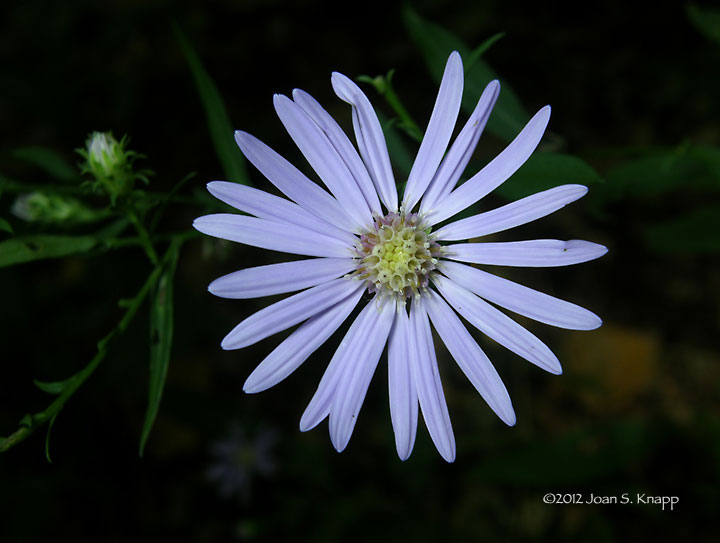
Aster (Unidentified species)

The flower, and its…

leaf.

Filmy or Mountain Angelica (Angelica triquinata)

I’m familiar with Hairy Angelica (Angelica venenosa) which grows in Fort Yargo State Park in Barrow County but this is the first time I’d seen Filmy or Mountain Angelica (A. triquinata). It’s green flowers are quite different from the white flowers of A. venenosa.

The flower head.

A close up

A compound leaf low on the plant

Solomon's seal (Polygonatum sp.)

These stems were ‘enormous’ – I estimated them to be 3 to 4 feet long - compared with the stems I’ve seen locally which are only 1 to 2 feet long. They were growing on an embankment almost at eye level so I had to content myself with photographing sections of them. I didn’t look closely at the underside of the leaves so don’t know if this was P. biflorum (Smooth Solomon’s Seal) or P. pubescens (Hairy Solomon’s Seal). P. biflorum grows throughout Georgia whereas P. pubescenss grows only in far north Georgia.


A section of the stem

 A close-up of the berries

Another view of the stem

Wild hydrangea (Hydrangea arborescens or H. radiata)

I thought this was H. arborescens, not realizing that a similar species, H. radiata, occurred in this area also. So, I didn’t pay enough attention to the undersides of the leaves to determine if this was H. arborescens or H. radiata whose leaves have ‘white’ undersides. Yet another reason to visit this area again.


The flower head with developing seed pods.

This road may prove to be a very interesting site to visit throughout the year based on the few plants we photographed on this trip
Click on an image to view a larger image

Identification Resources:
Southeastern Flora
Natural and Naturalized Plants of the Carolinas and Georgia:
Will Cook, Duke University:
 
Distribution:
United States Department of Agriculture Plants Database:

Related posts: