Showing posts with label Pipevine Swallowtail. Show all posts

Tuesday, July 7, 2015

Spring Walk At Fort Yargo State Park: Shelter A To The Old Fort, June 15th, 2015 (Part 2)


June 15th. (Continued from…) I started to walk again at Fort Yargo State Park in Winder, Georgia. One of my favorite walks is from the Group Shelter A to the Old Fort and back.This is a rewarding walk for viewing wildflowers and I’ve been trying to walk it weekly and document the wildflowers I see.


The route, which I described here, here, and here. 

The early spring wildflowers have finished blooming; it’s time to watch the developing fruit. A few late spring/summer wildflowers are blooming now.

I solved part of a mystery on this walk. Some time previously, I had photographed this…


fungus that looked like an ornate bracket fungus but I hadn’t been able to identify it. Sometime since my previous walk, something/someone had…


knocked a section from one of them. Suddenly the mystery was partially solved. This was composed of several bracket fungi with…

relatively deep pores – about ¼ inch deep at the center. These were definitely…

polypores; I managed to detach a section of one bracket to comfirm the presence of pores. These individual bracket fungi had drooped to overlap and, unlike many mushrooms that would simply dry up and fall off, had dried to give the impression of a single entity. I should have figured it out but this exposure had certainly clarified what had happened. They were still leathery to the touch but were dead. Ants had built nests in the snag; the ants may have eaten the mycelium. Now to try and identify them. 

Another surprise. On the uphill side of the trail, I found several stalks of…


Nakedflower Ticktrefoil (Desmodium nudiflorum) were blooming. I’d forgotten they were here. I prefer desmodiums to lespedezas – the clear flowers with the two accent ‘eyes’ - so I was delighted to find these.


The second Eastern Sweetshrub (Calycanthus floridus) seedpod was doing nicely. I tend to miss it now that its weight has caused it to droop below the leaves (Top) and have to carefully move the leaves aside (Bottom) to expose it for a good photo.
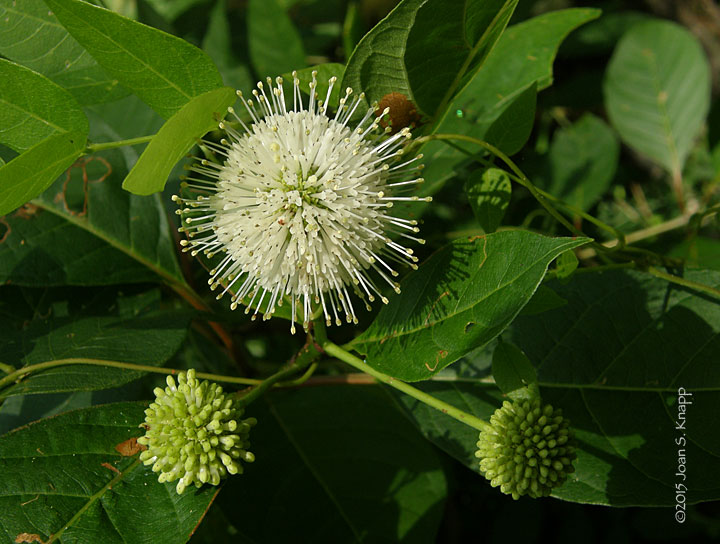

When I got to the Fishing Area, I found that the Buttonbush (Cephalanthus occidentalis) bushes had started to bloom.


I found this small hoverfly - Toxomerus geminatus – feeding on the flowers. (Thanks to Bug Guide for this identification). 

This was a good day for dragonflies and damselflies.


This Slaty Skimmer (Libellula incesta) let me get quite close. While I was photographing it flew over to a sweetgum leaf out over the water and, a few minutes later, returned to a…


nearby branch with a mate in tow - literally.


There were also a lot of male Blue Dashers (Pachydiplax longipennis) flying around in the area; this was the favorite perch. I didn’t see any female Blue Dashers in the area.


The Perfoliate Bellwort (Uvularia perfoliata) seed capsule was still developing.


I also found another small Strawberry Bush (Euonymus americanus) bush with developing fruit.


I made my way along to the Old Fort.


Another Buttonbush and a sedge were blooming. 

By the trail back down to the Fishing Area, I found more…

Pipsissewas with developing seed capsules. 

Back at the Fishing Area, where I had seen the dragonfly, there were a…


pair of Blue-fronted Dancers (Argia apicalis) damselflies that had mated. The female was laying eggs.


A Pipevine Swallowtail (Battus philenor) was resting on a branch nearby.


The final ‘find’ for the day were some Annual Blue-eyed Grasses (Sisyrinchium rosulatum) in bloom. 

Related posts: 

Sunday, May 13, 2012

Pipevine Swallowtails (Battus philenor) At Scull Shoals

The gravel road in the Scull Shoals Experimental Forest by dragonflies sunning themselves and butterflies sipping minerals from the gravel. Our encounters with them are often brief but, on this afternoon, we were treated to a 10-minute encounter between two Pipevine Swallotails (Battus philenor).

*****
This one arrived first and set about drinking the minerals. It opened and closed its wings repeatedly, and then sat for a while with…

Its wings extended, soaking up the warmth. It’s interesting that the color and pattern on the wings appeared different from different angles. We could identify this butterfly because it had lost one of its tails.

After about five minutes, a second butterfly arrived, and began to…

interact with the first butterfly. Both are males; neither has the row of spots along the back edge of the forewing which is present in the female.

This second male had a more distinct pattern than the first and both of its tails were intact.

The second male began to follow the first.

The second male is still following the first and it’s impossible to tell them apart based on their patterns and colors. The only way to tell them apart was the fact that one had lost one of its tails. After a while…

*****
The first male began to follow the second.

*****
Then, as if square dancing, they sashayed for a few minutes before…

the first male flew away into the woods and left the second male alone. An interesting peaceful, social encounter.
Click on an image to view a closer image


Identification resources:

-
BugGuide: Battus philenor (Pipevine Swallowtail) [Male] [Female]
- Michael Beohm, West Central Georgia Butterflies:
Pipevine Swallowtails (Battus philenor)

Related posts:
- April: Butterfly Afternoons At Scull Shoals

- Pipevine Swallowtail (Battus philenor)

Thursday, May 10, 2012

April: Butterfly Afternoons At Scull Shoals

During April, we were treated to a number of different butterflies along a road in the Scull Shoals Experimental Forest in Greene County, Georgia.

The road runs beside a deciduous forest above a swamp. The butterflies feed along the edge of the woods or find minerals in the gravel road.

Eastern Tailed-blue (Cupido comyntas). Superficially, Eastern Tailed-blues look like Spring or Summer Azures. However, they have tiny tails on their wings. After landing, they will open their wings rather than keeping them closed like the Azures do.

Pipevine Swallowtails (Battus philenor). The upper butterfly arrived first; the lower one arrived later. They were getting minerals from the gravel. They danced around each other for a while before the upper one flew off.We don't see these butterflies very often and it was a treat to see two at the same time.

Pearl Crescent (Phyciodes tharos). We saw a lot of these this Spring.

Summer Azure (Celastrina neglecta). At first I thought this was a Spring Azure (Celastrina ladon) but a close inspection of the photograph confirmed that it was a Summer Azure. The azures sit with wings folded and rarely open them for any length of time. The markings on the underside of the wings are lighter on the Summer Azure than on the Spring Azure.

Zebra Swallowtail (Eurytides marcellus). This was a fortunate catch. I’d photographed a zebra in the Piedmont National Wildlife Refuge a few months ago but most have been continuously on the move and rarely settling long enough to photograph. This zebra settled on a muscadine leaf for several minutes before it flew off into the woods.

Most of the butterflies were looking for moisture on leaves and ignoring the…


Hawthorne (Crataegus sp.) bush

American Lady (Vanessa virginiensis). This American Lady worked the hawthorne flowers for quite a while.

We’re beginning to see new butterflies in late April-May. More of these later…

Click on an image to view a larger image


Identification resources:

Michael Beohm, West Central Georgia Butterflies:

- Eastern Tailed-blue (Cupido comyntas)

- Pipevine Swallowtails (Battus philenor)

- Pearl Crescent (Phyciodes tharos)

- Summer Azure (Celastrina neglecta)

- Zebra Swallowtail (Eurytides marcellus)

- American Lady (Vanessa virginiensis)


Related posts:

- Eastern Tailed-Blue (Cupido comyntas)

- Pearl Crescent (Phyciodes tharos)

- Piedmont National Wildlife Refuge: Late Winter Surprises (Part 1)

- Spring Azure (Celastrina ladon)

Sunday, June 5, 2011

A Confusion of Butterflies: Spicebush Swallowtail (Papilio troilus)

The official names for a group of butterflies is rabble or swarm. However, in this case it was a confusion.

On a recent trip to Piedmont National Wildlife Refuge in Jasper County, Georgia, Butterfly Weed (Asclepia tuberosa) plants were in full bloom. And swallowtail butterflies were making the most of them. At the time, I thought I was looking at Pipevine Swallowtails (Battus philenor) although one butterfly had distinctly stronger markings. It wasn’t until I processed the images that I realized that I’d also been looking at a Spicebush Swallowtail (Papilio Troilus), the first I’ve ever seen.


They were flying frantically, just occasionally they would slow down enough for e to capture a good image. I captured two butterflies in this photo but, at one point, three swallowtails were feeding at this plant.

A Pipevine Swallowtail

A Spicebush Swallowtail in the foreground and a Pipevine Swallowtail in the background. The Pipevine Swallowtail has one row of spots on the underside of the forewing compared with the Spicebush Swallowtail which has two rows of spots on the underside of the forewing.

A close up of the Spicebush Swallowtail. Unfortunately I didn’t get a look at the underside of the wing of this butterfly.

Although both the Pipevine and Spicebush swallowtails are resident throughout Georgia, we see Pipevine swallowtails in our area and I've never seen a Spicebush swallowtail here.

Click on an image to view a larger image


Identification resources:
- Westcentral Georgia Butterflies by Michael Beohm:
- Spicebush Swallowtail (Papilio troilus)

- Pipevine Swallowtail (Battus philenor)

- BugGuide:

- Spicebush Swallowtail (Papilio troilus):
[Dorsal] [Ventral]
- Pipevine Swallowtail (Battus philenor):
[Dorsal] [Ventral]

Related post:
- Pipevine Swallowtail (Battus philenor)