Showing posts with label
Davidson-Arabia Mountain Nature Preserve.
Show all posts
Showing posts with label
Davidson-Arabia Mountain Nature Preserve.
Show all posts
Continuing from the Rocky Trail – South Lake Trail …
 As we entered the woods, we saw the Fern Trail, marked by a yellow blaze, going off to the south. We’ll have to walk that trail on another day.
 The Arabia Lake Trail circles the lake. We walked on the east side of the lake to meet up with the Forest Trail. Along the trail, where seeps emerged along the bank, we saw more leaves of more trout lilies (Erythronium sp.).
 We were a little amused by this sign warning of thin ice, especially since it was 85 F that day. But in winter, ice may form on the lake but it would be very thin. Hence the danger sign.
 We joined the Forest Trail starts at the northeast ‘corner’ of the lake and walked along a relatively level trail for a short while.
 The trail then climbed back up to the ridge, skirting the northern end of the stone outcrop, to return to the parking lot.
 In a shady grove near the end of the Forest Trail, we spotted a small grove with about a dozen Pink Lady's Slipper (Cypripedium acaule) orchids.
 On April 9th, the orchids were just beginning to open.
 The Forest Trail crossed the PATH trail to return to the parking lot. We chose to walk back to the parking lot on the paved PATH trail. PATH is a foundation that builds trails for walkers, runners, cyclists, and skaters. The Arabia Mountain path currently runs from Lithonia to Alexander’s Lake, just east of Panola Mountain State Park.
Click on an image to view a larger image
Related information:
PATH Foundation: Arabia Mountain Trail [Online trail map]
Related posts:
- Davidson-Arabia Mountain Nature Preserve: RR Trail - Frog Pond Trail
- Davidson-Arabia Mountain Nature Preserve: Frog Pond Trail
- Davidson-Arabia Mountain Nature Preserve: Rocky Trail – South Lake Trail
- Davidson-Arabia Mountain Nature Preserve: Bradley Mountain Trail (Part 1)
Continuing from the Frog Pond Trail…
From the quarry buildings at the end of the Frog Pond Trail, the South Lake Trail travels west over the stone outcrop to the woods and Arabia Lake. The South Lake Trail is marked with stone cairns. We left the trail on the Rocky Trail to find the Fern Trail and follow it to Arabia Lake.
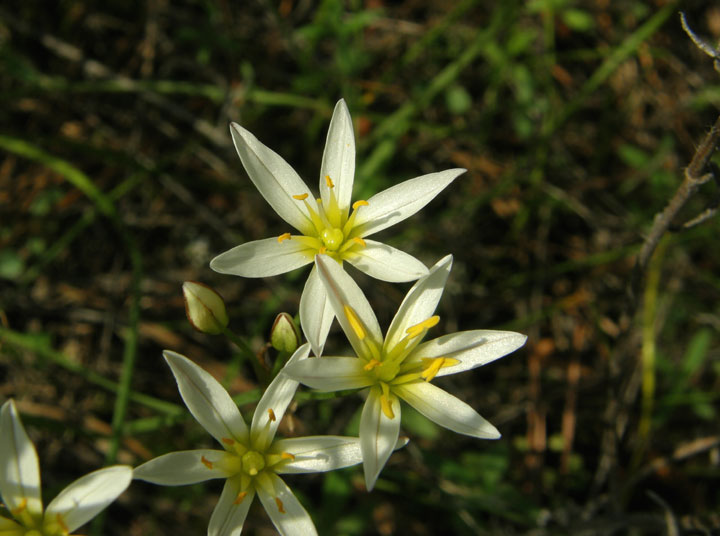
 Where the Rocky Trail left the South Lake Trail, the bank was covered with a blanket of Oneflower Stitchwort (Minuartia uniflora) in the foreground, Woolly Ragwort (Packera tomentosa) in the background, and False Garlic (Nothoscordum bivalve) to the right.
 Close up of the False Garlic flowers.
 The bank at the edge of the woods to the east of the Rocky Trail, a trail that is not marked with stone cairns. The bank was about 4 feet high. Organic matter from the woods has accumulated on the bank which no longer has the harsh scars from quarrying.
 The outcrop to the south side of the trail also shows signs of quarrying that have not softened with time. Some Loblolly pines (Pinus taeda) have established on the outcrop.
 As we approached the woods at the end of the Rocky Trail, we crossed a seep. Elf Orpine (Diamorpha smallii) blankets the thin soil on the outcrop in the foreground. Woolly Ragwort grows in the thicker soil along the seep.
 As we were looking for the Fern Trail, we found the forest floor at the edge of the stone outcrop covered with fruiting Polytrichum commune moss and trout lilies (Erythronium sp.). We also found this small patch of Pixie Cup lichen (Cladonia carneola).
We couldn’t find the Fern Trail. We worked our way along the edge of the stone outcrop in the hope that we would spot the trail.
 We found another area with a carpet of Elf Orpine in the foreground and Woolly Ragwort in the background.
At the southwest end of the stone outcrop we gave up our search for the Fern Trail and made our way back northeast around a patch of trees to the South Lake Trail. As we walked across the outcrop, a Kildeer (Charadrius vociferus) dashed from an area of Elf Orpine and began its ‘broken wing’ routine to distract us from its nest. Unfortunately, we didn’t get any photographs as she moved around so quickly. We looked around for the nest but the Elf Orpine carpet was so large, it would have taken a long time to search thoroughly.
 We crossed this seep just before we reached the South Lake Trail
 The last section of the South Lake Trail to the arch at the edge of the woods was fairly bare, with just a few scant patches of Elf Orpine.
From here we ventured entered the woods to reach Arabia Lake after a short walk. Then to the Arabia Lake and Forest Trails…
Click on an image to view a larger image
Related posts:
- Davidson-Arabia Mountain Nature Preserve: RR Trail - Frog Pond Trail
- Davidson-Arabia Mountain Nature Preserve: Frog Pond Trail
- Davidson-Arabia Mountain Nature Preserve: Bradley Mountain Trail (Part 1)
We enjoyed our hike on the Bradley Mountain Trail and wanted to explore the section of the Davidson-Arabia Mountain Nature Preserve on the west side of Klondike Road. This section of the preserve is accessed through the north entrance.
 Map of trails. Each of 12 sections of trail has it’s own name. A circuit of this section of the preserve involves making a loop of different individual trails.
 A number of interpretive diagrams explaining the vegetation in the preserve are on display at the kiosk at the north entrance to the park. This is the diagram for the Outcrop Solution Pit Community that includes Lichens (Cladonia sp.), mosses (Polytrichum moss [Polytrichum commune] and Campylopus sp.), Elf Orpine (Diamorpha [Arenaria] smallii) and Oneflower Stitchwort (Minuartia uniflora), and larger plants; Elliott’s Bent Grass (Agrostis elliottiana), Orange Grass (Hypericum gentianoides) and Porter's sunflower (Helianthus porteri).
We decided to hike the RR (Rail Road) – Frog Pond – Rocky – Arabia Lake – Forest Trail loop.
 Our hike began along the RR Trail that follows an old railroad bed, passing a large stone outcrop on the right.
 We saw leaves of trout lilies (Erythronium sp.) at the edge of the trail both here and along several other sections of the loop where the soil was moist.
 We found a new wildflower along this trial. It’s Japanese Mazus (Mazus pumilus) and it grew along this trail as well as a couple of dish gardens out on the stone outcrop. We’d seen patches of Oldfield Toadflax (Nuttallanthus canadensis) and it would have been easy to dismiss mazus plants as toadflax. It pays to take a closer look at a lot of flowers.
 We wandered out onto the stone outcrop where we saw Oneflower Stitchwort (Minuartia uniflora), Elf Orpine (Diamorpha smallii), and Woolly Ragwort (Packera tomentosa).
 A female Blue Corporal (Ladona deplanata) was sunning itself on the rock.
 The Common Pricklypear (Opuntia humifusa) was coming back to life. Both new pads and flower buds were developing.
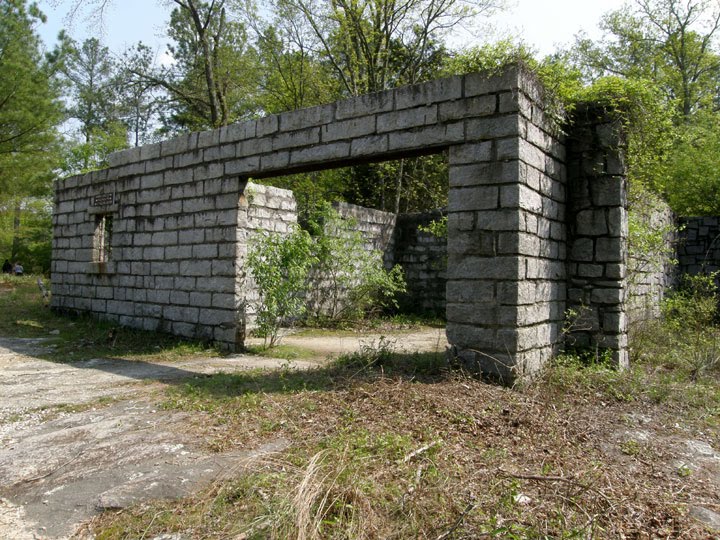
At the end of the RR Trail, we turned west on the Frog Pond Trail. The Frog Pond Trail begins in the woods and turns south across the stone outcrop to the remains of the old quarry storage building and weigh station
 Here, and in other moist areas we found the moss, Polytrichum commune, fruiting.
 A closer inspection showed that these fruiting bodies had already dispersed their spores. The remnant is quite striking though.
The Frog Pond Trail leaves the woods here and traverses the stone outcrop southwards...
April 9th, 2011. Click on an image to view a larger image
Related posts:
- Davidson-Arabia Mountain Nature Preserve: Bradley Mountain Trail (Part 1)
- Davidson-Arabia Mountain Nature Preserve: Bradley Mountain Trail (Part 2)
- Davidson-Arabia Mountain Nature Preserve: Bradley Mountain Trail (Part 3)
 As we entered the woods, we saw the Fern Trail, marked by a yellow blaze, going off to the south. We’ll have to walk that trail on another day.
 The Arabia Lake Trail circles the lake. We walked on the east side of the lake to meet up with the Forest Trail. Along the trail, where seeps emerged along the bank, we saw more leaves of more trout lilies (Erythronium sp.).
 We were a little amused by this sign warning of thin ice, especially since it was 85 F that day. But in winter, ice may form on the lake but it would be very thin. Hence the danger sign.
  We joined the Forest Trail starts at the northeast ‘corner’ of the lake and walked along a relatively level trail for a short while.
 The trail then climbed back up to the ridge, skirting the northern end of the stone outcrop, to return to the parking lot.
 In a shady grove near the end of the Forest Trail, we spotted a small grove with about a dozen Pink Lady's Slipper (Cypripedium acaule) orchids.
  On April 9th, the orchids were just beginning to open.
 The Forest Trail crossed the PATH trail to return to the parking lot. We chose to walk back to the parking lot on the paved PATH trail. PATH is a foundation that builds trails for walkers, runners, cyclists, and skaters. The Arabia Mountain path currently runs from Lithonia to Alexander’s Lake, just east of Panola Mountain State Park.