Showing posts with label Peucetia viridans. Show all posts

Friday, August 31, 2012

More Spotted Beebalm (Monarda punctata)


August 17th, 2012. I was making my way over to the Showy Rattlebox (Crotolaria spectabilis) plants growing at the edge of the woods on the south side of GA-16 east of Sparta in Hancock County. I had to walk through grass and cross a shallow ditch to reach the woods. At the bottom of the ditch, I happened to look down. And there it was a...


Spotted Beebalm (Monarda punctata) plant in bloom. I almost didn’t notice it. It didn’t stand out. I looked around and saw more plants growing along the ditch.


I’d wondered how many ‘decks’ of flowers could develop on a stem. This stem has five decks.


A closer view of the flowers


It seems that a lot of flowers have small ‘friends.’  This flower had a resident Green Lynx (Peucetia viridans) spider lying in wait in hope of a meal.


As I was walking about photographing the Showy Rattlebox (Crotolaria spectablis), I happened upon this clump of beebalm plants. The clump appears to have more plants than it actually has. Most of the stems had branched with blooms on each branch. It’s interesting how ‘dull’ the flowers are in low light – it was late afternoon and cloudy.
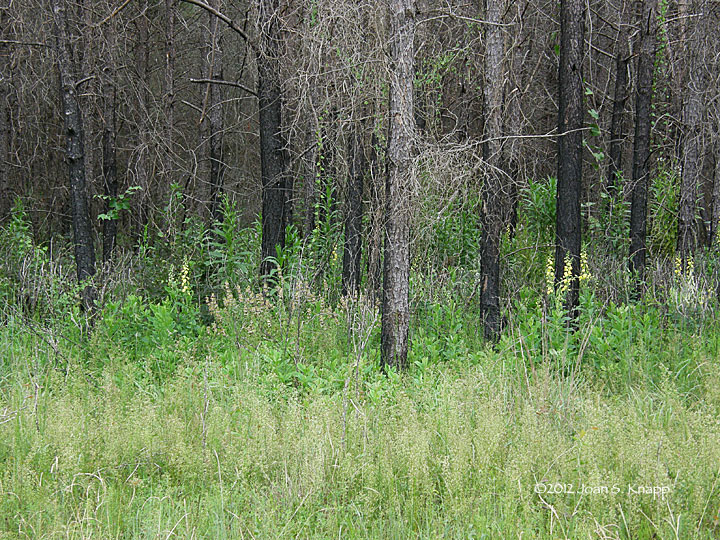

Looking back at the patch from the road. It’s hard to recognize them at a distance. They look like dead flowers. See a more complete set of photographs here.

Monarda punctata (Spotted Beebalm, Eastern Horse-mint, Dotted Horse Mint) is native to the United States where it’s found in states southeast of a line from Quebec and Ontario, Wisconsin, Iowa, Kansas to New Mexico. In Georgia, it’s found in many counties throughout the state. Interestingly it has not been formally documented in Oglethorpe County.
Click on an image to view a larger image

Identification resources:
- Southeastern Flora: Monarda punctata (Spotted Beebalm)
- Name that Plant: Native and Naturalized Plants of the Carolinas and Georgia: Monarda punctata (Eastern Horse0mint)- Missouri Plants: Monarda punctata

Distribution:
- United States Department of Agriculture Plants Database: Monarda punctata (Spotted Beebalm)
- University of North Carolina Herbarium: Monarda punctata


Related posts:
-  Spotted Beebalm (Monarda punctata)
- Showy Rattlebox (Crotolaria spectabilis)                  

Sunday, October 18, 2009

Green Lynx Spider (Peucetia viridans): Instars

This Green Lynx spider laid eggs around the second to third weeks in September. When she spun the egg case, she spun web between nearby branches and the branch on which the case was attached to stabilize the egg case.

As it got closer to the time the eggs hatched, she spun more lines to make sure that the egg case was secure. This photo was taken on September 29, 2009.

By the time the eggs hatched, the egg case was really secured. In this photo, the instars cluster on the egg case and in the webs around the case, the female is on the branch above and to the right of the case, and the remains of the egg 'shells' hang in the web below the case. This photo was taken on October 4th, 2009.

A close up of the same egg case with instars. This photo was taken on October 4th, 2009.

Close up of an instar. This photo was taken on October 9th, 2009. I couldn’t find the female this day. The instars appeared to be ‘on their own.’

PS: I couldn’t find the egg cases or any sign of the instars after the heavy rain last week. I hope at least some made their way down the bush into the grass below and survived the bad weather.

Related Posts:

- Green Lynx Spiders (Peucetia viridans)

- Green Lynx Spider (Peucetia viridans): Egg-laying Time Again….

Click on an image for a larger image

Tuesday, September 22, 2009

Green Lynx Spider (Peucetia viridans): Egg Laying Time Again…

Last year I didn’t notice the Green Lynx spiders in the butterfly bush until late summer and then followed their egg laying and guarding the egg cases last year,. I thought they must have been in the bush all year but I just hadn’t noticed them. This year I was actively looking for them. I saw a young spider in spring but then didn’t see them at all during summer. They may have been there but, if so, they were very unobtrusive. It’s also possible that they weren’t there but gravitated to the butterfly bush because it's a good place to find insects to eat and fatten up before laying eggs.

Then, in August, several females appeared. They were fat and healthy, ready to lay eggs.

They lurked on the underside of the flowers on the butterfly bush waiting to pounce on an unsuspecting butterfly, bee or fly.


Now they have laid eggs and each will guard its egg case faithfully until the eggs hatch. It’s not clear that they will eat during this time. They will fearlessly attack anything - including a human finger - that approaches.

Identification resource:
- BugGuide: Green Lynx Spider (Peucetia viridans) [Male] [Female]
Click the image to view a larger image

Saturday, August 15, 2009

Green Lynx Spiders (Peucetia viridans)

Maybe another sign of autumn. The Green Lynx spiders (Peucetia viridans) have appeared in the butterfly bush. I’ve seen a few now. There aren’t a lot of insects around the bush at the moment. The heat has suppressed flowering after the spring and the bush is just starting to show signs of new leaf and flower development for autumn. Fiery skippers and the occasional Silver-spotted skippers have been the main visitors to the bush. The Green Lynx spiders have been catching Fiery skippers.

Yesterday morning I found a female Green Lynx that had caught a skipper.

A male Green Lynx spider was also there.

He would approach the female. She would drop down a little on her silk and then climb up again when he retreated a little. This was repeated many times. I am not sure if he wanted to steal her butterfly or if his intentions were amorous. In either case, the female was not letting him near her meal.

Identification resource:
- BugGuide: Green Lynx Spider (Peucetia viridans) [Male] [Female]
Click the image to view a larger image