Showing posts with label Butterfly Milkweed. Show all posts

Saturday, June 20, 2015

Spring Is In The Air: Fort Yargo State Park, Section B To The Dam, June 4th (Part 1)


June 4th. When I visited Fort Yargo State Park in mid-February, there were few signs of Spring. The only wildflower plants that were obvious were the leaves of Cranefly Orchids (Tipularia discolor) that I found in many places.


The route… I’ve described it here, here, here, and here This walk doesn’t have the variety of wildflowers as my other walk from the Group A Shelter to the Old Fort but it does have some gems. One of the Smallflower (Asimina parviflora) had developed fruit that, unfortunately, it had lost; the Pink Lady’s Slipper (Cypripedium acaule) Orchids had bloomed, and some Green Adder’s-mouth (Malaxis uniflora) Orchids were blooming. 

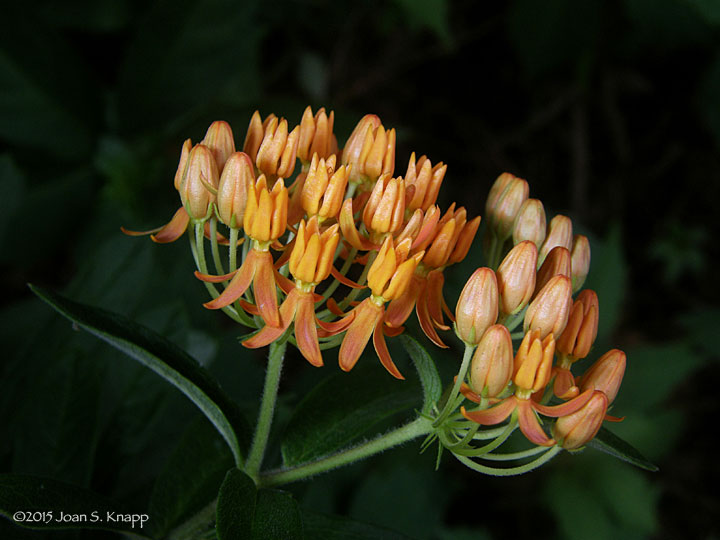
My previous walk on this trail had bordered on boring. The only ‘new’ wildflower was the Butterfly Milkweed (Asclepias tuberosa) that had set buds, but this walk would be very interesting. 


Many of the Butterfly Milkweed flower buds had opened. Luckily, I photographed them on this walk. They had disappeared before my next walk. Deer had eaten them; they had nipped the stems just below the flowers. I used to hear that deer wouldn’t eat milkweeds. If I believed it once, I don’t now. Deer at home have nipped the tops from our Green Comet Milkweed (Asclepias viridiflora) plants in the past. It was disappointing to see that these flowers had been eaten. They were putting on a small, but impressive show.


On the flat section of trail just beyond the trees, Elderberry bushes (Sambucus nigra) were in full bloom.


Cutleaf Evening Primroses (Oenothera laciniata) were blooming. There were only a few plants this year and the flowers are usually closed by the time I walk the trail. This one was blooming in the shade and not so quick to close.


A few Pleated Inkcap Mushrooms (Parasola – formerly Coprinus – plicatilis) were growing along the trail.
 
A few Plumeless Nodding Thistles (Carduus nutans) were blooming in the grass beside the trail. 


Things started to get interesting when I entered the main woods after crossing the gas pipeline right-of-way. I found, by chance,…


Crown-tipped Coral fungi (Artomyces – formerly Clavicorona – pyxidatus)
 fruiting on a fallen log in a relatively open area. Scuppernongs were growing around that log and probably helped maintain the humidity that would be necessary for these fungi to grow. I was lucky to get a glimpse of them; it would have been very easy to miss them.


The Witch’s Butter (Tremella mesenterica) jelly fungus near the ‘Christmas Fern Grove’ was still re-hydrated and, in fact, appeared to grow further (lower image) while I was on the trail.


I made my way along the trail to the approach to ‘The Hill.’ Off to my right, I saw some…


red spots on a fallen log. I’d seen them before but had never investigated further. Now I took a closer look. I expected them to be a nondescript fungus but, to my delight, found that they were the…


Red Raspberry (Tubifera ferruginosa) slime mold. 

I continued up ‘The Hill’ and then made my way over to the…


Tulip Poplar (Liriodendron tulipifera) where two fruit were still developing, and then on to the Outer Loop. I was walking along the Outer Loop when, out of the corner of my eye, I noticed a shape that didn’t belong. I almost ignored it but turned and walked over to take a closer look. It was a…
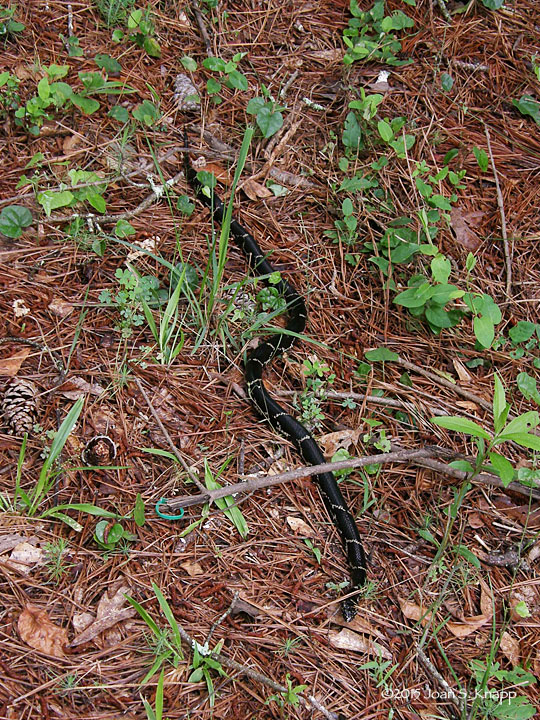

young Eastern Kingsnake (Lampropeltis getula getulaL). It was about 2 feet long and lying in the grass against the woods at the side of the trail. It wasn’t moving when I went over to take a closer look. I don’t know whether it had sensed the vibrations of my footsteps and stopped moving or was simply lying in wait for some hapless prey.
Down at the dam, I found a clump of…


Lanceleaf Coreopsis (Coreopsis lanceolata) plant in bloom, and a few…
Queen Anne’s Lace (Daucus carota) plants just starting to bloom. 


Then on to the return trail…
(To be continued…) 

Related posts: 

Wednesday, September 19, 2012

Butterfly Milkweed (Asclepias tuberosa) Seed Release


August 25th, 2012. It’s not often that we seed a release of seeds from milkweeds that is not affected by breezes. Usually the wind will blow the seeds away as they are released. On this occasion, however, we spotted seeds being released from the pod of a Butterfly Milkweed (Asclepias tuberosa) in a calm atmosphere.

Asclepias tuberosa (Butterfly Milkweed, Common Butterflyweed, Pleurisy Root, Wind Root) is native to the United States, where it’s found in states southeast of a line from Maine to Minnesota, South Dakota, Nebraska, Colorado, Utah to New Mexico and California. In Georgia, it’s found in many counties throughout the state.
Click on an image to view a larger image

Identification resources:
 - Natural and Naturalized Plants of the Carolinas and Georgia: Asclepias tuberosa (Common Butterflyweed, Pleurisy Root,Wind Root, Butterfly Milkweed)

Distribution Map:
- United States Department of Agriculture Plants Database: Asclepias tuberosa (Butterfly Milkweed)
- University of North Carolina Herbarium: Asclepias tuberosa

Friday, August 26, 2011

Butterfly Milkweed (Asclepias tuberosa): Yellow Variant


While driving south from Pond 2A in the Piedmont National Wildlife Area in Jones County, Georgia, we spotted this. Even at a distance we could tell it was a Butterfly Milkweed (Asclepias tuberosa). Asclepias tuberosa flowers are usually bright orange so we had to take a closer look.

A little closer…

And closer still. Clearly a Butterfly Milkweed plant.

The leaves were alternate

The flowers from the top

From the side…

And closer still.

Corpuscula that connect the pollinia via translators are visible between the hoods on several florets and missing from others.

This, clearly, is a yellow variant of Asclepias tuberosa. Earlier in the year we saw a plant with yellow-orange flowers over by the Woodpecker Trail but this is the first clearly yellow variant of this species we've seen in Georgia.
Yellow flowers have been reported elsewhere.
Click on an image to view a larger image


Distribution Map:
- United States Department of Agriculture Plants Database: Asclepias tuberosa (Butterfly Milkweed)

- University of North Carolina Herbarium:
Asclepias tuberosa

Identification resources:

- Southeastern Flora:
Butterfly Milkweed (Asclepias tuberosa)
- Natural and Naturalized Plants of the Carolinas and Georgia:
Asclepias tuberosa

Related posts:

- 2010: Year Of The Wildflower – Wildflower Index

- Butterfly Milkweed (Asclepias tuberosa)