Showing posts with label Butterfly. Show all posts

Friday, June 3, 2016

Zebra Swallowtail (Eurytides marcellus)


May 26th, 2016. While I was looking for wildflowers at the Broad River Wildlife Management Area, I encountered this… 


Zebra Swallowtail (Eurytides marcellus) feeding on Butterfly Milkweed (Asclepias tuberosa) flowers. It was in perpetual motion, settling momentarily on one flower and then flying to another. Occasionally, it would fly away as if in search for another plant, only to return to this plant again. I was lucky enough to ‘catch’ it for a rare instant when it stopped with its wings fully extended.

Reference: 
Butterflies and Moths of North America: Eurytides marcellus

Monday, September 7, 2015

Summer At Fort Yargo State Park: Shelter A To The Old Fort, July 20th, 2015 (Part 2)


July 20th. (Continued from…). I started to walk again at Fort Yargo State Park in Winder, Georgia. One of my favorite walks is from the Group Shelter A to the Old Fort and back.This is a rewarding walk for viewing wildflowers and I’ve been trying to walk it weekly and document the wildflowers I see.


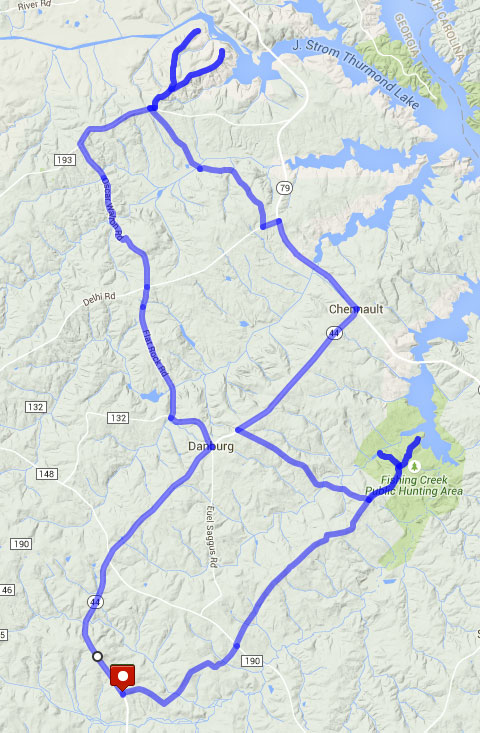
The route, which I described here, here, and here. 

The early spring wildflowers have finished blooming; it’s time to watch the developing fruit. A few late spring/summer wildflowers were blooming.

Fruit were developing on the Buttonbushes (Cephalanthus occidentalis).


Looking back along the lake from the Fishing Area.

The Carolina Wild Petunia (Ruellia caroliniensis) had finally finished blooming. In the ‘Rock Garden,’…


the seed capsules on the Wild Yam (Dioscorea villosa) were still doing well.


The Resurrection Fern (Pleopeltis polypodioides) on a tree trunk in the Rock Garden was still dried; two weeks now.


A seed capsule on an Eastern Sweetshrub (Calycanthus floridus) was hiding behind the leaves but wasn’t showing any signs of ripening.


Smooth Yellow False Foxgloves (Aureolaria flava) were still blooming in the shade of the woods.


The Perfoliate Bellwort (Uvularia perfoliata) plant, that had released its seeds, was still standing but completely dried. 

In the woods just behind the Perfoliate Bellwort, a...


spider, a Basilica Orbweaver (Mecynogea lemniscata), had spun a large web, and…


attached five egg cases to it. (Thanks to Bug Guide for this identification).

A little further along the trail,…


buds were developing on a Cranefly Orchid (Tipularia discolor). It woudn’t be long before they were open.


The Swamp Rosemallow (Hibiscus moscheutos) had finished blooming and were developing many seed capsules, one of which had already…


ripened and opened.


Seeds in a segment of a ripened capsule. 

On the walk back to the Fishing Area, I found a…


Cranefly Orchid in bloom beside the trail.


The final spotting for the day was an Appalachian Brown (Satyrodes appalachia) butterfly; a beautiful creature and the second that I’d seen on this trail this year. 

This may have been the ‘quietest’ along this trail so far this year, but it did have its high points. 

Related posts: 

Saturday, August 1, 2015

Road Trip: Wilkes – McDuffie Counties, June 26th, 2015 (Part 1)

June 26th. Once again, it was time for a road trip to monitor frogs. So, as usual, we used the trip to scout wildflowers.
We started the trip at the west end of Enoch John Road. On the section of road between Danburg Road and Anderson Mill Creek, I think I spent more time at the edge of, straddling, or in roadside ditches while photographing flowers.

There were the ‘usual suspects,’…


Lanceleaf Coreopsis (Coreopsis lanceolata),…


Starry Rosinweed (Silphium astericus),…


Hairy Angelica (Angelica venenosa), and


Heal-all (Prunella vulgaris).


A wild petunia, that I expected would be the Carolina Wild Petunia (Ruellia caroliniensis), turned out to be the Stalked Wild Petunia (Ruellia pedunculata); a nice surprise.

At the Anderson Mill Swamp, I found a…


Passionfruit (Passiflora incarnata) in bloom.


I was hoping that the Broadleaf Arrowhead (Sagittaria latifolia) would be in bloom, but alas not. 


A Zebra Swallowtail (Protographium marcellus) teased me for some time, flying back and forth along the road. 


From the Anderson Mill Creek swamp, we drove east to the swamp on the unnamed tributary to Fishing Creek.


The dam, repaired by the beaver, was holding. The large ‘bed’ of…


American Lotus (Nelumbo luteo) was thriving. We satisfied ourselves with admiring the…


flowers from the road. 


A small skipper, a Least Skipper (Ancyloxypha numitor), feeding on a


Bull Thistle (Cirsium vulgare). 


Then I noticed the…


leaves, and then the…


flowers of an Angularfruit Milkvine (Matelea gonocarpos). 


Then, on the other side of the road, I found another vine, climbing up a blackberry cane that had a…


Blackberry Knot Gall. This vine had even…


more flowers. 

(To be continued…)

Tuesday, May 26, 2015

Spring Walk At Fort Yargo State Park: Shelter A To The Old Fort, May 11th, 2015 (Part 1)


May 11th. I started to walk again at Fort Yargo State Park in Winder, Georgia. One of my favorite walks is from the Group Shelter A to the Old Fort and back.This is a rewarding walk for viewing wildflowers and I’ve been trying to walk it weekly and document the wildflowers I see.


The route, which I described here, here, and here.


The first part of the trail is through woods that are very shady and cool.


The first wildflower of the day was Venus’ Pride (Houstonia purpurea); there were only two plants. This is the first time that I had seen this flower.


The Strawberry Bush (Euonymus americanus) was still blooming.


A Blackgum (Nyssa sylvatica) was setting flower buds.


As I walked past the bench just beyond the Strawberry Bush, I startled a damselfly. It’s a juvenile that I haven’t been able to identify. It was remarkably ‘tame’ and posed for several photos before I left to check on the…


Redring Milkweed (Asclepias variegata) plants. The flower buds were still developing; they would probably be opened by the next time I walked this way.


A Red-spotted Purple (Limenitis arthemis) was sunning itself.


Approaching the first bridge, and…


crossing it.


Pipsissewa (Chimaphila maculata) flower buds were still developing nicely.


Berries were developing on Deerberry (Vaccinium staminium) bushes just beyond the first bridge.


The large seedpod was still developing on the Eastern Sweetshrub (Calycanthus floridus) bush. The second flower stem that looked promising originally, was starting to wither; obviously, it wont develop any further.


Rattlesnakeweeds (Hieracium venosum) were still in full bloom.


Some seed capsuled were definitely developing on the witchhazel. It looked like about nine or ten capsules were developing, a small number compared with the number of flower stalks on the plant.


The gall on the young witch hazel bush had developed further; it was a Witch Hazel Cone Gall caused by the Witch-hazel Cone Gall Aphid (Hormaphis hamamelidis).


The Christmas Ferns (Polystichum acrostichoides) above the cliff were starting to fruit.


Berries were still developing on the Elliott’s Blueberry (Vaccinium elliottii) plant but none were showing signs of ripening yet.


I took some time to check one of the Hazel Alder (Alnus serrulata) bushes by the water. The seed cones, that had remained unchanged for several months, were starting to swell.


A flower on one of the Green Arrow Arum (Peltandra virginica) had opened. It was lying on the soft mud so I couldn’t reach it. It doesn’t look like it had started to release pollen.

The Common (Sisyrinchium angustifloium) and Needle-tipped Blue-eyed Grasses (Sisyrinchium mucronatum) had bloomed. I’d been waiting for another blue-eyed grass, the…


Annual Blue-eyed Grass (Sisyrinchium rosulatum) to bloom. These bloom in the grass at the point in the Fishing Area. 

I had remembered that I’d seen…


Carolina Wild Petunia (Ruellia caroliniensis) blooming close by. I checked and found a plant just starting to bloom at the edge of a patch of Poison Ivy (Toxodendron radicans). This must have been the first flower of the season. It was white; usually these flowers are a light mauve. I expected that later flowers would be mauve.


And then off into the Rock Garden… 
(To be continued…) 

Related posts: