The route… I’ve described it here, here, here, and here This walk doesn’t have the variety of wildflowers as my other
walk from the Group A Shelter to the Old Fort but it does have some gems. One
of the Smallflower Pawpaw (Asimina
parviflora) had developed fruit that, unfortunately, it had lost; the Pink
Lady’s Slipper (Cypripedium acaule)
Orchids had bloomed, and some Green Adder’s-mouth (Malaxis unifolia) Orchids had bloomed and two were setting seeds.
The occurrence of slime mold fruiting bodies added a new focus of interest for
this walk.
Before I started back along the return trail, I wandered
around the area at the west end of the dam.


A Winged Sumac (Rhus
copallinum)
was beginning to bloom. I didn’t know it was a Winged Sumac at the time. I’ve
always been confused by sumacs but, it turns out, this one gives itself away.
It has…

narrow wings - ‘strips’ of leaf-like tissue – along the
stalk between the leaflets.

The Bigroot Morning Glory (Ipomoea pandurata) vine was still blooming in the shade at the edge
of the woods.

My next stop was the Hairy Angelica (Angelica venenosa). Seed capsules were starting to develop but a
little surprise was waiting for me, literally. A…


Swift Crab Spider (Mecaphesa celer) was hunting on the top of the flower head. Many adult
Swift Crab spiders are brightly colored but immature spiders are almost
colorless. This spider was still mostly colorless.
I didn’t see this spider at first; it was
perfectly camouflaged for the location it had chosen to hunt. Interestingly, among
the many genera in the Crab Spider family Thomisidae, there are three genera – Misumena, Misumenoides, and Mecaphesa
– that we find hunting on flowers. Spiders in these genera may be differentiated by
the arrangement of the eyes; mecaphesas are also hairy.

My favorite tree was bathed in sunlight.

A couple of bright red mushroom caught my attention. They
looked like they had been coated in red varnish. I guessed they were boletes –
mushrooms that have pores instead of gills. There were several in the area, so
I turned one over to take a closer look. Its …

pore surface was bright red and the stem had coarse
reticulations. This was a very striking mushroom and it was relatively easy to
identify as Frost’s Bolete (Boletus
frostii).

The seed capsules were still developing on the New Jersey
Tea (Ceanothus americanus).

The Oak Apple Gall had a tiny hole in it.

The Green Arrow Arum (Peltandra
virginica) fruit were still healthy.


A log lying across a small gully at the lake’s edge was
covered with mushrooms; their caps were about an inch in diameter. These fit
the description of Fuzzy Foot (Xeromphalina
campanella) mushrooms but I couldn’t get close to them.

Bicolor Lezpedeza (Lespedeza
bicolor) bushes were still blooming. These bushes grow in an area that gets
sun until early afternoon.


I found more ‘Honeycomb’ Coral Slime (Ceratiomyxa fruticulosa var. porioides) fruiting bodies on an old
rotting log by the trail on the north section of the trail.

The seed capsules were still developing on the Perfoliate
Bellwort (Uvularia perfoliata) plant.
A little way off the trail, I found a…


Dog Vomit (Fuligo septica) slime mold fruiting body that was
a pale green.

Another lone Hairy Elephantsfoot (Elephantopus tomentosus) was blooming by the trail.

I found this cluster of pretty mushrooms growing at the base of a
hardwood tree. I didn’t want to disturb this cluster so I turned over a…

smaller mushroom. The cap was convex when the mushroom was
young but later inverted into a vase shape; the gills started to run down the
stem and there was some evidence of cross gills. At this time, I haven’t been
able to identify it.

The seed capsules on the Green Adder’s Mouth Orchids (Malaxis unifolia) were still developing.
I made my way up to the top of ‘The Hill’ in the hope that I
might find some more slime mold fruiting bodies. I wasn’t disappointed.

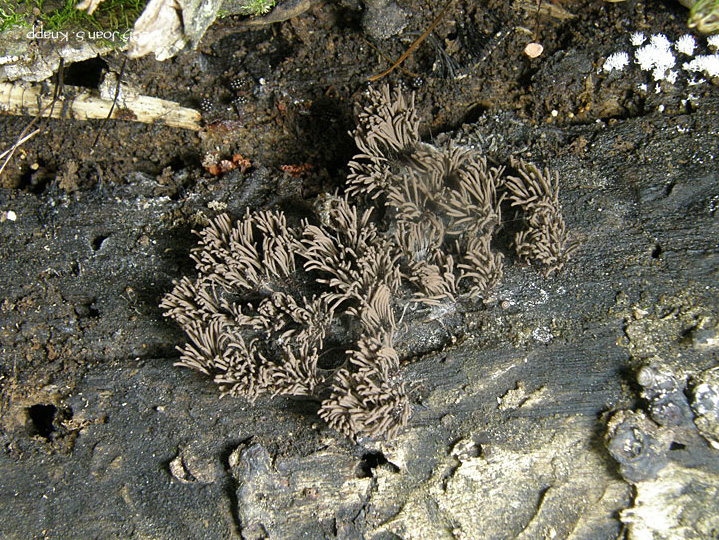
I found Chocolate Tube (Stemonitis
sp.) slime mold fruiting bodies on one end of a log. These had formed…

very
recently; the tubes…

hadn’t
had time to separate. These were the nicest fruiting bodies I’d seen to date.
On
another log, I found the…

Many-headed
slime mold (Physarum
polycephalum) forming fruiting bodies.

A closer
view. This was the first time I had seen this slime mold.

Another Dog
Vomit fruiting body
had formed on yet another log. Some of the plasmodium had settled on a pine
needle and formed a…

From the Hill, I walked back to the open area. I spotted a…

Sleepy Orange (Abaeis
nicippe) butterfly.

Brazilian Vervain (Verbena
brasiliensis) had been flowering along the open section of trail for some
time. On the other hand…

Spotted St. John’s Wort (Hypericum
punctatum) flowers for a relatively short time along the final section of
the trail.
Related posts:
- Spring Is In The
Air: Fort Yargo State Park, Section B To The Dam, May 1st (Part 2)