Showing posts with label Scull Shoals EF. Show all posts

Friday, February 22, 2013

Just Poking Our Heads Up To See If It’s Safe To Come Out


February 20th, 2013. After finding the Trillium cuneatum at the Broad River Wildlife Management Area, we stopped by the Scull Shoals Experimental Forest in Greene County, Georgia, to see if the these were coming up there. This location is a little higher (460 ft above sea level) compared with the Broad River WMA site (425 ft above sea level) although it is affected more by the weather fronts coming from the Artic than the Broad River WMA site.

At this location, a cluster of trilliums grows on the west side of a tree in a sheltered location. Others grow in the open beside the road.  We didn’t see any obvious sign of plants in the open and wandered over to the tree.

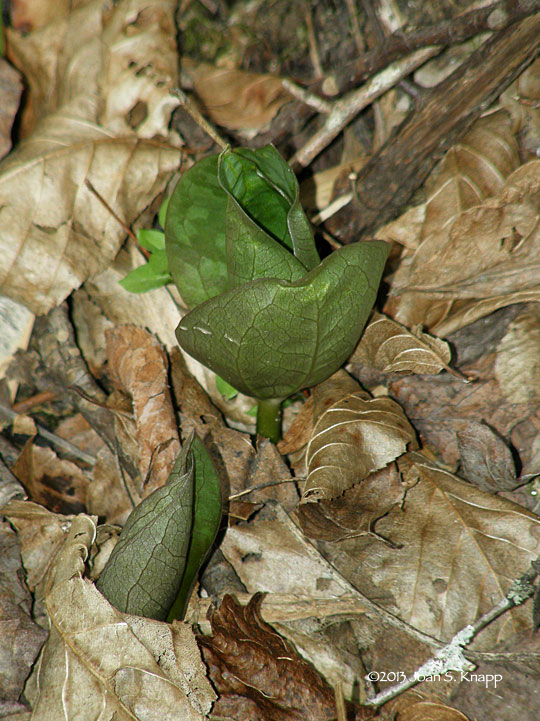
The tree… Looking closely, we found a number of plants just poking their heads up through the leaves. It would be so easy to trample the plants at this stage. Since we knew where they grew in this area, we were able to approach them without risking damaging them.

This one has emerged but the leaves haven’t really started to unfurl but…

It did give us a great opportunity to see the veining on the underside of the leaves. (Another trillium is opening just behind and to the right of this one).

The characteristic color pattern of Trillium cuneatum is visible on the top of the leaves of this plant.

The stalk is visible on this plant. Plants in this location are relatively large and have long stalks.

These two plants were the most developed and let us see even younger flower buds than we had seen on the plants at the Broad River WMA.

A closer view.

This is what they’ll look like a a few weeks. These were photographed last year.

Trillium cuneatum is known by the common names Little Sweet Betsy, Purple Toadshade, Whippoorwill Flower, and Large Toadshade. It is stalked, had mottled leaves and erect flowers that are purple to brown. The anthers and stamen are a characteristic maroon and gold. This species is found in the eastern United States from Pennsylvania and Illinois south and southeast to Georgia, Alabama and Mississippi. In Georgia, they are found more frequently in counties in north Georgia and in other areas in the state.

It wasn’t surprising that only a few trilliums had emerged in this location. The plants
at the base of this tree were not only protected from the cold but were bathed with warm sunshine in the afternoon, making this a slightly warmer location than the open areas where the other trilliums grow. It won’t be long, however, before the other plants also emerge to bloom again.
Click on an image to view a larger image

Identification resources:
- Native and Naturalized Plants of the Carolinas and Georgia: Trillium cuneatum (Little Sweet Betsy, Purple Toadshade, Whippoorwill Flower)

Distribution:

Related posts:

Wednesday, October 10, 2012

Yellowjacket Hover Fly (Milesia virginiensis)


September 7th, 2012. We stopped by our favorite spot in the Scull Shoals Experimental Forest in Greene County and were lucky to see one of my favorite insects, the…

Yellowjacket Hover Fly (Milesia virginiensis). These are big flies that mimic wasps. This one had stopped to rest for a few minutes before it moved on.
Click on an image to view a larger image

Identification resources:
- BugGuide: Yellowjacket Hover Fly (Milesia virginiensis) {Male] [Female] 

Related post:

Tuesday, August 28, 2012

Tall thistle (Cirsium altissimum) And Friend

August 17th, 2012. Tall Thistles (Cirsium altissimum) are blooming at the moment. Most plants are only 4 to 5 feet tall. Every now and then, we spot a truly tall plant as we did in the Scull Shoals Experimental Forest in the Oconee National Forest a couple of weeks ago. These photos were taken in the Oconee National Forest in either Greene or Oglethorpe counties.
 

 This plant was 10 to 11 feet tall. Last Saturday (8/25/2012) we saw a couple of plants at the Piedmont National Wildlife Refuge yesterday that were 7 to 8 feet tall but the plant at in the Scull Shoals EF has been the tallest we’ve seen this year.

 *****

Compared with the leaves most Cirsium species, the leaves of C. altissimum are smooth

 *****


 *****


 A developing buds

  *****

Opened flowers


A spent flower


A male Zabulon Skipper (Poanes zabulon) was feeding on one of the flowers.

Cirsium altissimum (Tall Thistle) is native of the United States where it’s found in states east of a line from Minnesota to Texas. In Georgia, it’s found in counties in the Piedmont.
Click on an image to view a larger image

Identification resources:
- Name that Plant: Native and Naturalized Plants of the Carolinas and Georgia: Cirsium altissimum (Tall Thistle)
- Missouri Plants: Cirsium altissimum

Distribution:
- United States Department of Agriculture Plants Database: Cirsium altissimum (Tall Thistle)
- University of North Carolina Herbarium: Cirsium altissimum

Saturday, July 14, 2012

Scull Shoals Experimental Forest: Just Checking In


July 6th, 2012. We made our almost-weekly stop at Scull Shoals Experimental Forest. Usually, we can drive to the end of the road to a turn-around and drive back out. But on the 6th… 


we found the road blocked by a fallen tree trunk. It was a snag and much of the wood was rotten. But the trunk was probably about 18 inches in diameter and too large to move. So we satisfied ourselves by climbing over it and walking a little way up the road. We could check a couple of plants we have been following and were treated to a variety of wildflowers and insects.


We’d just had rain after a long drought and ants had to clear their tunnels of sand that had washed into them. There weren’t any ants in sight; just the evidence of their housekeeping.


This Jack-in-the-pulpit (Arisaema triphyllum) is about three feet high now and had five suckers this year. It’s long since finished blooming for the year and one of its suckers is developing seeds.

*****

Passionflowers vines (Passiflora incarnata) are blooming. Insects are feeding and inadvertantly fertilizing the blooms.

*****

Angularfruit milkvines (Matelea gonocarpos) vines are blooming. It’ll be interesting to see if any develop seedpods this year.


A Hoary Edge (Achalarus lyciades) skipper was flitting from bloom to bloom, feeding on the last of the Heal All (Prunella vulgaris) plants still blooming. This butterfly wasn’t posing for photos and wouldn’t let me get a good shot of the top of its wings; I’ve posted some photos of this butterfly previously.


Six-spotted Tiger beetle (Cicindela sexguttata). Several of these beautiful beetles were scurrying around the road and they weren’t posing for photos either. I had to make do with a zoom shot which I’ve enlarged here.


A robber fly. I don’t know what species this is. It, also, was nervous about being approached but allowed me to get this photo.


One of several Eastern Tailed-blue (Cupido comyntas) along the road was folding its wings as soon as it landed. And last, but not least, a…


Slaty Skimmer (Libellula incesta) had a favorite perch just where we parked the pickup.

All-in-all, it was a fruitful stop even if we couldn’t get to the end of the road. Hopefully next time we visit, the snag will have been cleared from the road. It’s a long walk to the Green Comet Milkweed (Asclepias viridiflora) flowers we’re following.
Click on an image to view a larger image

Identification resources: 
 Southeastern Flora:

Bug Guide:
- Slaty Skimmer (Libellula incesta)

Related post:

Saturday, July 7, 2012

Damselfly: Fragile Forktail (Ischnura posita)

June 22rd, 2012. I was photographing a small wildflower by a road in the Scull Shoals Experimental Forest when I noticed some movement among the leaves a few inches above the ground. This usually means some small insect whose identification I have no chance of making. But this time, there were a couple of small damselflies not more than an inch in length flying stealthily from leaf to leaf. They’d settle on leaves unless disturbed so we had several opportunities to photograph them.

For once, it was relatively easy to identify them. The ‘exclamation mark’ pattern on the thorax is diagnostic for the Fragile Forktail (IIschnura posita). One had blue markings and the other had cream markings.


A view to give a relative size of the damselfly.

*****
 *****

Closer views of the ‘blue’ male resting on a leaf.

*****

Closer views of the ‘cream’ male resting on a leaf.


This damselfly is munching on a smaller insect it caught.
Click on an image to view a larger image

 Identification resources: 
- Dragonflies and Damselflies (Odonata) of Georgia: Fragile Forktail (Ischnura posita) 
- Giff Beaton, Pond Damsels (Coenagrionidae): Fragile Forktail (Ischnura posita) 
- Fairfax County Public Schools: Fragile Forktail (Ischnura posita) 
- BugGuide: Fragile Forktail (Ischnura posita) [Male-Cream] [Male-Blue]

Wednesday, June 20, 2012

I’m Just A Lowly Cabbage White, But I’m A Pretty Cabbage White

May 26th, 2012. The Cabbage White (Pieris rapae) butterfly is quite common. It occurs throughout Georgia from mid-March to early November. For all that, it’s not an easy butterfly to photograph. It tends to be on the move so we took the opportunity to photograph one that was feeding on wildflowers in the Scull Shoals Experimental Forest in Greene County, Georgia.

In the sun…

In the shade…

Up close.

It was nice to have an opportunity to see this common but somewhat elusive butterfly up close.
Click on an image to view a closer image


Identification resources:

- Butterflies and Moths of North America: Cabbage White (Pieris rapae)

- BugGuide:
Cabbage White (Pieris rapae) [Male] [Female] [Side]

Related post:

- Butterfly: Cabbage White (Pieris rapae)

Monday, June 18, 2012

Dragonfly: Gray Petaltail (Tachopteryx thoreyi)

May 18th, 2012. I was wandering back to the truck, a little despondent over repeated, but failed, attempts to photograph a Red Admiral (Vanessa atalanta) butterfly. I wasn’t paying much attention to anything when I became aware of something rather large flying directly towards me. I was aware that it was a dragonfly.

Now a lot of dragonflies along this road fly like small stealth helicopters – hardly noticeable unless you’re looking for them. Others are gregarious and dart around at high speed. But this dragonfly seemed to be traveling in slow motion, lumbering along like a huge cargo plane coming in to land. Time seemed to stand still. And then it landed *on* me. Not on my front, but down on the side of my shorts, towards the back.


I figured I’d get one shot. I switched from the zoom to macro setting. Then I held the camera as close as I dared. I couldn’t get a look at the viewfinder. I just had to aim the lens in the general direction of the dragonfly, hold the focus button long enough for the lens to focus and take the shot.

Not bad! And I was right. This was the only shot I got. When I started to turn slowly, it flew off. At first I thought it was one of the big stream cruisers but when that didn’t pan out, I searched for a name that included ‘gray’ and there it was. A Gray Petaltail (Tachopteryx thoreyi). A once-in-a-lifetime shot – or close to it.

Gray Petaltails are usually hard to spot because they frequently land on tree trunks and blend into the background. In Georgia they occur throughout the state between late March and late July.

Click on an image to view a larger image


Identification resources:
- Dragonflies and Damselflies (Odonata) of Georgia: Gray Petaltail (Tachopteryx thoreyi)

- BugGuide: Gray Petaltail (Tachopteryx thoreyi)
[Side] [Top]

Monday, June 4, 2012

Dragonfly: Blue Dasher (Pachydiplax longipennis)

May 4th, 2012. There is a turn-around at the end of one of the gravel road we frequent in the Scull Shoals Experimental Forest in the Oconee Wildlife Management Area in Greene County, Georgia. We’ve seen a lot of dragonflies along this road this year: Spangled Skimmers (Libellula cyanea), Common Whitetails (Plathemis lydia), Eastern Pondhawks (Erythemis simplicicollis).

We see quite a number of male Blue Dasher dragonflies during the year but very few females. On May 4th, we saw a single, shy female which permitted a couple of shots before she flew off into the woods.

A male Blue Dasher, photographed in Jasper County, Georgia in 2011.

*****
The female Blue Dasher. She was a pretty creature. I wish we saw more of them.

Blue Dashers are one of the more common dragonflies in Georgia, occurring throughout the state between mid-March and mid-November.

Click on an image to view a larger image


Identification resources:
- Dragonflies and Damselflies (Odonata) of Georgia
: Blue Dasher (Pachydiplax longipennis)
- BugGuide: Blue Dasher (Pachydiplax longipennis)
[Male] [Female]

Related post:

- Blue Dasher: Up Close And Personal

Sunday, May 13, 2012

Pipevine Swallowtails (Battus philenor) At Scull Shoals

The gravel road in the Scull Shoals Experimental Forest by dragonflies sunning themselves and butterflies sipping minerals from the gravel. Our encounters with them are often brief but, on this afternoon, we were treated to a 10-minute encounter between two Pipevine Swallotails (Battus philenor).

*****
This one arrived first and set about drinking the minerals. It opened and closed its wings repeatedly, and then sat for a while with…

Its wings extended, soaking up the warmth. It’s interesting that the color and pattern on the wings appeared different from different angles. We could identify this butterfly because it had lost one of its tails.

After about five minutes, a second butterfly arrived, and began to…

interact with the first butterfly. Both are males; neither has the row of spots along the back edge of the forewing which is present in the female.

This second male had a more distinct pattern than the first and both of its tails were intact.

The second male began to follow the first.

The second male is still following the first and it’s impossible to tell them apart based on their patterns and colors. The only way to tell them apart was the fact that one had lost one of its tails. After a while…

*****
The first male began to follow the second.

*****
Then, as if square dancing, they sashayed for a few minutes before…

the first male flew away into the woods and left the second male alone. An interesting peaceful, social encounter.
Click on an image to view a closer image


Identification resources:

-
BugGuide: Battus philenor (Pipevine Swallowtail) [Male] [Female]
- Michael Beohm, West Central Georgia Butterflies:
Pipevine Swallowtails (Battus philenor)

Related posts:
- April: Butterfly Afternoons At Scull Shoals

- Pipevine Swallowtail (Battus philenor)