Showing posts with label Fungus. Show all posts

Tuesday, January 19, 2016

Trembling Merulius (Phlebia tremellosa)


September 11th – 14th. Trembling Merulius (Phlebia tremellosa) is one of more than 100 species of crust fungi that grow as ‘resupinate’ or flat sheets. This fungus develops as flat sheets and some form extensions that curl over to form a small cap. tremellosa. 

I had seen patches of a brown fungus on this dead hardwood log but had never seen any evidence of fruiting. I might not have looked closely at them on this day except for the fact that they were cream rather than brown.


The patches of fungus – one to two inches wide/long - were made up of white margins surrounding areas of convoluted folding, termed ‘meruloid’ folding. This folding is the fruiting surface.

I planned to follow the development of these fungi, that probably turned a deeper pink or orange, but found that they were completely dry and brown three days later on September 14th


Before (fruiting) and after images of two flat patches of this fungus, and…


before and after images of one patch that had developed a primitive cap. 

From this experience, it’s clear that next time I see this fungus in the fruiting stage, I’ll have to follow it on a daily basis to see the transition from fruiting to dormant.

Note: This fungus gets its common name from its former scientific name, Merulius tremellosus. It has since been transferred from the genus Merulius to the genus Phlebia, becoming Phlebia tremellosa.

References: 
- Mushroom Expert, M. Kuo. (2008, December): Phlebia tremellosa 
- Messiah College: Phlebia tremellosa 
- Mushroom Observer, Joan Knapp: Phlebia tremellosa

Saturday, January 16, 2016

Lion's Mane (Hericium erinaceus)


September 9th -11th. On September 9th, I found a small…


Lion’s Mane (Hericium erinaceus) fungus growing on a fallen log near the Fishing Area in Fort Yargo State Park. This was the first Lion’s Mane I had ever seen.


It was a young specimen, only four to five inches long.


Its teeth were just starting to grow out. This would require another visit in a few days, not another week, to photograph again. 

I returned on September 11th to photograph it again.


Photographed with artificial light, and…


photographed with natural light.


Its teeth had grown to a little more than 1 inch in length.

I was hoping to follow its development but when I returned on September 14th, it was gone, probably collected since they are considered a delicacy by people who collect wild mushrooms/fungi. Just a reminder that it is illegal to collect plants, fungi including mushrooms etc. in State Parks in Georgia.

References
 - Mushroom Expert. Kuo, M. (2013, March). Hericium erinaceus 

Related posts:

Tuesday, November 17, 2015

Summer At Fort Yargo State Park: Shelter A To The Old Fort, August 25th, 2015 (Part 1)


August 25th. I started to walk again at Fort Yargo State Park in Winder, Georgia. One of my favorite walks is from the Group Shelter A to the Old Fort and back.This is a rewarding walk for viewing wildflowers and I’ve been trying to walk it weekly and document the wildflowers I see.


The route, which I described here, here, and here.
 
The early spring wildflowers have finished blooming; it’s time to watch the developing fruit. Summer wildflowers were still blooming but it was time to turn attention to the fungi in the woods.

The first thing I saw near the beginning of the trail was surprising; slime mold fruiting bodies.


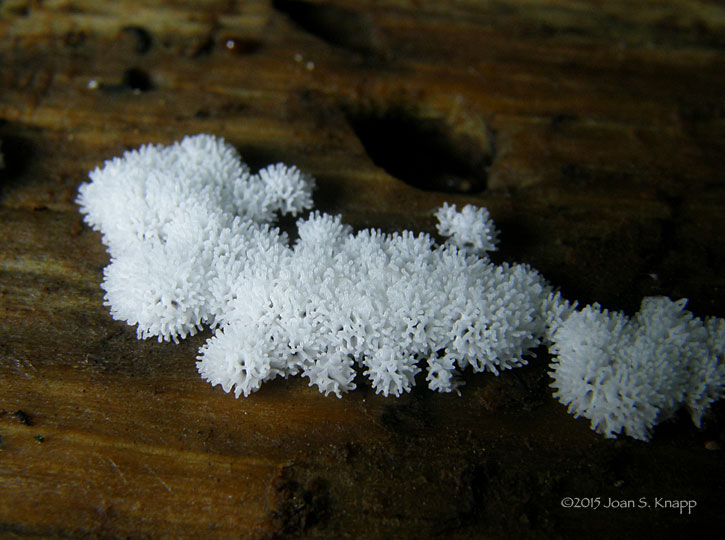
A cluster of ‘Honeycomb’ Coral Slime (Ceratiomyxa fruticulosa var. porioides) fruiting bodies had formed at the base of an old pine stump. This is one of my favorite slime molds although it’s hard to appreciate its structure when the fruiting bodies are mature and releasing their spores. Nevertheless, I was excited to see them.


A little further along the trail, I spotted a eupatorium a little distance from the trail. Closer inspection showed it was a single Roundleaf Thoroughwort (Eupatorium rotundifolium) plant in bloom. It was the only plant of this species that I’ve seen in the park. I’m afraid that the trees are going to shade it out. 

On the other side of the trail, still in the pine forest, I found a ‘new’ mushroom.


Superficially, it was similar to the Ornate-stalked Bolete (Retiboletus ornatipes) but the cap was a deeper color (although not as deep a red as I have seen since.) This mushroom was also a bolete with pores instead of gills. Unlike the Ornate-stalked Bolete, this mushroom had a reddish color under the ornate stem. This was the Shaggy Stalked Bolete (Heimioporus betula). 

Just beyond the pine forest, there are three old logs, probably pine, that are covered with small bracket fungi. I had to stop and take a closer look at them. There were at least two different types of fungi on these logs.


The first type were dark with light margins.


Their undersides were covered with pores. These were Turkey Tails (Trametes versicolor). Turkey Tail fungi can vary widely in color patterns.


Nearby were small bracket fungi that looked similar in shape and also had concentric color patterns. It would be easy to call them Turkey Tails but their


undersides had gills, not pores. These are called Gilled Polypores (Lenzites betulina).


Flowering Spurges (Euphorbia corollata) were still blooming in the open woods just beyond the pine forest.


The Virginia Meadowbeauty (Rhexia virginica) were also still blooming at the lake’s shore.


The fruit on the Strawberry Bush (Euonymus americanus) had developed a litle more pink color but they were still far from ripe.


The Small Wood Sunflower (Helianthus microcephalis) plants were still blooming in the shade along this section of the trail.


At the edge of the open woods, I found this small cousin of the Partridge Pea (Chamaecrista fasciculata) that grows along roadsides. This plant is the small Sensitive Partridge Pea (Chamaecrista nictitans). The plant was about 12 inches tall. In my experience, it’s unusual to see the the flowers fully open, but I was lucky enough to find one on this plant. 

I made my way along to the open area under the power line where a flash of red caught my eye.


It took me a couple of seconds to realize I was looking at fruit on another, large Strawberry Bush. These fruit were further along than those on the bush in the shade. 

Below them, closer to the water,…


a Perennial Wildbean (Strophostyles umbellata) was still blooming, as were…


Groundnut (Apios americanus),…


Pigeonwings (Clitoria mariana) and…


Spurred Butterflypea (Centrosema virginianum) vines.

From here, I walked along to the ‘first’ bridge.
(To be continued…) 

References: 
- Mushroom Expert. Kuo, M. (2010 March). Heimioporus betula. 
- Mushroom Expert. Kuo, M. (2005 March). Trametes versicolor. The turkey tail. 
- Mushroom Expert. Kuo, M. Lenzites betulina. The Gilled Polypore. 

Related posts: 

Sunday, November 1, 2015

Little Nest Polypore (Poronidulus conchifer)


August 21st. I spotted these polypores on a small branch that had fallen during a recent storm.


From a distance, it was clear that they were something that I had never seen before, and not something that I would mistake for another fungus.


The mature polypores were approximately 1 to 1.5 inches ‘wide’ and 1 inch ‘deep.’ The ‘main’ polypores were a very pale cream color with zones of darker color. They were attached to the branch by a short ‘stem.’ Most of the large polypores had a small ‘cup’ at the point of attachment of the polypore to the branch. These cups were 0.25 to 0.75 inches wide, and had concentric zones of cream and dark browns or grays.


Further along the branch were small cups that didn't have the larger polypres.


The pores on the underside of the brackets were clearly visible to the naked eye in stark contrast to the pores on a Turkey Tail (Trametes versicolor) bracket. The pores were approximately 0.5 mm in diameter, angular, and irregularly shaped.


The caps also had pores of the same size as the larger polypore. 

It didn’t take long to identify these as the Little Nest Polypore (Poronidulus conchifer). These fungi are sometimes called Trametes conchifer in some field guides, but they have been assigned to their own genus. 

Poronidulus conchifer polypores grow on branches, stumps, and logs east of the Great Plains in North America.  The small caps develop first, and the larger polypore develops later. As they age, the small caps fall off, leaving the larger polypore. Aged polypores lose their color, and are stark white. It is rare to find photographs of fresh specimens.

So far, I have seen them on recently fallen branches in Barrow and Walton counties in Georgia. I have also weathered polypores on branches that had fallen in previous seasons.

Reference;
Kuo, M. (2010, March). Poronidulus conchifer.