May 26th, 2012. There’s a tiny granite outcrop by a rural road in Greene County that we visit regularly throughout the year. It’s on our way back from Hancock County. It’s probably not much more than 50’ x 20’ in area but it has some of the essential granite outcrop plants; Appalachian Stitchwort (Minuartia glabra), Elf Orpine (Diamorpha smallii), Grimmia moss, lichen and last, but not least, fairly large areas of Appalachian Fameflower (Phemeranthus teretifolius).
The Appalachian Fameflower is fascinating because flowers don’t open until late afternoon and then only for a few hours. If the flower is not fertilized by a passing insect while it is open, it will self-fertilize. We first saw this plant in bloom at the Rock and Shoals Natural Area near Athens in 2011. The flowers were closed when we arrived at the granite outcrop at 4:30 pm. As we photographed what we thought were buds, the flowers began to open until they were completed open after about 10 minutes.
Then, late last year, we found them at the granite outcrop in Greene County. Last week, we stopped by the outcrop. We couldn’t see the plants from the truck but when we got out, we could see carpets of the succulent leaves that heralded their ‘arrival’ again this year. Yesterday we stopped by again. The flowers weren’t immediately visible but, again, when we walked over to the outcrop we could see that the plants were blooming.
 A small area carpeted with the fameflower plants.
 A close up of the plant. This is a perennial and the black stub at the base of the succulent leaves is evidence that these plants are several years old.
 An individual plant in bloom. The flowers are only about 1/2 inch in diameter.
 A couple of flowers.
 A single flower in profile. Individual flower stems may have several flowers. Developing buds are visible below the open flower.
 *****
***** Individual flowers
 This Variegated Fritillary (Euptoieta claudia) was actively working this patch of flowers and probably pollinating it at the same time.
Phemeranthus teretifolius is one of two Phemeranthus sp. that may be found in Georgia and the Carolinas. Phemeranthus teretifolius is known by several common names: Quill Fameflower, Appalachian Rock-pink, Appalachian Fameflower, or Rock Portulaca. Phemeranthus teretifolius is native to the United States: From Pennsylvania, Maryland, West Virginia, Kentucky, Tennessee, the Carolinas, Georgia and Alabama. Phemeranthus teretifolius is distributed more widely in the Piedmont in Georgia than is Phemeranthus mengesii.
Click on an image to view a larger image
Identification resources:
- Natural and Naturalized Plants of the Carolinas and Georgia: Phemeranthus teretifolius (Appalachian Rock-pink, Appalachian Fameflower, Rock Portulaca)
- Carolina Nature: Appalachian Rock-pink, Talinum - Phemeranthus teretifolius
Distribution Map:
- United States Department of Agriculture Plants Database: Phemeranthus teretifolius (Quill Fameflower)
- University of North Carolina Herbarium: Phemeranthus teretifolius
Related post:
- Appalachian Fameflower (Phemeranthus teretifolius)http://anybodyseenmyfocus.blogspot.com/2011/05/appalachian-fameflower-phemeranthus.html
March 23rd, 2012. We had a few hours. The weather wasn’t great but we felt like getting out. So we drove one of the back roads in Wilkes County, Georgia. We drove out to Lexington on US-78 and turned north on GA-77 to the road marked as the Saxon-Mattox Road. It’s the last road before the Broad River crossing. This road runs from Saxon to Norman and then to Broad. On DeLorme’s Georgia Atlas & Gazetteer, the road begins as Goose Pond Road and then becomes CR-113 to Norman. The section from Norman to Broad is Norman Rd NE. We didn’t really expect to see much but we were really in for a pleasant surprise. This road runs roughly parallel to the Broad River through dry pine and deciduous forests. Periodically the road dips to cross creeks that drain into the Broad River.
We encountered the spring beauties in the moist areas on either side of the creeks. Their pink, cup-shaped blooms were clearly visible above the grass by the side of the road and in the adjacent fields.
 The plants themselves appeared insignificant. It was difficult to distinguish the leaves from the grass blades because Claytonia virginica has such slender leaves. Note the Poison Ivy to the left of the claytonia; it's that time of year again!
 A side view of the plant showing the raceme arrangement of the flowers
 *****
**********
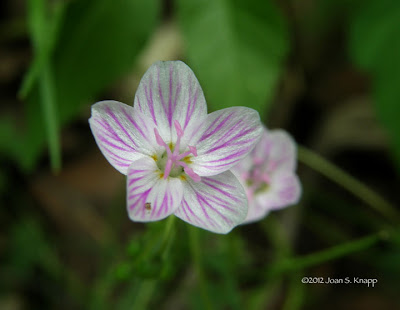 Closer views of the flowers.
 *****
***** Variations in the shape of the petals of some flowers.
Claytonia virginica is native to the United States and is found from Quebec to Texas. In Georgia, it has been found in several counties across the state although not in the coastal plain counties. It has not been documented in Wilkes County although, clearly, it occurs there. We found it in the surrounds at every creek crossing along this road. Although usually called Spring Beauty, I prefer the name Virginia Springbeauty to differentiate this species from the 28 Claytonia species that may be found in the United States
Click on an image to view a larger image
Identification resources:
- Southeastern Flora: Claytonia virginica (Spring Beauty)
- Name that Plant:
Claytonia virginica (Spring Beauty)
Distribution:
- University of Norh Carolina Herbarium: Claytonia virginica- USDA Plants Database: Claytonia virginica (Virginia Springbeauty)
Related post:
- Saxon-Norman-Broad, Wilkes County, Georgia: Prostrate Blue Violet, Green-and-gold & Trumpet Honeysuckle
 A small area carpeted with the fameflower plants.
 A close up of the plant. This is a perennial and the black stub at the base of the succulent leaves is evidence that these plants are several years old.
  An individual plant in bloom. The flowers are only about 1/2 inch in diameter.
 A couple of flowers.
 A single flower in profile. Individual flower stems may have several flowers. Developing buds are visible below the open flower.
 *****
***** Individual flowers
 This Variegated Fritillary (Euptoieta claudia) was actively working this patch of flowers and probably pollinating it at the same time.


