July 8th. When I visited Fort Yargo State Park in mid-February,
there were few signs of Spring. The only wildflower plants that were obvious
were the leaves of Cranefly Orchids (Tipularia
discolor) that I found in many places.

The route… I’ve described it here, here, here, and here This walk doesn’t have the variety of wildflowers as my other
walk from the Group A Shelter to the Old Fort but it does have some gems. One
of the Smallflower (Asimina parviflora)
had developed fruit that, unfortunately, it had lost; the Pink Lady’s Slipper (Cypripedium acaule) Orchids had bloomed,
and some Green Adder’s-mouth (Malaxis
unifolia) Orchids had bloomed and two were setting seeds. The occurrence of
slime mold fruiting bodies added a new focus of interest for this walk.
I found a few of the ‘usual suspects’ on the trail in the
main woods.

The Witch’s Butter (Tremella
mesenterica) was growing again after recent rains.

The Bicolor Lespedeza (Lespedeza
bicolor) bushes were still blooming; the flowers seemed a little deeper
pink than the earlier ones.

A Starry Rosinweed (Silphium
astericus) was still blooming in the woods; and still had buds waiting in
the wings.
I stopped by the first log. I found a some Wolf’s Milk (Lycogala epidendrum)
fruiting bodies in a ‘bed’ of slime mold fruiting bodies that looked like…

Coral slime (Ceratiomyxa
fruticulosa var. fruticulosa) that has just simple sporangia.

Closer examination, when I processed the images. showed that
these were mature fruiting bodies of Ceratiomyxa
fruticulosa var porioides. This slime mold has ‘honeycomb-shaped’ fruiting
bodies compared with the simple ‘single-stalk’ fruiting bodies of the fruticulosa
variety. It’s easier to see this structure in the developing image here.

Then I found some more fruiting bodies of what is probably
Arcyria cinerea. And more Chocolate Tube (Stemonitis
sp.) fruiting bodies, both…


a bit the worse for wear, and even some more that were…

hanging upside down ‘under’ the log. The pull of gravity had
caused the spores to ‘clump’ which made the sporangium look somewhat segmented.
Then I found…

these small black shiny fruiting bodies, less than a
millimeter tall. The dull bodies are the same as the shiny ones. The shiny
‘crust’ has broken to allow the spores to be released. Believe it or not, these
fruiting bodies are on tiny stalks.
Among the tiny black fruiting bodies, I found these…

white fruiting bodies. There were a few individuals, but
most seemed to occur as…


clusters of four or more. I don’t know what these are
either. They were, perhaps, a millimeter tall.
The last slime mold I found on the log was…

this one. I almost missed these. They were so small; perhaps
a millimeter tall but with very tiny tan-colored sporangia sitting on top of
very slender brown stalks. The look bigger in the photo than they were.

I finally left the first log and walked past the Turkey Tail
(Trametes versicolor) bracket fungi
and up ‘The Hill’ to the second log.
At the second log, I was in for another surprise. I found a
small patch of the fungus that I have tentatively identified as the…

Orange Sponge Polypore (Pycnoporellus
alboluteus).
This patch was only seven to eight inches long but I was glad to see it. This
means the fungus is probably safe if the big patch on the other trail is
damaged when proposed improvements to the park are made over the next 10 to 20
years. Anyway, I settled in to take some photos.
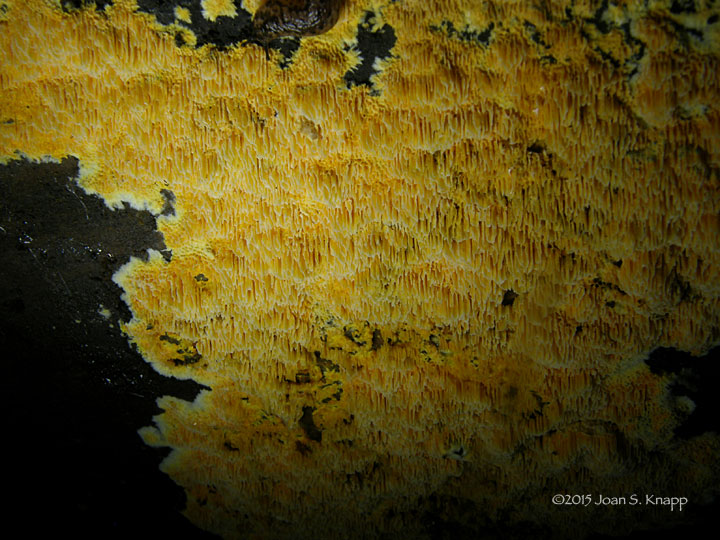
From the side, showing the pores that have

‘eroded’ so that the fungus looks like veils. And from…

underneath - using a mirror – showing the irregular pores. Descriptions
of the fungus include the ‘erosion’ of the pores. The erosion of the pores may
be helped along by some of the…

creatures, like this Leopard slug, that feed on fungi. (I’ve
seen many tiny leopard slugs around the slime molds too.)
I also found…

Wolf’s Milk (Lycogala epidendrum) fruiting bodies – young
and older – on top of the log. There were lots of…

Chocolate Tube (Stemonitis
sp.) fruiting bodies on the side of the log. These were distinctly grayish;
white fungal growth on the log made me think that the fungus had invaded the
slime mold fruiting bodies.
I made my way up the trail to the…

Tulip Poplar (Liriodendron
tulipifera) that was still hosting a couple of fruits.

Hairy Elephantsfoot (Elephantopus
tomentosus) had started to bloom – finally!
From here, I walked on down to the dam.
(To be continued)
Related posts:
- Spring Is In The
Air: Fort Yargo State Park, Section B To The Dam, May 1st (Part 2)


