May 19th, 2012. I’ve photographed a few Pipsissewa (Chimaphila maculata) plants blooming at Fort Yargo State Park but nowhere else. Then, as we were driving along the Saxon-Norman-Broad road, I spotted a cluster of three plants at the edge of the woods. One plant had three flowers, one had two, and the third plant had a single flower. I acquired five ticks while photographing these flowers. W and I thought we should start rating our flower photographs by the number of ticks acquired while photographing them.
 The cluster of flowering plants at the edge of the woods. Only two plants are visible in this photo.
 Three flowers from the top. It was worthwhile lying on the ground to try to capture photographs of the undersides of the flowers.
 Plant with three flowers
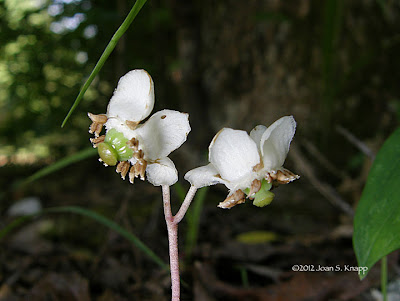 The plant with two flowers
 The plant with a single flower. This flower was facing to the side, allowing a better view of the underside.
I’ve photographed a series of Pipsissewa flowers ranging from buds to seed pods previously at Fort Yargo State Park.
Chimaphila maculata, native to the eastern United States and Canada, is known by the common names Pipsissewa, Striped Wintergreen, Striped Prince's Pine or Spotted Wintergreen. In Georgia, it’s found mainly in counties in the Piedmont. Chimaphila maculata is one of two Chimaphila species that grows in the southeastern United States. The other species, Chimaphila umbellata (Prince's-pine, Pipsissewa) does not grow in Georgia; it grows south only as far as northern South Carolina. is native to the eastern United States and Ontario and Quebec in Canada.
Click on an image to view a larger image
Identification resources:
- Southeastern Flora: Pipsissewa or Spotted Wintergreen (Chimaphila maculata)
- Natural and Naturalized Plants of the Carolinas and Georgia: Chimaphila maculata
Distribution Map:
- United States Department of Agriculture Plants Database: Chimaphila maculata (Striped Prince's pine)
- University of North Carolina Herbarium: Chimaphila maculata
Related posts:
- Pipsissewa or Spotted Wintergreen (Chimaphila maculata)
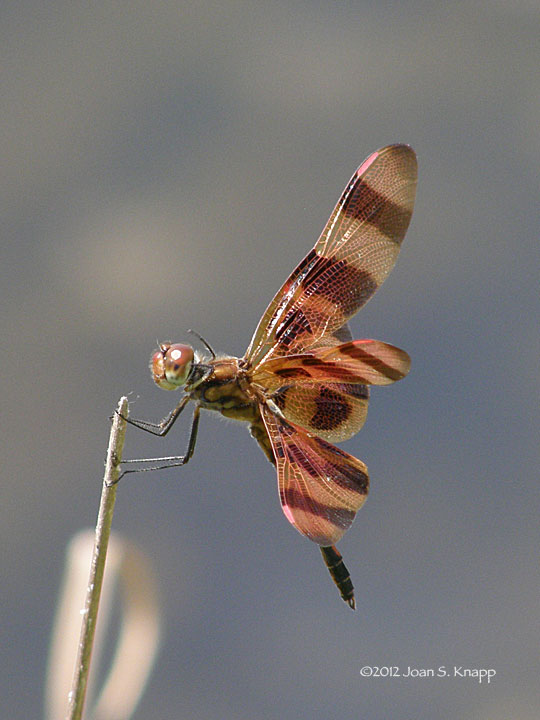
June 23rd, 2012. Ride The Wild Wind. Or that’s how it probably seemed to a male Halloween Pennant (Celithemis eponina) we encountered in the Piedmont National Wildlife Refuge in Jones County, Georgia. As always we stopped by Pond 2A to look for wildflowers and dragonflies, mainly dragonflies – although we did pretty well in the wildflower department too. Widow Skimmers (Libellula luctuosa) predominated – patrolling the shore of the pond and the downhill side of the dam. But there were a few Halloween Pennants, the first we’ve seen this year.
It was hot! Probably in the 90s F. There were gusts of wind occasionally and those kept this dragonfly on its toes, so to speak.
 He was ‘obelisking’ with his abdomen high in the air, trying to minimize his exposure to the heat of the sun. Then the breeze came up and…
 the need to balance began. He dropped his abdomen and flexed his wings to maintain his balance.
 *****
***** At one point, I disturbed him and he flew to the tip of another grass stem nearby where he continued to…
 balance, abdomen down and again flexing his wings in the breeze.
 *****
***** *****
***** Then back to obelisking when the breeze dropped again. Only to have to…
 *****
***** drop his abdomen and begin his balancing act once again.
Most dragonflies perch with front and back wings aligned in the same plane. Pennants, on the other hand, typically perch at the top of stems with the fore- and hindwings in different planes. This always gives the impression that they are off balance.
Click on an image to view a larger image
Identification resources:
- Dragonflies and Damselflies (Odonata) of Georgia: Halloween Pennant (Celithemis eponina)
- BugGuide: Halloween Pennant (Celithemis eponina) [Male] [Female]
- Bill Horn: Halloween Pennant Dragonfly
Related posts:
- Halloween Pennants In A Storm
- First Halloween Pennant Of The Season-
Dragonfly: Halloween Pennant
 We arrived at Margery Lake in Charlie Elliott Wildlife Center just in time to watch the sun set.
Click on an image to view a larger image
May 18th, 2012. I was wandering back to the truck, a little despondent over repeated, but failed, attempts to photograph a Red Admiral (Vanessa atalanta) butterfly. I wasn’t paying much attention to anything when I became aware of something rather large flying directly towards me. I was aware that it was a dragonfly.
Now a lot of dragonflies along this road fly like small stealth helicopters – hardly noticeable unless you’re looking for them. Others are gregarious and dart around at high speed. But this dragonfly seemed to be traveling in slow motion, lumbering along like a huge cargo plane coming in to land. Time seemed to stand still. And then it landed *on* me. Not on my front, but down on the side of my shorts, towards the back.
I figured I’d get one shot. I switched from the zoom to macro setting. Then I held the camera as close as I dared. I couldn’t get a look at the viewfinder. I just had to aim the lens in the general direction of the dragonfly, hold the focus button long enough for the lens to focus and take the shot.
 Not bad! And I was right. This was the only shot I got. When I started to turn slowly, it flew off. At first I thought it was one of the big stream cruisers but when that didn’t pan out, I searched for a name that included ‘gray’ and there it was. A Gray Petaltail (Tachopteryx thoreyi). A once-in-a-lifetime shot – or close to it.
Gray Petaltails are usually hard to spot because they frequently land on tree trunks and blend into the background. In Georgia they occur throughout the state between late March and late July.
Click on an image to view a larger image Identification resources:
- Dragonflies and Damselflies (Odonata) of Georgia: Gray Petaltail (Tachopteryx thoreyi)
- BugGuide: Gray Petaltail (Tachopteryx thoreyi) [Side] [Top]
 The plants were 3 – 4 feet tall but were ‘buried’ among many plants so it wasn’t possible to get a good photograph of an individual plant.
 Leaves were opposite.
 The sepals
 The flower, front on. It's about an inch in diameter
 The flower, in profile showing the stigma and stamen