Sunday, September 9, 2012

Another Schweinitz’s Polypore (Phaeolus schweinitzii) On Oak


August 18th. 2012. We found a Schweinitz’sPolypore (Phaeolus schweinitzii) at the base of an oak tree off the end of the house a month or so ago. These polypores are usually associated with pines rather than oaks and are a 'butt rot fungus' that attacks the roots and the heartwood to weaken trees.
Then I spotted another one at the base of a very tall oak tree on Bradford Road (CR-132) in Wilkes County, Georgia. It was well back behind a barbed wire fence so I had to satisfy myself with photographing it from a distance.
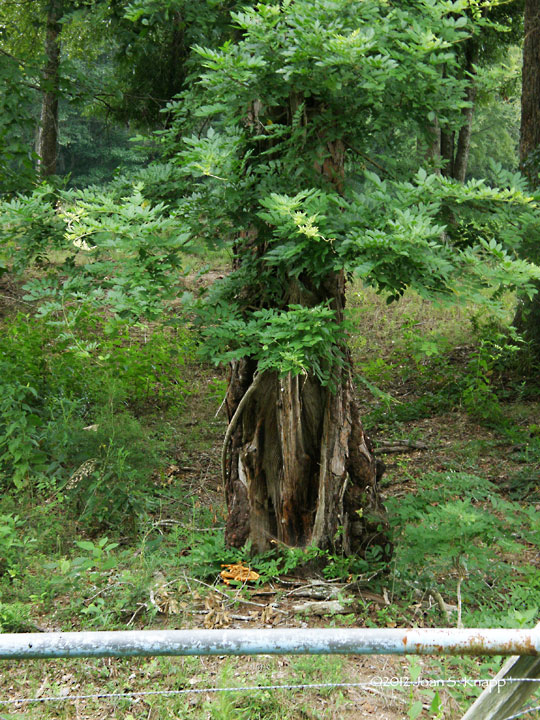
The view from the fence. This is a very tall oak tree covered with what look like a bignonia (or related) vine. The Schweinitzii’s Polypore is on the left at the base of the tree.

 A closer view of the fungus at the base of the tree

Closer still, and…

As close as I could get. This is a beautiful specimen of the fungus. Wonder if it’s going to lead to the downfall, literally, of a great oak.
Click on an image to view a larger image

Identification resources:
- Michael Kuo, Mushroom Expert.com: Phaeolus schweinitzii
- William Tannegerger: Phaeolus schweinitzii – Schweinitzii’s Polypore
- Gary Emberger, Messiah College: Phaeolus schweinitzii

Related post:

Saturday, September 8, 2012

Still More American Caesar’s Mushroom (Amanita jacksonii)


August 18th, 2012. I mentioned before that I was delighted to see the volvas on the American Caesar’s (Amanita jacksonii) mushrooms this year when I’d never seen them before. We were driving down Oscar Walton Road when I spotted two sentinel…

American Caesar’s mushrooms on an embankment beside the road. They were beautifully colored.

The volva was quite evident on the mushroom on the right. When I photographed them, I noticed two more amanitas on the…

top of the embankment nearby. They weren’t quite as photogenic as the first two but…

The volvas on each was clearly visible and the cap on the mushroom on the left had just ‘cleared’ its volva.
Click on an image to view a larger image

Identification resources:
- Rodham E. Tulloss, Eticomm.net: Amanita jacksonii
- Michael Kuo, MushroomExpert.com: Amanita jacksonii
 
Related post:

Friday, September 7, 2012

Obedient Plant (Physostegia virginiana)


August 18th, 2012. We had reached a section of the Saxon-Norman-Broad road at the edge of farmland where we see very little of interest when we saw a large patch of flowers. The roadside had been mowed recently but this patch of plants had been spared. I felt sure that this was a patch of naturalized non-native plants but… They were worth photographing and I was delighted to find that they were a native wildflower – the Obedient Plant (Physostegia virginiana) – that had been spared by someone who appreciated them.

The patch of flowers. The grass cleared by the mower is clearly visible in the foreground. It’s unusual of patches of wildflowers to be spared when roadsides are being mowed.

A closer view of the patch.

Stems of Physostegia virginica are thickly leaved along the lower section of the stem compared with Physostegia angustifolia

An individual stem

*****
*****
*****
*****
*****
Close views of an individual flower.

Physostegia virginiana (Obedient Plant, False Dragonhead, Obedient-plant) is native to the United States, where it’s found in states east of a line from North Dakota to Texas, and including Montana, Utah and New Mexico. In Georgia, it’s been documented in a few counties in north and south; It has not been formally documented in Oglethorpe County.
Click on an image to view a larger image 
 
Identification resources:
- Name that Plant: Native and Naturalized Plants of the Carolinas and Georgia: Physostegia virginiana (Northern Obedient-plant, False Dragonhead, Obedient-plant)

Distribution:
- United States Department of Agriculture Plants Database: Physostegia virginiana
- University of North Carolina Herbarium: Physostegia virginiana

Thursday, September 6, 2012

Palespike Lobelia (Lobelia spicata)


August 18th, 2012. Again, along the Saxon-Norman-Broad road, I spotted two plants of Lobelia spicata (Palespike Lobelia) growing in the shade at the very edge of the roadway.

The spike

*****
 Closer views of individual blooms

Lobelia spicata (Palespike Lobelia) is native to the United States where it’s found in from Maine west to Montana, and south through South Dakota to Texas. In Georgia, it’s found only in northern counties; it’s been documented as far south as Greene County.
Click on an image to view a larger image

Identification resources:
- Name that Plant: Native and Naturalized Plants of the Carolinas and Georgia: Lobelia spicata (Spiked Lobelia, Pale Spiked Lobelia)
- Missouri Plants: Lobelia spicata

Distribution:
- United States Department of Agriculture Plants Database: Lobelia spicata (Palespike Lobelia)
- University of North Carolina Herbarium: Lobelia spicata

Wednesday, September 5, 2012

Winged Loosestrife (Lythrum alatum)


August 18th, 2012. We made another ‘run’ along the Saxon-Norman-Broad Road in Oglethorpe-Wilkes counties. The Winged Loosestrife (Lythrum alatum) plants were growing in the deep ditches by the road in Oglethorpe County. These plants would be easy to overlook since they aren’t really showy. I managed to get a few photographs but didn’t dare climb down into the ditch. It would have taken a winch to get me out again.
*****
 Views of the flower. Flowers are about ½ inch diameter.

 A closer view.

 The back of the flower

Lythrum alatum (Winged Lythrum, Winged Loosestrife, Wing angle Loosestrife) is native of the United States where it’s found in states southeast of a line from Maine to Montana and south to Colorado and Texas. In Georgia, it’s been documented in only a few counties in the state including Wilkes but not Oglethorpe counties.
Click on an image to view a larger image

Identification resources:
- Southeastern Flora:  Lythrum alatum (Wing angle Loosestrife)
- Missouri Plants: Lythrum alatum
- Illinois Wildflowers: Lythrum alatum (Winged Loosestrife)
 
Distribution:
- United States Department of Agriculture Plants Database: Lythrum alatum (WingedLythrum)

Tuesday, September 4, 2012

Partridge Peas (Chamaecrista fasciculata & Chamaecrista nictitans)


August 18th, 2012. With the rainfall we’ve had recently, roadsides in many counties in the Piedmont are lined by forests of partridge pea plants that are blooming profusely. Two species, Chamaecrista fasciculata and Chamaecrista nictitans, occur in this area.
Chamaecrista fasciculata is the showier of the two species – sometimes called the Showy Partridge Pea - and is responsible for most of the roadside displays.  
 
The flowers open completely.

Chamaecrista nictitans has smaller flowers, that…

rarely open completely so that it’s not as showy as its cousin, C. fasciculata.

*****
The seedpods, green and ripe.

Chamaecrista fasciculata (Partridge Pea, Common Partridge Pea, Showy Partridge Pea) is native of the United States, where it’s found in states southeast of a line from Massachusetts to Wisconsin and South Dakota and southwest to Texas and New Mexico. In Georgia, it’s found in many counties throughout the state.

 Chamaecrista nictitans (Sensitive Partridge Pea) is native of the United States, where it’s found in states southeast of a line from Maine to Wisconsin and Illinois and southwest to Kansas, New Mexico and Arizona. In Georgia, it’s found in many counties throughout the state.
Click on an image to view a larger image

Identification resources:
Southeastern Flora:
Name that Plant: Native and Naturalized Plants of the Carolinas and Georgia:

Distribution:
United States Department of Agriculture Plants Database:
University of North Carolina Herbarium:

Monday, September 3, 2012

Pinkscale Blazing Star (Liatris elegans)


August 3rd - 17th, 2012.  On August 3rd we found Liatris elegans (Pinkscale Blazing Star) in the Ogeechee Wildlife Management Area in Hancock County, Georgia - the second time we’ve found this wildflower in Hancock County. The stems stand about 15 to 18 inches tall. They were just beginning to bloom on August 3rd.

 The stem showing alternatively arranged, simple leaves.

 Blooms developing along the stem

*****
 On August 3rd, these stems had a single bloom at the tip of the stalk.

 On August 17th, the stems had many more flowers along their length

 A closer view of blooms

 More blooms at the tip


A closer view of multiple blooms at the tip. These were photographed in October, 2010.

Liatris elegans (Pinkscale Blazing Star, Common Elegant Blazing Star) is native to the  United States where it’s found in southern states from South Carolina west to Oklahoma and Texas. In Georgia, it’s been documented in counties of the coastal plain including Hancock County.
Click on an image to view a larger image

Identification resources:
- Southeastern Flora: Liatris elegans (Pinkscale Blazing Star)
- Name that Plant: Native and Naturalized Plants of the Carolinas and Georgia: Liatris elegans (Common Elegant Blazing Star)
- Alabama Plants: Liatris elegans (Pinkscale Grayfeather)
 
Distribution:
- United States Department of Agriculture Plants Database: Liatris elegans (Pinkscale Blazing Star)
- University of North Carolina Herbarium: Liatris elegans

Related posts: