In early May, we were driving along Dry Branch Road in the Ogeechee Wildlife Management Area in Hancock County, Georgia, when we noticed some small plants with white flowers. We hadn’t seen these before so we investigated.
 These plants were little more than 12 inches high here.
 They have pretty white flowers that...
 Bloom on a cyme.
 An individual bloom up close, from the front and…
 From the back.
 The leaf. Something about the shape of the leaf didn’t ‘fit’ with the bloom, and…
 The hairs on the stem seemed to say ‘don’t touch.’ It would have been tempting to touch it but I didn’t. I used a stick to move the foliage for a better look. It turns out they are stinging hairs.
We returned in late May. The plants were developing seed pods. They were a pretty combination of deep evergreen and apple green. The developing seed pods, also with stinging hairs, from
 Above
Above
 The side
A couple of weeks later, we saw no sign of the plants.
Cnidoscolus stimulosus is native to the United States and grows from Virginia to Louisiana and in Kentucky. It grows in sandy soil or dry pastures on the coastal plain and infrequently in the Piedmont.
Click on an image to view a larger image
Distribution Map:
- United States Department of Agriculture Plants Database: Cnidoscolus urens var. stimulosus (Finger Rot)
- University of North Carolina Herbarium: Cnidoscolus stimulosus
Identification resources:
- Southeastern Flora: Tread Softly, Finger Rot (Cnidoscolus stimulosus)
- Alabama Plants: Cnidoscolus stimulosus -Tread Softly
- Natural and Naturalized Plants of the Carolinas and Georgia: Cnidoscolus stimulosus (Tread-softly, Spurge-nettle, Bull-nettle, Finger-rot)
Related Post:
- 2010: Year Of The Wildflower – Wildflower Index
On our visit to the Broad River Wildlife Management Area in Wilkes County, Georgia, we made our way along a trail down to the Broad River. In a clearing in the woods where we saw the Little Wood Satyr (Megisto cymela) and a Southern Pearly Eye (Enodia portlandia), we also saw a Polygonia sp. (Question Mark or Comma). We were trying to get a look at the underside of the wing to identify the butterfly when it flew into a nearby Sweetgum (Liquidamber styraciflua), W got there first and it was obvious that he’d seen something much more interesting than the butterfly. And he had. A dragonfly that had settled for the night, clinging to a branch.
A photo session ensued...
 Looking from directly behind.
 Looking form a slight angle
 Looking from the side
 A closer view of the thorax and head from ‘above’
 A closer view from a slight angle
 A closer view from the side, and ..
 A view of the wing pattern.
We had seen several of these or similar dragonflies in the woods, cruising back and forth near the water, and rarely settling. I guessed this was a cruiser and after reviewing photographs from several sources, decided that it was one of three species: a Stream Cruiser (Didymops transversa), a Florida Cruiser (Didymops floridensis), or a Georgia River Cruiser (Macromia illinoiensis georgina). Based mainly on the pattern of the white bars on its abdomen, I’ve identified it as a Georgia River Cruiser. I’d be interested to learn if others concur with this identification.
It was interesting that we photographed this dragonfly using either a macro flash or an led light array held close. The close views were taken with a macro lens also held very close to the dragon. At one point it swiveled its head to ‘watch’ us but it at no time did it appear to show any concern about the activity close to it.
Judging by the lack of photographs of this species online, it appears that we were treated to a rare sighting of this cruiser at rest.
Click on an image to view a larger image
Identification resources:
- BugGuide:
- Georgia River Cruiser (Macromia illinoiensis georgina)
- Stream Cruiser (Didymops transversa)
- Florida Cruiser (Didymops floridensis)
- Giff Beaton's Dragonflies and Damselflies (Odonata) of Georgia and the Southeast: Georgia River Cruiser (Macromia illinoiensis georgina)- Dave Welling, Striking Images of Nature: Georgia River Cruiser (Macromia illinoiensis georgina)
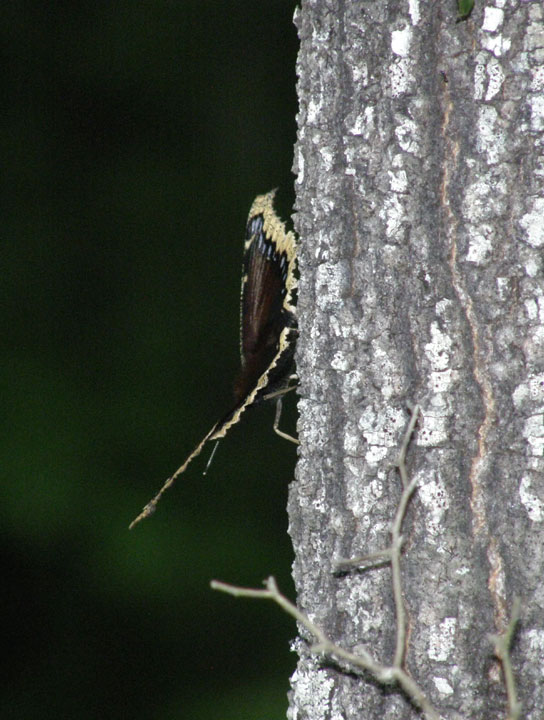
In mid-May, were driving down a rural road in Wilkes County, Georgia, when we witnessed a strange site. A ‘Question Mark’ (Polygonia interrogationis) was chasing a Mourning Cloak (Nymphalis antiopa). We’re calling it a Question Mark but it could have been a Comma (Polygonia comma). We never did see the underside of the wings clearly enough to identify it but… At that time, we didn’t know that the butterfly being chased was Mourning Cloak either; we identified it a little later too.
Anyway, a Question Mark was chasing a Mourning Cloak through the woods at the edge of the road. It was clear that the Question Mark was chasing the Mourning Cloak; this was not a random encounter between the two butterflies. The chase was so obvious that we stopped to watch. The Question Mark would chase the Mourning Cloak and then return to a specific tree. The Mourning Cloak would fly around and return to the same tree. This happened several times. So we had to get out of the car and investigate.
 The Mourning Cloak had alighted on the tree trunk. This was the best view we got of the top of the wings but its identity was unmistakable.
 It was then that we discovered that two Question Marks were involved in this encounter. They flew off, leaving the tree to the…
 Mourning Cloak which relaxed, wings folded. The ‘texture’ on the underside of the wing was quite remarkable.
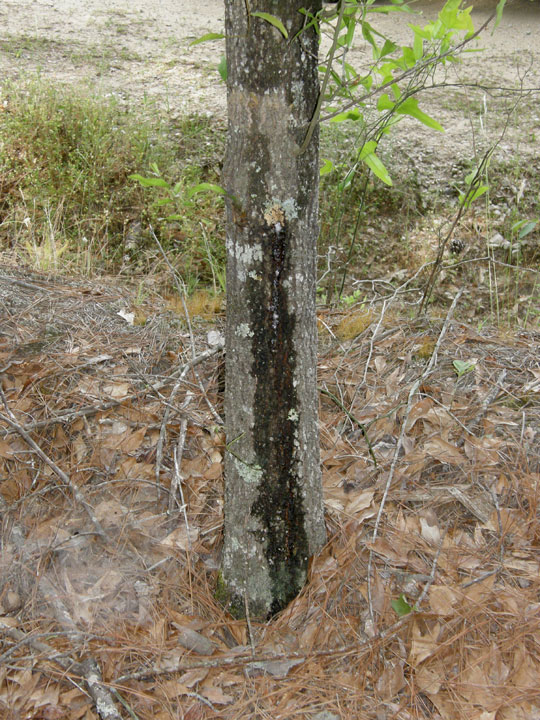
 We found a place where we could climb the embankment and walked back to the tree. The mystery was solved. The tree was leaking sap that had attracted the butterflies. It seemed a little unusual to see sap leaking in mid-May but the butterflies were making the most of it.
Mourning Cloaks are easy to identify; they are unique unlike the Polygonia sp. (Question Marks and Commas). Mourning Cloaks may be found between mid-April and mid-October throughout most of Georgia except for the very south of the state. Mourning Cloaks occur in woodlands which probably explains why, although they may be common in some areas, they are not seen frequently. I’ve only seen one previously in an opening in the woods at Fort Yargo State Park in Barrow County, Georgia.
Click on an image to view a larger image
Identification resources:
- Westcentral Georgia Butterflies by Michael Beohm: Mourning Cloak (Nymphalis antiopa)
- BugGuide: Mourning Cloak (Nymphalis antiopa) [dorsal] [ventral]
Related posts:
- The Sap Tree
To get to the pond in the field on the other side.
We were driving north on a rural road in Wilkes County, Georgia, when we saw a turtle crossing the road. Even at a distance, it was easy to identify it as a Common Snapping Turtle (Chelydra serpentina). Even if turtles are moving in the right direction, we do like to make sure they are well off the pavement before we leave.
 A not-too-distant view. A handsome young turtle, with a carapace about 10-12 inches long, making its way purposefully across the road.
 Even closer, but not too close.
 Its head. Obviously it's very alert.
 An interesting iris. Do all turtles have this type of iris?
 Strong claws…
 And a dragon-like tail. Quite prehistoric.
 We talked with it about moving off the road so that it wouldn’t be run over. This one didn’t think it needed any help, thank you. And it was very agile. When we tried to encourage it off the pavement, it swung around surprisingly fast to face what it perceived as a threat.
 'Ok, I'm leaving now'
 Although I’ve seen several Snapping Turtles at fairly close range, I’d never noticed that the back end of the Snapping Turtle’s carapace was distinctly ‘serrated’
 Enough of humans. It’s off into the grass towards the fence.
 And further still
 Almost to the fence.
 Looking for a way through the shrubs along the fence.
 And through the fence to ‘freedom’
Click on an image to view a larger image
Identification and Distribution:
- Savannah River Ecology Laboratory, Herpetology Program: Common Snapping Turtle (Chelydra serpentina).
We stopped by the Oconee Wildlife Management Area at the south end of Lake Oconee in search of milkweed plants (Asclepias sp.). Most roads in this section of the Oconee WMA are closed at the moment but, while we were wandering around.at the end of the open section of road, we spotted a number of butterflies feeding on a patch of Heal All (Prunella vulgaris) plants. They were skippers.
Most skippers are frustrating to identify. So, like most things, we start with the simple and move on to the more difficult ones. This skipper had distinct marking on both top and underside of the wings that made it fairly easy to identify. This was a Hoary Skipper (Achalarus lyciades). Showing both top and underside of the wings
 A close view of the top of the wing
 A close view of the underside of the wing.
The Hoary Edge belongs to the Subfamily Eudaminae, known as Dicot Skippers. As explained by Wayne at Niches in his discussion of a Silver-spotted Skipper (Epargyreus clarus) the larvae of dicot skippers prefer a diet of dicotyledon plants, especially legumes, whereas the larvae of other skippers feed on monocotyledon plants including bamboos, palms, lilies, daffodils, irises, hostas, and orchids.
Click on an image to view a larger image
Identification resources:
- Westcentral Georgia Butterflies by Michael Beohm: Hoary Edge (Achalarus lyciades)
- BugGuide: Hoary Edge (Achalarus lyciades) [dorsal] [ventral]
 These plants were little more than 12 inches high here.
 They have pretty white flowers that...
 Bloom on a cyme.
 An individual bloom up close, from the front and…
 From the back.
 The leaf. Something about the shape of the leaf didn’t ‘fit’ with the bloom, and…
 The hairs on the stem seemed to say ‘don’t touch.’ It would have been tempting to touch it but I didn’t. I used a stick to move the foliage for a better look. It turns out they are stinging hairs.
 Above
Above The side