Showing posts with label Blue Ridge WMA. Show all posts

Monday, October 8, 2012

Great Spangled Fritillary (Speyeria cybele)


September 2nd, 2012. It was the Labor Day (US) holiday weekend so we took the opportunity to make an overnight trip into the Chattahoochee National Forest. After making our way out of the Coopers Creek Wildlife Management Area, we drove up to Blue Ridge for the night. We retraced our way up the Noontootla River Valley through the Blue Ridge Wildlife Management Area as we had in mid-December 2011 but, instead of driving southwest, we drove north on Winding Stair Gap and Rock Creek Roads.

We caught our first glimpse of a Great Spangled Fritillary a couple of months ago in the Wilson Shoals Wildlife Management Area but didn’t manage to get a photograph. So we were on the lookout for them on this weekend. Great SpangledFritillaries are more widely distributed in the eastern United States than are the Diana Fritillaries and their range in Georgia extends further down into the state than does the Diana Fritillary. The Great Spangled Fritillary is another ‘big’ fritillary – about the same size as the female Diana Fritillary or a swallowtail. There are nine subpsecies of Speyeria cybele and the color patterns differ quite a lot. Speyeria cybele subsp. cybele is the subspecies that occurs in Georgia.
 
We were rewarded with our first sighting of a Great Spangled Fritillary as we were driving along Winding Stair Road. The butterfly was…

Feeding on a very tall thistle in the shade. This photograph was taken with zoom and flash. The butterfly has reflective, metallic spots, similar to the Gulf Fritillary, on the underside of the wing that appear grey due to the angle at which the light hit the spots.

We found a second fritillary ‘sharing’ the thistle flowers with the Diana Fritillary near the fish hatchery on Rock Creek Road. Thistle flowers are a magnet for butterflies at this time of year.


It was hectic on the thistles - competing with the Diana Fritillaries - and this fritillary was taking a ‘time out’ on a nearby tree before returning to the thistles…

Right side up, and …

head down, and then…


A couple of nice poses for the camera.

Back to the business of eating.

It was great to finally get a good look and some photographs of this butterfly.
Click on an image to view a closer image

Identification resources:
Butterflies and Moths of North America: Speyeria cybele (Great Spangled Fritillary)
BugGuide: Speyeria cybele (Speyeria cybele) [Dorsal] [Ventral] 


Distribution:
Butterflies and Moths of North America: Speyeria cybele (Great Spangled Fritillary)
United States Geological Survey, Butterflies of North America: Speyeria cybele (Great Spangled Fritillary)

Related posts:

Sunday, October 7, 2012

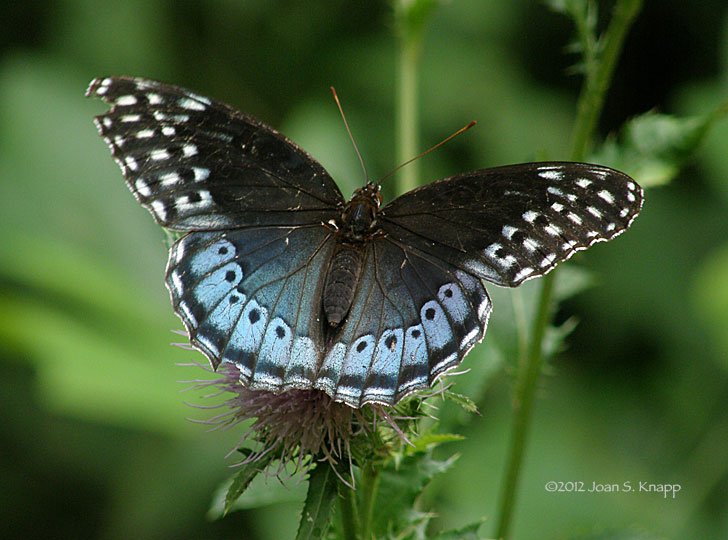
Female Diana Fritillary (Speyeria diana)


September 1st – 2nd, 2012. It was the Labor Day (US) holiday weekend so we took the opportunity to make an overnight trip into the  Chattahoochee National Forest. After making our way out of the Coopers Creek Wildlife Management Area, we drove up to Blue Ridge for the night. We retraced our way up the Noontootla River Valley through the Blue Ridge Wildlife Management Area as we had in Mid-December 2011 but, instead of driving southwest, we drove north on Winding Stair Gap and Rock Creek Roads.

We caught our first glimpse of the female Diana Fritillary on a thistle mid-afternoon on September 1st. It was high above the road and we had no hope of stalking it. I didn’t have my butterfly guide with me so we had to wait until we got wifi access later in the evening to identify this butterfly. We’d never seen a Diana Fritillary before. Although some have been sighted in the DeKalb-Fulton-Cherokee-Bartow-Paulding county area, most sightings are in north Georgia counties. These butterflies are more common in the Appalachian region Tennessee, South Carolina and North Carolina.


The first butterfly we saw. Enough for an identification. This is a large butterfly, the size of a swallowtail and about twice the size of the Variagated (Euptoletea claudia) and Gulf (Agraulis vanillae) fritillaries we see in our area. At first I thought it was a swallowtail.

Late in the afternoon, we encountered two females feeding on a thistle growing beside the ridge road in Coopers Creek WMA


 Near the fish hatchery in the BlueRidge WMA.

Then we were treated a great display by two females on thistles growing by a bridge crossing a small creek on Rock Creek Road.


It was clear that the butterflies enjoy the thistles. This butterfly is covered with pollen.

A closer view

We didn’t see any male Diana Fritillaries. W caught a glimpse, at a distance, of a butterfly he thought was a Mourning Cloak. It’s very likely that this was a male Diana Fritillary but…  Finding the males will have to be a goal for next year.
Click on an image to view a closer image

Identification resources:
- Butterflies and Moths of North America: Speyeria diana (Diana Fritillary)
- BugGuide: Speyeria diana (Diana Fritillary) [Female] [Male]

Distribution:

Related posts:
- Blue Ridge WMA: Noontootla River Valley to Springer Mountain Junction
- Blue Ridge WMA: The North Route  
- Tough Life For A Milkweed: Aphis nerii & Oncopeltus fasciatus 
- Over The Hills And Through The Woods: Noontootla Creek And Springer Mountain

Saturday, October 6, 2012

Blue Ridge WMA: The North Route


September 2nd, 2012. It was the Labor Day (US) holiday weekend so we took the opportunity to make an overnight trip into the Chattahoochee National Forest. After making our way out of the Coopers Creek Wildlife Management Area, we drove up to Blue Ridge for the night. We retraced our way up the Noontootla River Valley through the Blue Ridge Wildlife Management Area as we had in mid-December 2011. We hadn’t seen many wildflowers on that trip. We saw a variety of wildflowers on this trip. The first section of the trip was on the Forest Service road to the junction with the road to the Appalachian Trail parking area below Springer Mountain.

Last year, we drove on to the southwest. This year, we retraced our route and continued north to GA-60. The road to/from the Appalachian Trail parking lot below Springer Mountain back to the junction with the Noontootla River road is an east-west road. The north side is dry but the south side is sheltered with some, probably seasonal, seeps that maintain a moist environment.  Here we found…

gentians, probably Gentiana saponaria (Soapwort Gentian, Harvest Bells) in bloom along the embankment.


Closer views

In one of the moister areas we found unusual ferns and empty seedpods from flowers that had bloomed earlier. An area to visit again.

A large patch of Collinsonia canadensis (Richweed) plants were blooming on the north side of the road.

An individual plant in the patch


Close-ups of individual flowers

When we reached the junction with the Noontootla River road, we continued north on Winding Stair Gap Road. The road ran along the top of the ridge. We found…


Aureolaria flava (Smooth Yellow False Foxglove)

The Appalachian Trail crossed the road. Here the Winding Stair Gap Road split into the Appalachian Blue Ridge Road to the right, and Rock Creek Road to the left. We took Rock Creek Road which ran north past Rock Creek Lake to the Chattahoochee National Fish Hatchery and on through the Blue Ridge WMA to GA-60.

We found a small patch of Conoclinium coelestinum (Blue Mistflower, Mistflower, Wild Ageratum, Hardy Ageratum) near the fish hatchery

A Dog Day cicada (Tibicen sp.) was sunning itself in a nearby plant

A clematis, probably Clematis virginiana (Virgin’s Bower) had finished blooming and was setting seed

Seed pods of Asclepias tuberosa (Butterfly Milkweed) were releasing their seeds

The Oenothera biennis (Evening primrose) plants had finished blooming and were setting seed


Amphicarpa bracteata (Hog Peanut) vines were common

The sad note for the day was the sighting of a Copperhead (Agkistrodon contortrix) that had been killed while crossing the road. It did provide the opportunity for a photograph without having to worry about being bitten.

Next: The high points – Dianna and Great Spangled Fritillaries
Click on an image to view a larger image

Identification resources:
Southeastern Flora:
- Aslepias tuberosa (Butterfly Milkweed)  
- Oenothera biennis (Evening primrose) 

Name that Plant: Native and Naturalized Plants of the Carolinas and Georgia:

Distribution:
United States Department of Agriculture Plants Database:

SavannahRiver Ecology Laboartory: Copperhead (Agkistrodon contortrix)
Related posts:
- Tough Life For A Milkweed: Aphis nerii & Oncopeltus fasciatus

Friday, October 5, 2012

Tough Life For A Milkweed: Aphis nerii & Oncopeltus fasciatus

-->
September 2nd, 2012. It was the Labor Day (US) holiday weekend so we took the opportunity to make an overnight trip into the Chattahoochee National Forest. After making our way out of the Coopers Creek Wildlife Management Area, we drove up to Blue Ridge for the night. We retraced our way up the Noontootla River Valley through the Blue Ridge Wildlife Management Area as we had in mid-December 2011. We hadn’t seen many wildflowers on that trip. We saw a variety of wildflowers on this trip. The first section of the trip was on the Forest Service road to the junction with the road to the Appalachian Trail parking area below Springer Mountain. Then we drove out to the Appalachian Trail about half-a-mile north of it’s origin on the top of Springer Mountain.

We found more milkweed plants like those we had seen on the road along the Noontootla River. The plants in the valley had been growing in the shade. Even then I could see some aphids on the seed pods but couldn’t reach the plants because of a deep ditch between the road and the embankment.  But here, the plants were growing in full sun and we could walk up to the plants. We found not only aphids but milkweed bugs.


Aphis nerii (Oleander or Milkweed Aphid)
This is the first time I’ve seen the Oleander/Milkweed Aphid

The aphids covered large areas on some seed pods

A closer view. 

Still closer. For some really close-up photos, click here
 
Oncopeltus fasciatus (Large Milkweed Bug)
I’ve seen and photographed Large Milkweed bugs before but this is the first time I’ve seen the nymphs clustered like this.

A single cluster of nymphs at the base of a leaf

One brave little soul which had climbed up to the top of a stem

It's a tough life for a milkweed plant.
Click on an image to view a larger image

Identification resources:
- Name that Plant: Native and Naturalized Plants of the Carolinas and Georgia: Asclepias exaltata (Poke Milkweed, Tall Milkweed)
- Robert W. Freckmann Herbarium: Asclepias exaltata (Poke Milkweed, Tall Milkweed)
University of Florida/Florida Department of Agriculture and Consumer Services: Aphis nerii (Oleander Aphid) 


Distribution:
United States Department of Agriculture Plants Database:

Related posts:
- Over The Hills And Through The Woods: Noontootla Creek AndSpringer Mountain

Thursday, October 4, 2012

Blue Ridge WMA: Noontootla River Valley to Springer Mountain Junction

September 2nd, 2012. It was the Labor Day (US) holiday weekend so we took the opportunity to make an overnight trip into the Chattahoochee National Forest. After making our way out of the Coopers Creek Wildlife Management Area, we drove up to Blue Ridge for the night. We retraced our way up the Noontootla River Valley through the Blue Ridge Wildlife Management Area as we had in mid-December 2011. We hadn’t seen many wildflowers on that trip. We saw a variety of wildflowers on this trip. The first section of the trip was on the Forest Service road to the junction with the road to the Appalachian Trail parking area below Springer Mountain.

The mountains northeast of Blue Ridge. It’s easy to see how the mountains got their name.


We only caught fleeting glimpses of the Noontootla River. The view is obscured by pine tress and rhododendrons

We found a large patch of milkweed plants with seed pods. I’m guessing these are Asclepias exaltata (Poke Milkweed) but it’s going to mean a trip back next Spring to verify the identification when the plants are blooming. These plants have only been documented in far northern counties in Georgia, including Fannin County. In anticipation, here are some photographs of the plant and flowers.

Seedpods were long and slender. Some plants had two seed pods


Individual Richweed (Collinsonia canadensis) plants were growing along the edge of the road.

Downy Rattlesnake Plantain (Goodyera pubescens) plants had bloomed this year. Good cause for another trip back to this beautiful valley next year

A close-up view of developing seed pods

Small Bonny Bellflowers (Campanula divaricata) were growing along the road embankment

Mountain Aster (Eurybia chlorolepis) plants were blooming. These stood out among the wildflowers we saw.

White Snakeroot (Ageratina altissima) flowers were a little past their best but still stood out.

At the junction of the road at the top of the ridge, we turned southwest and drove out to the Appalachian Trail below Springer Mountain.
Next: Out to Springer Mountain and back
Click on an image to view a larger image

Identification resources:
Southeastern Flora:
- Goodyera pubescens (Downy Rattlesnake Plantain)
- Ageratina altissima (White Snakeroot)
Name that Plant: Native and Naturalized Plants of the Carolinas and Georgia: Eurybia chlorolepis (Blue Ridge White Heart-leaved Aster)

Distribution:
United States Department of Agriculture Plants Database: