Showing posts with label Gwinnett County. Show all posts

Monday, March 7, 2011

Harbins Park: Day of the Fungi (Part 2)

After I turned onto the emergency exit (C ) and walked down to the hiking trail (D) and over to the equestrian trail (F), I started to see lichens – a lot of lichens. There are an enormous number of lichens and I’m not an expert at identifying them. Any corrections to my guess are more than welcome.

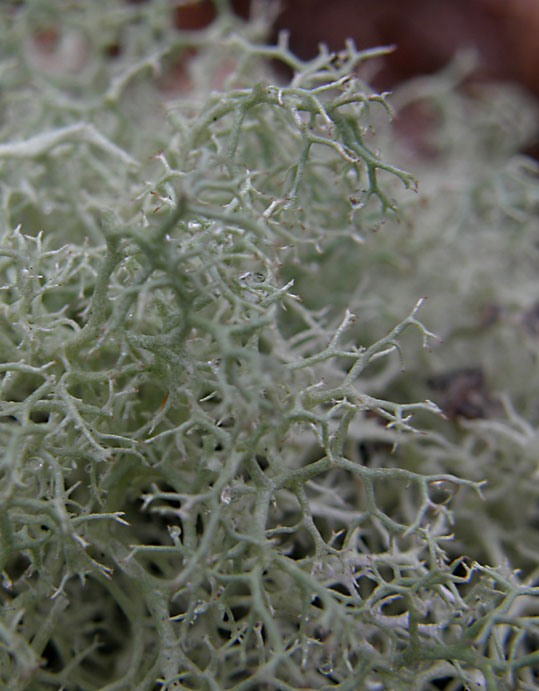
I started to see these lichens after I turned onto the emergency exit trail. They became thicker and more common as I walked down towards the river. The guide to common lichens on the Georgia Piedmont suggests that this is probably the Dixie Reindeer lichen, Cladina (Cladonia) subtenuis.

A closer view

A close up.

I found a few small patches of the Crowned Pixie-cup lichen (Cladonia carneola) on rotting logs.

A closer view.

This appears to be the Peg lichen (Cladonia sobolescens). I found these on a mound of soil covered with moss in the same area where I found the Crowned Pixie-cup lichens. This lichen resembles the British Soldier lichen (Cladonia cristatella) which have red fruiting bodies and which I'd seen in January.


Areas around the overlook over the Alcovy River were covered with carpets of the Dixie Reindeer lichen.

*****
I think these are the Perforated Ruffle lichen (Parmotrema perforatum). I saw these on the trunk of a tree along the Miller Lake Trail in Mulberry Creek Park and they are on trees in our field where they are blue-green with brown cups. I was struck by the fact that these were greenish with green-brown cups. The lichen in the lower photo was on a fallen branch in the humid area around the river viewing platform. The lichen in the lower photo was on a limb further along the trail where the air was drier.

The hiking trail climbed back up onto the ridge with open, drier woods with fewer lichens although I did find this.

*****
For some reason I’m finding a lot of Old Man’s Beard lichen (Usnea strigosa) this year. Usually I find clumps lying along the trail. These photos clearly show the attachment of the lichen to a fallen tree limb and the fruiting bodies.

There were very few fungi high on the ridge towards the end
of the trail I took.

*****
The most artistic find of the day was a cluster of gilled mushrooms on this stump.

The final gem of the day was this sighting of some Witch's butter (Tremella mesenterica). It had dried a little in the wind but was a welcome splash of color in an otherwise brown woods.

So a trek just to enjoy the walk became a trek of discovery of a rich trove of fungal friends.

Click on an image to view a larger image


Identification resources:

- University of Georgia, Center for Remote Sensing and Mapping Science, Georgia Lichens Project: A Guide to Twelve Common & Conspicuous Lichens of Georgia’s Piedmont

- Discover Life: Cladonia

- Stephen Sharnoff Photography: Lichens


Related posts:
- Harbins Park: Day of the Fungi (Part 1)

- Gwinnett County-Harbins Park: Trail Trip #1 (Part 2)

- Gwinnett County: Little Mulberry Park – Miller Lake Trail

Saturday, March 5, 2011

Harbins Park: Day of the Fungi (Part 1)

Yesterday saw the last of my Christmas lunches – believe it or not. Sometimes it’s challenging to connect with friends. No point in going back to work. The parking is a real challenge after lunch so I signed out for the afternoon.

I decided to go to the park just to walk. The forecast was for drizzle so I didn’t expect much. I dressed for rain and carried my camera in its small case, just in case. I thought I’d walk the equestrian trail that I had walked on my first visit to the park. I was opened-minded and decided to make up my walk as I went, depending on how I felt. That’s one of the great things about this park. It’s has a variety mix and match opportunities.

The route I took. I left that paved Meadow Trail to join the hiking trail (A) and followed this trail to the equestrian trail (B). I took the emergency exit trail (C) to the join the hiking trail again (D). This trail took me by the overlook platform (E) above the Alcovy River. Last time I walked the hiking trail, I switched back to the equestrian trail half way between the river overlook an F. This time, it was getting late and I rejoined the equestrian trail (F) and followed it back to where (A) I joined the trail originally. I followed the equestrian trail to G where I returned to the paved trail to complete the walk.

The recent rain and warmer temperatures, in the 60s F, had created perfect conditions to rejuvenate many of the fungi and lichens along the trail. Even so, I was surprised by the variety of fungi I saw.
Along the equestrian trail (B) to (C); all on fallen tree trunks or limbs.

A bracket fungus. These were firm, polyporous brackets. A Trametes sp., possibly T. elegans.

A closer view of the same fungus.

This is a crustlike fungus on a fallen tree limb. The tawny brown fungus with a white margin with projecting runners fits the description of Coniophora puteana, a dry-rot fungus.

*****
*****
Many logs along this trail were covered with what appear to be a Parchment fungus, a Stereum sp. Stereum ostrea?

This 'frilly' fungus covered the limb. Is this another Stereum sp.? Stereum ochraceoflavum? Each fungus was paper thin; thinner than indicated by photos of Stereum ochraceoflavum that I’ve seen.

And a closer view.

After I turned onto the emergency exit trail at (C) and headed south towards the river, I saw fewer of the previous fungi and started to see lichens.

To be continued…

Click on an image to view a larger image

Identification resources: Michael Kuo: Mushtoomexpert.com
Relared posts:

- Gwinnett County-Harbins Park: Trail Trip #1 (Part 1)

- Gwinnett County-Harbins Park: Hiking Trail. Part 1, Trailhead To Footbridge #1

Monday, February 21, 2011

Gwinnett County: Little Mulberry Park – East Meadow Trail (Part 2)

The East Meadow Trail circled the meadow and then ran along just inside the edge of the woods. It emerged for a short distance before diving back into the woods for the final quarter mile.

The woods were mostly bare with several downed tree trunks.

Some smaller trees, including this American Beech (Fagus grandifolia) hadn’t lost their leaves and broke the monotony of bare trees.

This was one of the few ‘bushes’ in the woods.

A closer look. It was more a series of long thorns with connecting stems. It didn’t have any leaves. I know I’ve seen photos of it somewhere but can’t remember what it is. Can anyone help me identify this plant?

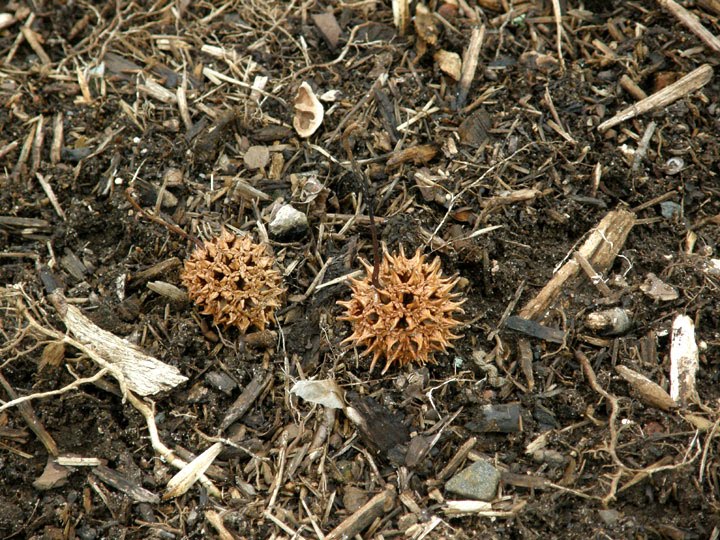
A couple of Sweetgum (Liquidambar styraciflua) seedpods. The ground was littered with them.

Clumps of wild onions dotted the landscape. I’ve never seen these bloom. Looked like something had nibbled on these.

The East Mulberry Trail, which had crossed the open meadow entered the woods again.

Another fallen tree. The trunk was covered with bracket fungi, probably Turkey Tail (Trametes versicolor), which is common in these woods. These were well past their prime.

The Carriage Trail (D), a paved, multi-use trail, connects the meadow trails with the Miller Lake Trail.

More leave. A maple tree this time.

Another American Beech tree by the trail. There were a lot of small trees in this area with leaves still attached. These were a welcome change from the bare woods.

A close up of their leaves.

There were also several holly trees in this area of the woods.

And mounds of moss. This was the most impressive mound.

Almost at the end of the East Meadow Trail.

The mile marker at the end of the trail.
Click on an image to view a larger image


Resource:

- Gwinnett Parks and Recreation: Little Mulberry Park


Related posts:

- Gwinnett County: Little Mulberry Creek Park – East Meadow Trail (Part 1)

- Gwinnett County: Little Mulberry Creek Park – West Meadow Trail

- Gwinnett County: Little Mulberry Park – Miller Lake Trail

Saturday, February 19, 2011

Gwinnett County: Little Mulberry Park – East Meadow Trail (Part 1)

When I got to the 0.75-mile marker where a trail connects the West Meadow Trail to the East Meadow Trail, I decided I had time to walk the East Meadow Trail too.

The East Meadow Trail is paved but seems to be more intimate than the West Meadow Trail. The trail winds a little more and threads its way among small clusters of trees. Some areas have been mowed but most of the area is natural.

A trail begins by winding through some woods.

As the trail starts, a cross-country trail goes straight ahead.

Once out of the woods at the beginning, the trail winds through an open area dotted with trees. The sign on the left states: Meadow Restoration.

The cross-country trail wound around the end of the woods where the trail began and crossed the paved trail. It then followed the mowed path along the edge of the woods. I’m not sure where it went; that has to wait for a future walk.

A view to the southeast. Although there is a small subdivision just outside the park boundary, the view from the trail is rural.

The trail winding through another cluster of trees in the open meadow.

A Common Mullein (Verbascum thapsus) plant that survived the winter in the open. New leaves are developing.

The trail winds though more trees. This turned out to be a special spot on this walk.

A characteristic rosette of Hairy Bittercress (Cardamine hirsuta) in bud. I wasn’t really looking for wildflowers. It seemed a little early to expect any. But there it was! There were a few plants starting to bud. They were in a spot that would get an hour or so of sun in the middle of the day but were protected from radiant cooling at night. (I’d seen some rosettes in protected areas around our house. When I got home, I checked and found a single plant starting to bud). Spring is on the way.

A closer view. The purple colored stems of the young plants makes them easy to spot.

At about the mid-point of the trail, the path moved into the open. Here, the East Mulberry Trail enters the
meadow from the woods to the northeast. It’s an un-paved path – an equestrian trail that crosses the meadow before it exits back into the woods to the northwest.

The sign for the East Mulberry Trail warns of its steepness.

The trail winds along the meadow at the edge of the woods.

A view from the meadow to the southwest.

A sentinel tree in the meadow just before the trail winds back into the woods.

(To be continued)

Click on an image to view a larger image

Resources:

- Gwinnett Parks and Recreation: Little Mulberry Park

- Southeastern Flora: Common Mullein (Verbascum thapsus)

Related posts:

- Gwinnett County: Little Mulberry Creek Park – West Meadow Trail

- Gwinnett County: Little Mulberry Park – Miller Lake Trail

- Hairy Bittercress (Cardamine hirsuta)