Showing posts with label Chattahoochee NF. Show all posts

Monday, December 24, 2012

White County: Raven Cliffs Wilderness


October 20th, 2012. On our way back from Young Harris we drove down the Richard B. Russel Highway (GA-348) which skirts the Raven Cliffs Wilderness. Raven Cliffs or Duke’s Creek Falls is a popular stop along this highway. We, however, drove south, turned GA-75 and US-129/GA-11. We took the Kellum Valley Rd north from the highway. At Harkins Road, the road continues as Toll Gate Road to a trail head for the Raven Cliffs Wilderness.

The road follows Towns Creek and is paved at first and then graveled to the trailhead. Just past the last house, the road was ‘flooded’ by what appeared to be spring water that flooded the area west of the road and the road itself for about 100 yards or so. Beautifully clear water; 2 to 3 inches or deeper in some parts.

Gentiana saponaria (Soapwort Gentian, Harvestbells)
It wasn’t long before we found patches of Gentiana saponaria (Soapwort Gentian, Harestbells). We continued to find them by the road to the trail head.

The first patch of gentians on the east side of the road. I spotted five blooming plants in this photo alone. There were more to the left of this area.

An individual plant. The blooms were a deep blue-purple and fully opened.


Flowers, up close

We wandered around the trailhead and found several interesting items…

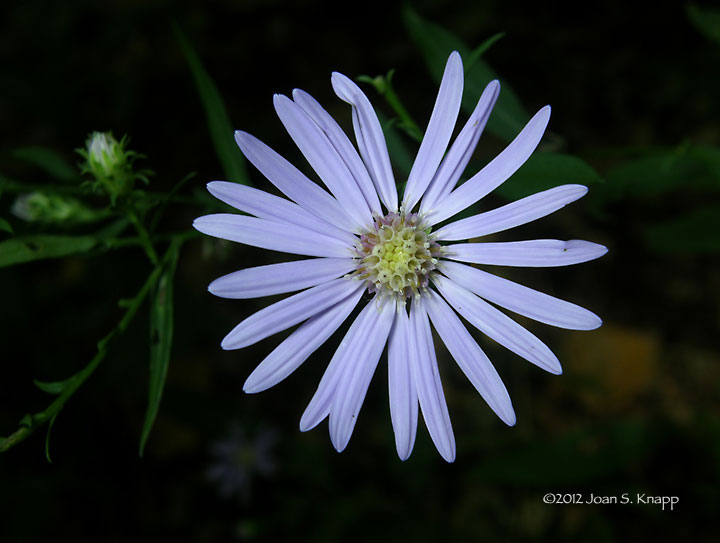
An unidentified ‘Aster.’

A small plant in the woods at the trail head

A bud,

An individual flower, and …

in proflie

A Grapefern (Botrychium sp.)


And then we found a shallow well that was probably intended to impound spring water. There was only a little water in it.

From a short distance

A closer view

The area along Toll Road was quite moist and will be interesting to visit in different seasons.
Click on an image to view a larger image

Monday, December 17, 2012

Flaxleaf Whitetop Aster or Stiff Aster (Ionactis linariifolius)


October 19th, 2012. In the WarwomanWildlife Management Area, along Sarah’s Creek Road from where we found the Showy Gentian (Gentiana decora), we found some asters. .It’s easy to over look asters after a while but we stopped and photographed them. A little research suggests that these were Flaxleaf White Top or Stiff Aster (Ionactis linariifolius).


The flowers, and…

 leaves

Ionactis linariifolius (Flaxleaf Whittop Aster, Stiff Aster, Flaxleaf Aster, Stiff-leaf Aster) is native to the United States where its found from Maine west to Minnesota and south to Texas and Florida. In Georgia, its been documented in counties throughout the state, including Rabun County.
Click on an image to view a larger image

Identification Resources:
Natural and Naturalized Plants of the Carolinas and Georgia: Ionsctis linariifolius (Stiff-leaf Axter, Flaxleaf Aster, Stiff Aster)

Distribution:
United States Department of Agriculture Plants Database: Ionactis linarifolia (Flaxleaf Whitetop Aster)

Related posts:
- Warwoman Wildlife Management Area: Showy or Appalachian Gentian (Gentiana decora)

Saturday, December 15, 2012

No Hang Gliding!


September 22nd, 2012. Near the end of Mill Creek Road in the Swallow Creek Wildlife Management Area we saw this sign on a tree.

I was bemused by the sign. There was no way that anyone could have launched a hang glider in this area which was heavily forested. I guess these were just ‘standard’ signs that would have applied to motor vehicles, ‘motorized equipment’ and bicycles in this area and hang gliders in other areas; just not to hang gliders in this area.
Click on the image to view a larger image

Related posts:

Thursday, December 13, 2012

Swallow Creek Wildlife Management Area: Kidneyleaf Grass of Parnassus (Parnassia asarifolia)


September 22nd, 2012. I photographed Parnassia asarifolia (Kidneyleaf Grass of Parnassus) by the side of North Germany Mountain Road which runs through the Black Mountain State Park in Rabun County, Georgia in 2011 and again in 2012. At this site the plants grow in complete shade.

On our way home from Rabun County, we explored the Swallow Creek Wildlife Management Area in Towns County; download a map of the WMA here. From Cynth Creek Road, we drove south and entered the WMA again on Mill Creek Road and drove to the end of the road which is a trail head just a short distance from the Tennessee Valley Divide and the Appalachian Trail.


 At first the road ran along the valley just above the creek and then climbed along the side of the ridge. W spotted another patch of parnassias growing in a wet area by the side of the road as we climbed out of the valley. Which species? There are two species – P. asarifolia and P. grandifolia (Largeleaf Grass of Parnassus) – and we’ve been on the lookout for P. grandifolia. These plants proved to be P. asarifolia and, although we were a little disappointed that it wasn’t P. gradifolia, we were delighted to find another patch of P. asarifolia. It was somewhat challenging to photograph them in full sun, but not much choice.

The plants were growing in water flowing from a spring a little farther up the hill.

A little closer

Closer still, and…

up close


Close-ups of the flowers, and…

a flower that’s going to seed.

The circle of small appendages (staminodia) that have gold tips (false anthers) – nectaries - designed to attract pollinators to the flowers. Below are two photographs actually showing…


an ant, and a...

a fly feeding at these nectaries.

We drove on up the hill and found still more plants growing in the flow from the spring water coming from the rocks above. We found these plant...


growing in crevices on the vertical rock face. The flowers were in full sun and the plants themselves in deep shade so the photographs leave something to be desired. The kidneyleaf shape is so clear in this photographs.

We’ll have to come back to this site in the morning to photograph in the morning before the sun shines directly on the flowers.
Click on an image to view a larger image

Identification Resources:
Southeastern Flora

Natural and Naturalized Plants of the Carolinas and Georgia:

Distribution:
United States Department of Agriculture Plants Database:

Related posts:

Tuesday, December 11, 2012

Zen: Just Hangin' Out

September 22nd, 2012. The petioles of Angelica sp. are quite wide and often curled up; they open out as the leaves develop. This spider obviously found this uncurled petiole a comfortable resting place. It looks a little like it’s lying in a hammock with its front legs hanging over the edge.

Click on an image to view a larger image


Identification Resources:

Southeastern Flora
- Angelica triquinata (Filmy Angelica)

Natural and Naturalized Plants of the Carolinas and Georgia:
- Angelica triquinata (Mountain Angelica, FilmyAngelica)


Distribution:

United States Department of Agriculture Plants Database:

 
Related posts:


Monday, December 10, 2012

Swallow Creek Wildlife Management Area: Late Season Gems on Cynth Creek Road


September 22nd, 2012. On our way home from Rabun County, we explored the Swallow Creek Wildlife Management Area in Towns County; a map of the WMA may be downloaded here. I’d never heard of this WMA which has several access roads from GA-75. We drove up to the end of CynthCreek Road. .

Although most wildflowers had finished blooming, we found a number of interesting plants and fungi that will ensure we return again next year.

Coral Fungus

There were a number of coral fungus under a canopy of rhododendrons. This was the best specimen, although older than the specimen we found previously.

A close up

Aster (Unidentified species)

The flower, and its…

leaf.

Filmy or Mountain Angelica (Angelica triquinata)

I’m familiar with Hairy Angelica (Angelica venenosa) which grows in Fort Yargo State Park in Barrow County but this is the first time I’d seen Filmy or Mountain Angelica (A. triquinata). It’s green flowers are quite different from the white flowers of A. venenosa.

The flower head.

A close up

A compound leaf low on the plant

Solomon's seal (Polygonatum sp.)

These stems were ‘enormous’ – I estimated them to be 3 to 4 feet long - compared with the stems I’ve seen locally which are only 1 to 2 feet long. They were growing on an embankment almost at eye level so I had to content myself with photographing sections of them. I didn’t look closely at the underside of the leaves so don’t know if this was P. biflorum (Smooth Solomon’s Seal) or P. pubescens (Hairy Solomon’s Seal). P. biflorum grows throughout Georgia whereas P. pubescenss grows only in far north Georgia.


A section of the stem

 A close-up of the berries

Another view of the stem

Wild hydrangea (Hydrangea arborescens or H. radiata)

I thought this was H. arborescens, not realizing that a similar species, H. radiata, occurred in this area also. So, I didn’t pay enough attention to the undersides of the leaves to determine if this was H. arborescens or H. radiata whose leaves have ‘white’ undersides. Yet another reason to visit this area again.


The flower head with developing seed pods.

This road may prove to be a very interesting site to visit throughout the year based on the few plants we photographed on this trip
Click on an image to view a larger image

Identification Resources:
Southeastern Flora
Natural and Naturalized Plants of the Carolinas and Georgia:
Will Cook, Duke University:
 
Distribution:
United States Department of Agriculture Plants Database:

Related posts: