Showing posts with label Mountain Azalea. Show all posts

Wednesday, June 3, 2015

Spring Walk At Fort Yargo State Park: Shelter A To The Old Fort, May 18th, 2015 (Part 1)


May 18th. I started to walk again at Fort Yargo State Park in Winder, Georgia. One of my favorite walks is from the Group Shelter A to the Old Fort and back. This is a rewarding walk for viewing wildflowers and I’ve been trying to walk it weekly and document the wildflowers I see.

The route, which I described here, here, and here.


A few Flowering Spurge (Euphorbia corollata) plants were blooming. The main flowering season for this species is in late Summer-early Fall but they do flower in the Spring. This flower was fertilized and the seed capsule forms on a ‘stalk’ from the flower center. Gives new meaning to the term, superior ovary.


The Strawberry Bush (Euonymus americanus) had finished blooming and seed capsules were already forming from fertilized; they were about one-quarter inches in diameter.


The Blackgum (Nyssa sylvatica) was blooming. It would be easy to overlook these flowers.
 
I headed over to the…


Redring Milkweed (Asclepias variegata) plants. These were blooming.


The common name, Redring Milkweed, is attributable to the red rings at the base of the centers of the flowers. 

I had been keeping my eye on an area near a bench in the open. It is a short detour from the trail. A patch of…


Helmet Flower (Scutellaria integrifolia) plants were blooming. It would be easy  to walk along the trail without seeing these if you didn’t know where to look for them.


Approaching the first bridge… 

I checked the Solomon’s Seal (Polygonatum biflorum) plants near the path to the disc golf course.


Berries were developing on these; the flower petals were caught on the berries.
As I was crossing the bridge, I got a really pleasant surprise.


A Gray Petaltail (Tachopteryx thoreyi) dragonfly flew past me and landed on the bridge rail. I was fortunate enough to get a shot before it flew away. This is the second close encounter with a Gray Petaltail. A few years ago, one landed on my shorts in the Scull Shoals Experimental Forest in Greene County, Georgia. I read somewhere that these dragonflies are hard to spot. Usually, they land on tree trunks where they blend into their background. So I have been particularly fortunate in sightings of this dragonfly.


Tulip Poplar (Liriodendron tulipifera) flowers were still falling from the trees during storms.


Pipsissewa (Chimaphila maculata) flower buds were still developing nicely, and..


berries were still developing on Deerberry (Vaccinium staminium) bushes just beyond the first bridge.


The large seedpod was still developing on the Eastern Sweetshrub (Calycanthus floridus) bush. It had gained enough weight that the developing seedpod was hanging downward rather than almost horizontally; a good sign that it is developing and may mature.


The Rattlesnakeweeds (Hieracium venosum) had finished blooming. Seedheads were abundant and the seeds were dispersing in the windy weather.

I was anxious to see how the seed capsules of the witch hazel were developing.


The capsules were developing nicely. I counted 19 or 20 capsules on this plant, many fewer than the number of flowers that had bloomed last Fall.


Some of the flowers on the Mountain Azaleas (Rhododendron canescens) at the top of the cliff had been fertilized and were starting to swell.


I was happy to find that the second remaining Eastern Sweetshrub bush, at the top of the cliff, had swelled noticeably. It had remained the same size for so long that I was afraid that it would not mature. I’m hopeful now.


I made my way along to the bridge to the Fishing Area and was pleasantly surprised by a…


small Yellow-bellied Slider (Trachemys scripta scripta) that was basking in the sun on a floating log beside the bridge. 

And then into the Fishing Area… 
(To be continued…) 

Related posts: 

Sunday, April 19, 2015

Spring Walk At Fort Yargo State Park: Shelter A To The Old Fort, 10th April, 2015 (Part 1)

April 10th. I started to walk again at Fort Yargo State Park in Winder, Georgia. 
One of my favorite walks is from the Group Shelter A to the Old Fort and back. This is a rewarding walk for viewing wildflowers and I’ve been trying to walk it weekly.


The route, which I described here, here, and here. Things, in the way of Spring wildflowers, were starting to warm up on my most recent walk, documented here and here.


We’d had a lot of cloudy, rainy weather - the forecast indicated it would start raining at about 1:00 pm - so I was trying to get this walk in before the rain started. The light level was low so photographing presented a challenge and I had to use more artificial light than I like but… I found a few ‘new’ flowers on this walk. 


A couple of Dwarf Cinquefoil (Potentilla simplex) were blooming, as was 


this plant that I think is a hawthorne (Craetagus sp.) 


Black Cherry (Prunus serotina) trees were blooming. 


The Black Walnut (Juglans nigra) had leafed out nicely. 


The buds on Deerberry (Vaccinium stamineum) bushes were just starting to open.


Most of the Strawberry (Euonymus americanus) bushes still had triplet flower buds although many had lost one of the buds. 


Many Eastern Sweetshrubs (Calycanthus floridus) buds had opened. The opened flowers were brown compared with the deep maroon of the buds. The opened flowers blended with the green leaves and were harder to see.


The shoreline was becoming increasingly green compared with a few weeks previously. 


As I approached the cliff, I noticed some small trees with white flowers that I think I had only seen once before in either Oglethorpe or Wilkes counties. These were Carolina Silverbell (Halesia carolina); the trees ranged from about 5 to 15 feet high. Luckily many of the flowers were at waist to eye level and easy to photograph. In a few years, these may be beyond reach and will have to be enjoyed at a distance. 


The Mountain Azaleas (Rhododendron canescens) – at least that’s my identification based in the fact that the tubes were slightly sticky to the touch – at the top of the cliff were in various stages of blooming.


When I looked over the edge of the cliff, I could see a Mountain Azalea and Trumpet Honeysuckle (Lonicera sempervirens) flowers. 


The Mountain Azalea was putting on quite a show. 


The Trumpet Honeysuckle flowers were just starting to open, while… 


those at the top of the cliff were developing nicely. 

To be continued… 


Related posts: 

Friday, May 7, 2010

Pinxter Azalea (Rhododendron canescens)

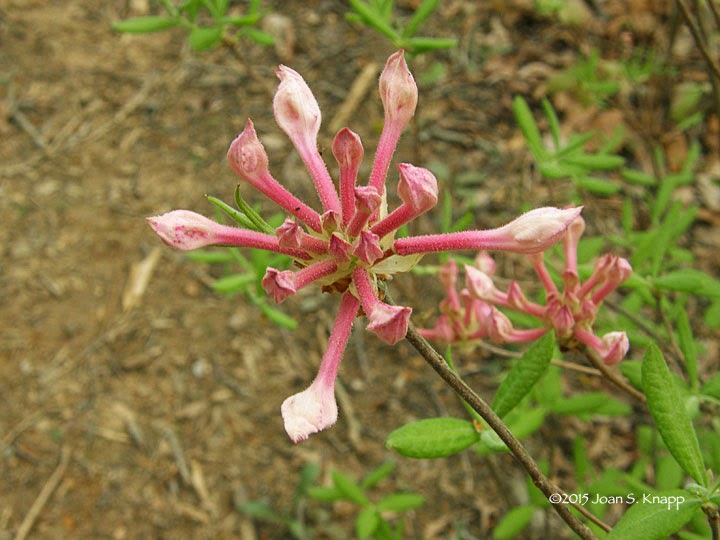
Rhododendron canescens is known as the Sweet Pinxter Azalea, Pinxter Azalea, Pinxter Flower, Hoary Azalea, or Mountain Azalea. Pinxter Azaleas grow at several places along the lake shore at Fort Yargo State Park; particularly along sections of segments, 2, 6, and 13. Most years they provide blazing displays of flowers. Unfortunately, many of these plants were cut down and place in the lake to attract fish. There were some very limited displays but the flowers only lasted for a week or so. Hopefully, these plants will grow back in flower profusely again in future years.

The flower buds have a lot of character

Very early

A little further along

And further yet

Opening in the shade along segment 13.

Opening at the lake’s edge

In happier days

Rhododendron canescens
is native to the United States. It grows in the southeastern United States from Virginia south to Florida, west to Texas and Oklahoma as well as in Kentucky, Pennsylvania and Maryland.

Click on an image to view a larger image


Distribution Map:

- United States Department of Agriculture Plants Database: Rhododendron canescens (Mountain Azalea)


Identification resources:

- Southeastern Flora: Mountain Azalea (Rhododendron canescens)

Related posts:
- 2010: Year Of The Wildflower

- Piedmont Azalea: Rhododendron canescens