Showing posts with label Clarks Hill WMA. Show all posts

Wednesday, May 23, 2012

Indian Pink (Spigelia marilandica)

May 4th – 12th. We spotted Indian Pinks first on a rural road in Hancock County and then the following day in the Clarks Hill Wildlife Management Area in McDuffie County. The following weekend we found them again in the Piedmont National Wildlife Refuge in Jones County. I had seen photographs of this wildflower but had never encountered it in person.

It’s just a fleeting glimpse of red that grabs your attention.

A single stem with opposite leaves and a cluster of flowers at the top.

The arrangement of the flowers from the side, and…

from the top.

The showiest plants were in the Piedmont NWR near Allison Creek.

This plant had branched to produce two flower heads, from the side, and…

*****
from the top.

A close view of the flower.

It will be interesting to try and follow a couple of plants. According to ‘Name that plant,’ the plant produces ‘irregularly angled’ black seeds with that are catapulted before the seed capsules appear fully ripe.’


Spigelia marilandica
(Indian Pink, Woodland Pinkroot, Wormgrass) is native of the United States where it’s found in states southeast of a line from Maryland to Indiana and Illinois and southwest to Missouri, Oklahoma and Texas. In Georgia, it’s found in many counties throughout the state but more frequently in north Georgia and in southern counties.

Click on an image to view a larger image


Identification resources:

- Southeastern Flora: Spigelia marilandica (Indian Pink)

- Name that Plant: Native and Naturalized Plants of the Carolinas and Georgia
: Spigelia marilandica (Indian Pink, Woodland Pinkroot, Wormgrass)

- Missouri Plants:
Spigelia marilandica

Distribution:

- United States Department of Agriculture Plants Database: Spigelia marilandica (Woodland Pinkroot)

- University of North Carolina Herbarium: Spigelia marilandica

Monday, September 19, 2011

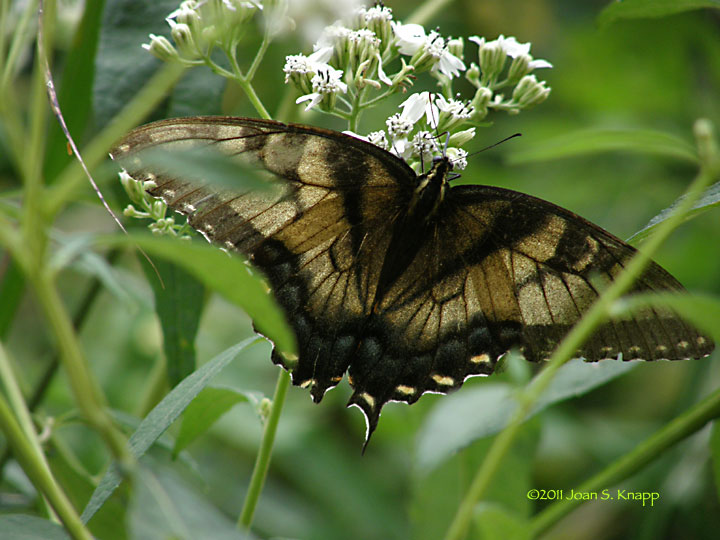
Eastern Tiger Swallowtail (Papilio glaucus): Intermediate

September 4, 2011. When we drove up to the White Crownbeard (Verbesina virginica) plants, several butterflies were feeding on the flowers. In addition to a yellow Eastern Tiger Swallowtail (Papilio glaucus) and a Monarch (Danaus plexippus), there was a dark swallowtail. I assumed it was a black female. When I got close enough to take the photo, it was clear that this butterfly was different. I could see…

the black rib pattern of the yellow form showing through the dark colored wings.

I’d never seen a butterfly like this before but a little research revealed that the female could exist in several forms including this rare ‘intermediate’ form. A lucky find.


See other photos of the intermediate form here and here.

Click on the image to view a larger image

Identification resources:
- Micheal Beohm, West Central Georgia Butterflies: Eastern Tiger Swallowtail (Papilio glaucus)

- Butterflies and Moths of North America: Eastern Tiger Swallowtail (Papilio glaucus)

Thursday, September 15, 2011

Clarks Hill WMA: Osprey Nest Stands

On our way back from South Carolina, we checked out several roads into the Clarks Hill Wildlife Management Area in McDuffie County, Georgia.

We drove out to the lake shore of J Strom Thurman Reservoir on the Savannah River and saw…

this stand. First thought, at this time of year when the hunting season is starting, was that they were deer stands but the location was wrong; they wouldn’t be out in the open like this. It only took a couple of minutes to realize that these were Osprey (Pandion haliaetus) nest stands. There were five of them in a row along the shoreline.

this one, and…

this one, and…

these two.

Sadly, there was no evidence – nest materials in the stands – that these stands had been used this season.
They look a little the worse for wear. We’ll check back next year to see if there’s any activity – just in case.
Click on an image to view a larger image


Identification resources:

- All about Birds: Osprey (Pandion haliaetus)

- The Osprey (Pandion haliaetus)