Showing posts with label Jasper County. Show all posts

Thursday, July 24, 2014

Piedmont National Wildlife Refuge: Fivelobe cucumber (Cayaponia quinqueloba)


July 17th, 2014. 
Fivelobe Cucumber (Cayaponia quinqueloba) 
Piedmont NWR, Jasper County, GA

We spotted this cucumber plant near one of the many fords in the refuge. Some still had remnants of the flowers attached. These fruit will turn red as they ripen.
 
Related posts:  


Wednesday, July 23, 2014

Piedmont National Wildlife Refuge: Halloween Pennant (Celithemis eponina)


July 17th, 2014. 
Halloween Pennant (Celithemis eponina) on grass stem at Pond 2A 
Piedmont NWR, Jasper County, GA

Halloween Pennants are common at Pond 6A and Pond 2A in the Fall; there were just a few at this visit. This pennant, a male, was perched in a breezy area and was moving its wings rapidly to maintain its balance. 
 
Related posts: 

Tuesday, July 22, 2014

Piedmont National Wildlife Refuge: Golden-winged Skimmer (Libellula auripennis)


July 17th, 2014. 
Golden-winged Skimmer (Libellula auripennis) on sedge stem at Pond 6A 
Piedmont NWR, Jasper County, GA

This is the first time that I’ve seen a Golden-winged Skimmer. They may be found throughout Georgia from May through September.
 
Related posts:  

Monday, July 21, 2014

Piedmont National Wildlife Refuge: Green Lynx Spider (Peucetia viridans) on Rosepink (Sabatia angularis)


July 17th, 2014. 
Green Lynx Spider (Peucetia viridans) on Rosepink (Sabatia angularis) 
Piedmont NWR, Jasper County, GA

I was clearing grass blades away from the plant and almost missed this Green Lynx spider which was nicely camouflaged.
 
Related posts: 

Sunday, July 20, 2014

Piedmont National Wildlife Refuge: Rosepink (Sabatia angularis)

July 17th, 2014. 
Rosepink (Sabatia angularis)
Piedmont NWR, Jasper County, GA


Plants were in bloom along the roadside and in many open meadows
More information on this flower here.

Related post:
- Piedmont National Wildlife Refuge: Pond 6A

Saturday, July 19, 2014

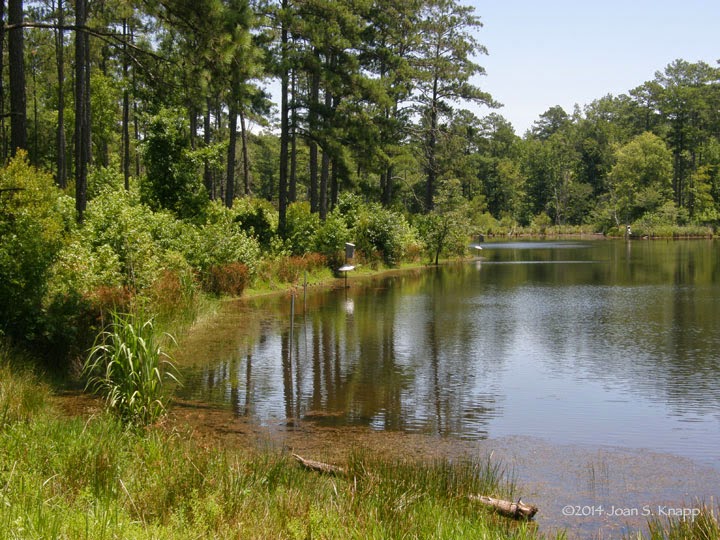
Piedmont National Wildlife Refuge: Pond 6A


July 17th, 2014.
North shore, Pond 6A 
Piedmont NWR, Jasper County, GA


Tuesday, September 25, 2012

Red-spotted Purple (Limenitis arthemis): Up Close And Personal


August 31st, 2012. While we were looking for wildflowers below the dam at Fox Lake in the Charlie Elliott Wildlife Center in the Clybel Wildlife Management Area, I almost trod on a Red-spotted Purple (Limenitis arthemis) butterfly that had settled on a grass stem a few inches above the ground. I was able to pull the grass stem without disturbing the butterfly.


 From above

A closer view of the top of the head with two white, triangular spots

The underside

A closer view

*****
*****
Closer views of the head

We left it sunning itself on a leaf.
Click on an image to view a closer image

Identification resources:
- Butterflies and Moths of North America: Red-spotted Purple (Limenitis arthemis)
- BugGuide: Red-spotted Purple (Limenitis arthemis) [dorsal] [ventral] 

Related posts:
- Jewelweed (Impatiens capensis)

Monday, September 24, 2012

Jewelweed (Impatiens capensis)


August 31st, 2012. We didn’t have a lot of time so we made a quick trip to the Charlie Elliott Wildlife Center in the Clybel Wildlife Management Area in Jasper County, Georgia. Jewelweed (Impatiens capensis) is not common in the counties around here. The best place to find them is in moist areas and we found a stand of plants by Murder Creek Church Road belong Fox Lake.
 
Can’t see the trees for the forest

The leaves. The bushes may grow to 7 to 8 feet.

*****
*****
*****
The flower, from different angles

Impatiens capensis (Jewelweed, Spotted Jewelweed, Spotted Touch-me-not, Orange Jewelweed, Orange Touch-me-not) is native to the United States, where it’s found in eastern states from New England to North Dakota and south, including Colorado, to Texas; It also occurs in Washington, Oregon and Idaho. In Georgia, it’s found mainly in counties in the northern part of Georgia although it’s not been formally documented from Jasper County. In north Georgia, they can be found growing by the highway in some places.
This plant gets the name 'Touch-me-not.' not because it has stinging hairs but because touching the mature seedpods causes them to release the seeds explosively. 
Click on an image to view a larger image

Identification resources:
- Southeastern Flora: Impatiens capensis (Jewelweed)
- Name that Plant: Native and Naturalized Plants of the Carolinas and Georgia: Impatiens capensis (Spotted Jewelweed, Spotted Touch-me-not,Orange Jewelweed, Orange Touch-me-not)
- Missouri Plants: Impatiens capensis

Distribution:
- United States Department of Agriculture Plants Database: Impatiens capensis (Jewelweed)
- University of North Carolina Herbarium: Impatiens capensis

Related post:

Sunday, September 23, 2012

Charlie Elliott Wildlife Center: Wildfowers At Fox Lake

August 31st, 2012. We didn’t have a lot of time so we made a quick trip to the Charlie Elliott Wildlife Center in the Clybel Wildlife Management Area in Jasper County, Georgia. One of the roads, Murder Creek Church Road, passes below the dam impounding Fox Lake (still called Boyle Lake Number Five on Google Maps). This is a moist area and a good place to look for wildflowers.


Desmodium canescens (Hoary Ticktrefoil)?

Flowers at the tip of the stem

The leaves

A flower, up close

A drama was playing out among the flowers, This Green Lynx spider (cc) had caught a bumble bee – as big and probably heavier than itself - and was figuring out how to converit from prey to dinner.

Ipomoea lacunosa (Whitestar)

The flower and leaf

A closer view of a flower

Ipomoea coccinea (Redstar)

The tube

Close up of the face of the flower

Helenium amarum (Bitter Sneezeweed)

This wildflower is one of the most faithful bloomers throughout the dry months.

Diodia virginiana (Virginia Buttonweed)

Grows like a grass along the ground and is easy to overlook

Impatiens capensis (Jewelweed)

Jewelweed is not common in this area but can be found in moist areas

Erigeron strigosus (Daisy Fleabane)

These plants bloom in the spring but don’t bloom well during the heat of summer. They seem to bounce back when it cools down again.

Apios americana (Groundnut)

A flower head

The leaves

Closer view of the individual flowers. It would have been easy to overlook these flowers since they blend into the vegetation.

Verbena brasiliensis (Brazilian Vervain)

Dellcate flowers on tall plants. The flowers are only about 1/4 inch diameter but the plants may be 5 to 6 feet tall.

Quite a variety of wildflowers made the trip worthwhile.
Click on an image to view a larger image

Identification resources:
Southeastern Flora:

Name that Plant: Native and Naturalized Plants of the Carolinas and Georgia:

Missouri Plants:
Distribution:
United States Department of Agriculture Plants Database:
- Ipomoea lacunosa (Whitestar) 

Tuesday, September 11, 2012

Velvetleaf Ticktrefoil (Desmodium viridiflorum)?


August 25th, 2012. Another visit to the Piedmont National Wildlife Refuge. As we were driving down Starr Road from GA-83 through the Oconee National Forest in Jasper County, we saw a leafless stem covered with flowers. The flowers were still in good shape so we stopped to take a closer look. It was a Desmodium species but which one? There are so many. I came to the conclusion that this is Desmodium viridiflorum (Velvetleaf Ticktrefoil) but welcome any correction.
This was a very robust plant. The stem reached about 4 feet from the vegetative part of the plant which stood about 2 feet high.

The tip of the stem which was quite thick and strong.

The leaves were about 1-1/2 inches long and roughly ‘velvety’

Flowers of the Desmodium species have ‘clear’ pink petals, in contrast to the opaque, ‘streaky’ pink and white flowers of the Lespedeza species and  have two ‘eye spots’ at the base of the banner petal.

This view gives a better view of the ‘eye spots’ and shows the fused stamens. A free stamen is also visible

An even better view of the fused and free stamens and the calyx.

Seed pods of a Desmodium species (not D. viridiflorum) showing the typical branch or chain that gives the genus its name. The seed pods have hooks that act like Velcro and stick to the fur of passing animals or clothing on humans

A sock to which desmodium seed pods have attached showing how effective this method of seed dispersal is. It takes quite a while to pick these off.

Desmodium viridiflorum (Velvetleaf Ticktrefoil, Velvety Tick-clover) is native to the United States, where it’s found in states southeast of a line from Connecticut-Pennsylvania west to Missouri and southwest to Oklahoma and Texas. In Georgia, it’s been documented in several counties throughout the state.
Click on an image to view a larger image

Identification resources:
- Name that Plant: Native and Naturalized Plants of the Carolinas and Georgia: Desmodium viridiflorum (Velvety Tick-clover)
- Missouri Plants: Desmodium viridiflorum
- Virginia Tech Weed Identification Guide: Desmodium viridiflorum

Distribution:
- United States Department of Agriculture Plants Database: Desmodium viridiflorum (Velvetleaf Ticktrefoil)
- University of North Carolina Herbarium: Desmodium viridiflorum