Showing posts with label McDuffie County. Show all posts

Sunday, August 2, 2015

Road Trip: Wilkes – McDuffie Counties, June 26th, 2015 (Part 2)


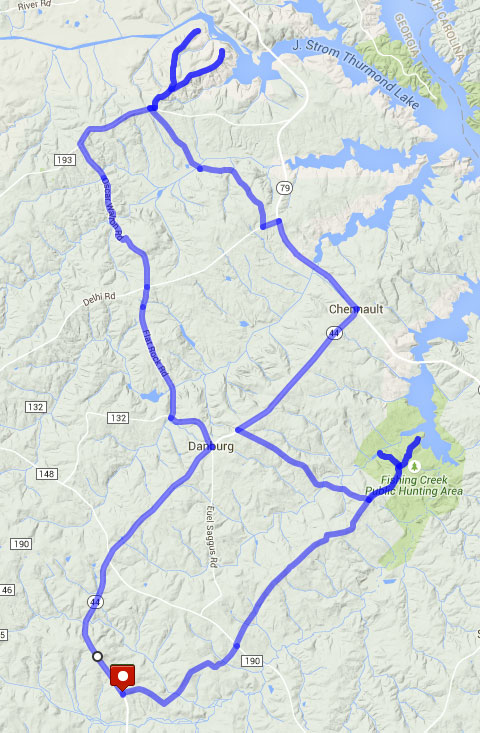
June 26th. (Continued from…). Once again, it was time for a road trip to monitor frogs. So, as usual, we used the trip to scout wildflowers.
From Enoch John Road, we crossed Sandtown Road onto Jones Chapel Road, heading for the Fishing Creek Wildlife Management Area (WMA). Part way down the road, we were confronted with more than…


two dozen Variegated Fritillaries (Euptoieta claudia) ravenously feeding on Lanceleaf Coreopsis (Coreopsis lanceolata) flowers. These were the only flowers in sight and the fritillaries were making the best of them. They were moving so rapidly, I only managed this one shot.

The Fishing Creek WMA isn’t the greatest place for wildflowers but we can count on finding Clasping Milkweed (Asclepias amplexicaulis) in a couple of places. These plants are easy to identify, even when they are not in bloom; their…


leaves look leathery with undulating margins but the cardinal characteristic is how they ‘clasp’ around the stem. Several plants had…


developing seed follicles. This one was outstanding, with four follicles. 

We drove down to a point overlooking the Fishing Creek inlet to Clarks Hill Lake on the Savannah River, where…


Buttonbushes (Cephalanthus occidentalis) were blooming over the water. 

A small movement on the ground attracted my attention. It was a…


Small toad – about ½ to ¾ inches long. It hopped ahead of me and stayed in the shade, making photographing it challenging. It’s probably a Fowler’s Toad (Anaxyrus [Bufo] fowleri). It’s not the first time we’ve seen baby toads in this same spot.
We headed back out of the WMA and turned right on Ohara Standard Road, where we had found Narrowleaf Evening Primrose (Oenothera fructicosa) plants in bloom on our previous trip.

This time, some Butterfly Milkweed (Asclepias tuberosa) were still blooming. Being almost the only ‘game in town,’ they had attracted a…


Gray Hairstreak (Strymon melinus), and a…


Thread-waisted Wasp (Ammophila sp.), neither of which was discouraged by my presence. 

We headed over to the Broad River WMA via Bolton Road where we were tantalized by the sight of…


Clematis sp. seeds. Based on the flowering seasons of Clematis sp., these probably were one of the species with small, bell-shaped flowers. These may have been blooming on our previous trip but we overlooked them because they would blend into their background. We’re going to make a note to look for flowers earlier in the year now that we know precisely where to look for them. 


We still had plenty of sunlight left. We can’t start the frog survey until dark when the frogs start to call. So we decided to drive down GA-17 to Clarks Hill WMA. This is a better spot for wildflowers. At the right time of year, we’ve found Birdfoot Violets (Viola pedata), White Wild Indigo (Baptisia alba), and Indian Pink (Spigella marilandica). The roadside is mowed and the edge of this zone is often the best plat to find wildflowers. 

At the end of one road, we found…


Pigeonwings (Clitoria mariana), and a…


Spiked Hoarypea (Tephrosia spicata). 

At the edge of the woods, we saw a…


tree that had been thoroughly worked over by woodpeckers. 

Right at the edge of the mowed area, we spotted a lone…


Rosepink (Sabatia angularis) plant in...


bloom. It would have been easy to miss this in the late afternoon sun. 

We found one of the gates that is usually closed was open so we took the opportunity to drive through and we made our final spotting of the day.


From a distance, the plants did look like much, but there were a lot of them. When I walked over to them, I could see the similarity of the…


flower heads to the Hoary Mountainmint (Pycnanthemum incanum).


The leaves, however, were quite narrow compared with the Hoary Mountainmint. A little bit of research revealed that this was the Narrowleaf Mountainmint (Pycnanthemum tenuifolium).


Close-up views of the flowers. 

Once again, we had a successful trip meeting old friends, encountering some mysteries, and making at least one new friend.

Related posts:

Thursday, April 18, 2013

Clark Hill Wildlife Management Area: Early Spring Wildflowers

-->
April 6th, 2013. We drove over to the Clark Hill Wildlife Management Area to look for Adder’s Tongue ferns. We didn’t find any but were treated to a number of early spring wildflowers.

Green-and-gold (Chrysogonum virginianum)

We saw only one small patch of these on the north side of the road just around the bend from the check-in station. This species is found in many counties in north Georgia as well as some counties in south Georgia.


Birdfoot Violet (Viola pedata)

These were growing on the south side of the road just around the bend from the check-in station and extended for one-quarter to one-half a mile. The area on the north side of the road had been burned recently so it wasn’t possible to determine if these also grew on that side of the road. This species is also found more frequently in north Georgia counties than in south Georgia counties


An unusual white variant


Yellow Stargrass, Hairy Yellow Stargrass, Common Stargrass (Hypoxis hirsuta)

There were just a couple of Yellow Stargrass plants on the top of the embankment among the Birdfoot Violets. One was doing well; the other was not thriving. This species may be found in many counties throughout Georgia


Rattlesnakeweed, Veiny Hawkweed (Hieracium venosum)

Rattlesnake Weed plants are easily recognized by the characteristic leaf coloration. These were just setting buds and will be flowering before long. This species is found more frequently in counties in north Georgia than in south Georgia.


Trumpet Honeysuckle (Lonicera sempervirens)

We found Trumpet Honeysuckle blooming in a couple of places. This species may be found in counties throughout Georgia.


The characteristic perfoliate leaves


Hog Plum, Flatwoods Plum (Prunus umbellata)

These trees were blooming in many places in the WMA. This particular plant was only three to four feet high which made photographing the flowers easy. This species may be found in counties throughout Georgia except for the most northen counties.


Resurrection Fern, Scaly Polypody (Pleopeltis polypodioides)

We found some nice specimens of Resurrection Fern, a species that may be found in counties throughout Georgia.


Yellow Thistle (Cirsium horridulum)

This species may have cream, pink or maroon flowers. The plants in this area weren’t producing the foot-high flower stalks I’m familiar with at home. The flower stalks were almost non-existent; the plants were producing flowers at ground level. This species is found in many counties in Georgia.


Flowering Dogwood (Cornus florida)

We didn’t see too many Flowering Dogwoods in the WMA. This tree was in full bloom at the edge of the woods not far from the lake. This species may be found in counties throughout Georgia.


I didn’t expect to find as many wildflowers in bloom in this area so it was a pleasant surprise to find so many plants in bloom.

Click on an image to view a larger image


Identification resources:


Southeastern Flora:


Natural and Naturalized Plants of the Carolinas and Georgia:


Distribution:

United States Department of Agriculture Plants Database:


Related post:

- Trumpet Honeysuckle (Lonicera sempervirens): Berries & Seeds 


Wednesday, May 23, 2012

Indian Pink (Spigelia marilandica)

May 4th – 12th. We spotted Indian Pinks first on a rural road in Hancock County and then the following day in the Clarks Hill Wildlife Management Area in McDuffie County. The following weekend we found them again in the Piedmont National Wildlife Refuge in Jones County. I had seen photographs of this wildflower but had never encountered it in person.

It’s just a fleeting glimpse of red that grabs your attention.

A single stem with opposite leaves and a cluster of flowers at the top.

The arrangement of the flowers from the side, and…

from the top.

The showiest plants were in the Piedmont NWR near Allison Creek.

This plant had branched to produce two flower heads, from the side, and…

*****
from the top.

A close view of the flower.

It will be interesting to try and follow a couple of plants. According to ‘Name that plant,’ the plant produces ‘irregularly angled’ black seeds with that are catapulted before the seed capsules appear fully ripe.’


Spigelia marilandica
(Indian Pink, Woodland Pinkroot, Wormgrass) is native of the United States where it’s found in states southeast of a line from Maryland to Indiana and Illinois and southwest to Missouri, Oklahoma and Texas. In Georgia, it’s found in many counties throughout the state but more frequently in north Georgia and in southern counties.

Click on an image to view a larger image


Identification resources:

- Southeastern Flora: Spigelia marilandica (Indian Pink)

- Name that Plant: Native and Naturalized Plants of the Carolinas and Georgia
: Spigelia marilandica (Indian Pink, Woodland Pinkroot, Wormgrass)

- Missouri Plants:
Spigelia marilandica

Distribution:

- United States Department of Agriculture Plants Database: Spigelia marilandica (Woodland Pinkroot)

- University of North Carolina Herbarium: Spigelia marilandica