Showing posts with label Insect. Show all posts

Friday, August 10, 2012

Exploring…


August 4th, 2012. We’ve spent a lot of time along a single road in the Scull Shoals Experimental Forest in Greene County, Georgia. We decided to explore the roads north and east of here in the Oconee National Forest that includes both Greene and Oglethorpe counties. Given how dry it’s been this year, we found quite a variety of flowers.
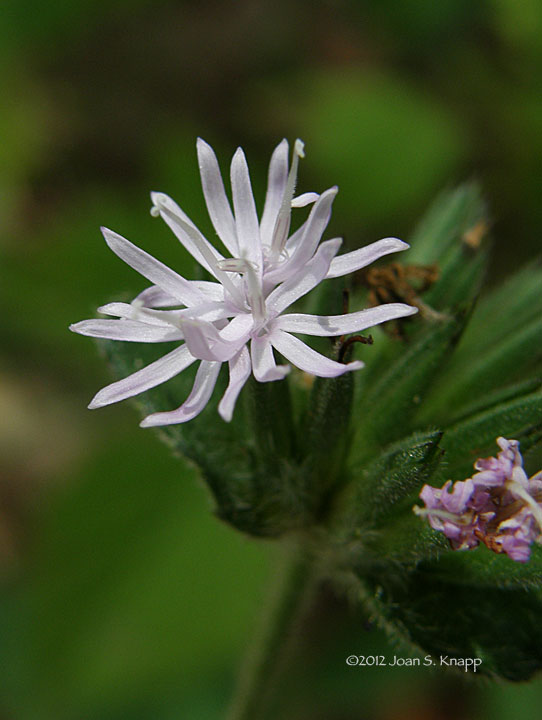


Carolina Elephantsfoot (Elephantopus carolinianus)  


Pencil flower (Stylosanthes biflora) 


A Lespedeza sp, L. bicolor? 


 A bee fly


St. Peter's wort (Hypericum crux-andreae)


 Hoarymountainmint (Pycnanthemum incanum) with a friend
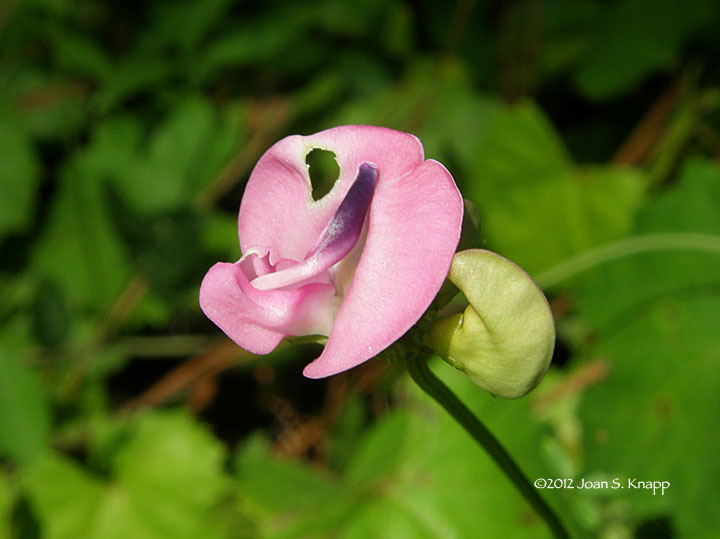

 Amberique-bean (Strophostyles helvola)


 Sweet everlasting (Pseudognaphalium obtusifolium). These are were just starting to bloom.


Spurred Butterfly Pea (Centrosema virginianum)


 Carolina thistle (Cirsium carolinianum)


 Rosepink (Sabatia angularis). We found only one plant.


 Yellow Buckeye (Aesculus flava)?  The nuts look like Asculus flava.


Pearl Crescent (Phyciodes tharos) on Lance Coreopsis (Coreopsis lanceolata)

Next: The highlights…
Click on an image to view a larger image

Sunday, April 24, 2011

Periodical Cicada (Magicicada tredecim)

The cicada world is abuzz in anticipation of the emergence of Brood XIX of the 13-year cicadas.

I know this now, but I was clueless yesterday morning when W and I went down to the Piedmont National Wildlife Refuge in Jasper County, Georgia, to see if we could spot Red-cockaded Woodpeckers (Picoides borealis). We were also looking for butterflies and wildflowers including plants of Asclepias sp. that we had seen last Fall. But we’re also on the lookout for anything unusual – and 'unusual' is what we encountered yesterday.


We were driving into the refuge along Sugar Hill Road from Hillsboro. Something relatively large and with clear wings flew across in front of us and settled on a leaf of a Sweetgum (Liquidambar styraciflua) tree. We piled out of the truck with cameras in hand, fully expecting what ever it was to fly off. But it didn’t and we found ourselves looking at a red-eyed cicada. This was noteworthy since most of the cicadas we usually encounter have brown or green eyes. This cicada flew off. I started stalking a Pipevine Swallowtail (Battus philenor) and W wandered over to the other side of the road where he found another red-dyed cicada, and then another one, and another…

A cicada posing on the leaf of a Sweetgum tree.

Another cicada posing on the trunk of a Loblolly Pine (Pinus taeda).

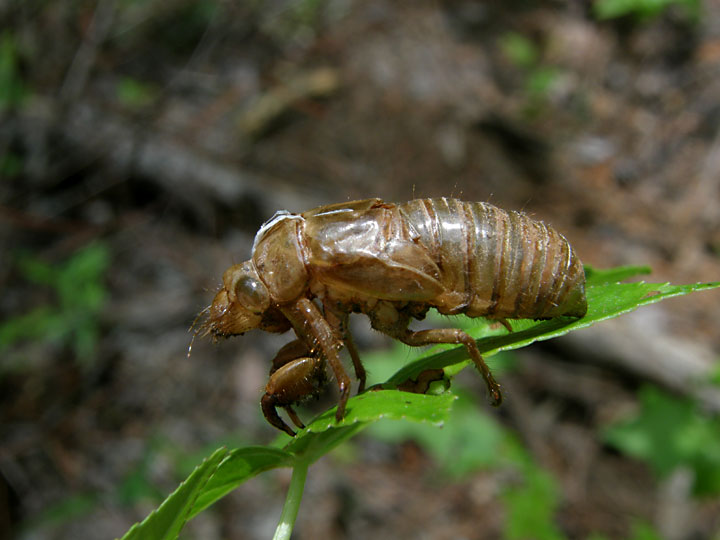
As we looked around, we found skins such as this one on a Sweetgum leaf, the trunk of a nearby Loblolly Pine, and on a twig.

The cicada flew from the pine trunk onto the ground where it blended into its surroundings. I'd watched its flight path and found it. It was easy to pick it up gently and…

It posed on my hand for some time before I returned it to a tree branch.

It was early afternoon when we found the cicadas and they were calling in the woods to the south of Sugar Hill Road. So many were calling that it wasn't possible to distinguish individual calls.


Based on the distribution of Magicada sp., this species is Magicada tredicem.


Dr. Nancy Hinkle and colleagues at the University of Georgia are studying the emergence of Brood XIX this year. If you live in Georgia and find these cicadas, please take a few moments to take photos of cicadas and shed cicada skins that you find as well as some notes on where you found them, and e-mail them to Insects@uga.edu.


You can also report your sighting at the magicada Brood XIX website
Click on an image to view a larger image

Information and Distribution Maps:

- www.magicada.com: Brood XIX

- www.magicada.com: Magicicada tredecim

- www.magicada.com: Magicicada neotredecim

- NPR:
'Brood 19' cicadas poised to swarm the South

- Nancy Hinkle: Calling All Cicada Seekers

- Walter Reeves: Have You Seen This Creature?

Thursday, April 22, 2010

Bee Fly (Bombylius sp.)

While I was photographing the Chokeberry flowers, the strangest little creature flew up, fed on the flower for a few seconds and then flew off. It looked like an alien insect - brown and furry – with a long proboscis. I was fascinated but managed a couple of quick shots before it took off. It made a moderately loud buzzing sound so I was able to follow it even though I could barely see it. It flew down the shore line a little way and then circled back for a second go at the flower I was photographing.

Here it is…
I didn’t have the faintest idea what it was but searched Google Images using ‘flying insect long proboscis’ with not much hope of finding it. But, there on the first page were two images that resembled it. It appears to be a bee fly, Sparnopolius confuses. I only got a good look from the front and, although I had a reasonable idea of what it looked like, I couldn’t get a photograph of the entire insect. It left a second time and didn’t return.


I didn’t expect to see another one. But I was standing in a weed patch at home photographing butterflies when I saw another one. Talk about a nervous and deliberate insect. This fly approached the dead goldenrod over my shoulder and, like a helicopter, hovered for the longest time, trying to decide whether to land. It aborted its landing and flew around in a circle and approached a landing again and again and again and… Finally it would land but only stay for a few seconds before it repeated the whole process again and again and again. I stood there for about 30 minutes waiting to get a photograph. I’d decide to leave but then wait just in case… It seemed really nervous. Even refocusing the camera was enough to startle it into another flight and approach.

Surprisingly it landed on the foliage on the ground and I managed to get a photograph that shows the pigment pattern on its wings.

I searched Bug Guide. There are two genera that contain species that resemble this insect; Sparnopolius and Lordotus. The insects color resembles Sparnopolius confuses.None of the photographs in Bug Guide show this pigment pattern on the wings. Allison Hazen’s photograph has identified ‘her’ insect as Sparnopolium confuses and does indicate a similar pigment pattern on its wings.

Any thoughts on this identification?


Many thanks to Zombieroach for correcting my identification. Bombylius sp. do exhibit the pigment pattern on the wings.
Click on an image to view a larger image


Identification resources:
-
Bug Guide:
- Bee Fly (Sparnopolius confusus)

-
Bee Fly (Bombylius sp.)
- Allison Hazen. Best of (Macro Photography) (Set): Bee Fly (Sparnopolius confusus)

Sunday, December 6, 2009

Bess Beetle: Horned Passalus (Odontotaenius disjunctus)

This post was submitted to An Inordinate Fondness #2. Visit Birder's Lounge to learn more about beetles.

This Horned Passalus was making its way very slowly and gracefully over a fallen tree branch by the path just opposite the pool. The temperature was about 45 F which probably explains why it was moving so slowly. It had lost one antenna. When I picked it up to photograph the remaining antenna, it doggedly continued its steady pace across my hand. When I placed it back on the log, it simply moved on to the leaf litter as if nothing had happened.


The beetle…

The antenna…
Click on an image to view a larger image

Identification resources:
- Bug Guide: Horned Passalus (Odontotaenius disjunctus) [Beetle] [Antenna]

Related posts:
- Woods in the Fall

Monday, October 26, 2009

Common Eastern Bumblebee: Last Insect of the Season?

This year the fall weather has been wetter and cooler than last year. Most of the wildflowers are ‘done’ for the season. There are a few dandelions, goldenrod and a couple of flowers left on the butterfly bush. This Common Eastern Bumblebee is among the last insects of the season.

During the day, they are feeding on the few remaining wildflowers...

In the evening they settle where they can. This one has taken refuge in one of the last flowers on the butterfly bush.
Click on an image to view a larger image