Showing posts with label Green Arrow Arum. Show all posts

Friday, October 9, 2015

Summer On A Fort Yargo State Park Trail: Section B To The Dam, August 12th (Part 2)


August 12th. (Continued from…). When I visited Fort Yargo State Park in mid-February, there were few signs of Spring. The only wildflower plants that were obvious were the leaves of Cranefly Orchids (Tipularia discolor) that I found in many places.


The route… I’ve described it here, here, here, and here This walk doesn’t have the variety of wildflowers as my other walk from the Group A Shelter to the Old Fort but it does have some gems. One of the Smallflower Pawpaw (Asimina parviflora) had developed fruit that, unfortunately, it had lost; the Pink Lady’s Slipper (Cypripedium acaule) Orchids had bloomed, and some Green Adder’s-mouth (Malaxis unifolia) Orchids had bloomed and two were setting seeds. The slime molds appeared to be finished for the season. For the moment, some wildflowers we still blooming but there was a lull between seasons.


The seed capsules on the Hairy Angelica (Angelica venenosa) at the beginning of the return trail didn’t appear to have changed over the previous two weeks; they still looked very healthy.


The fruits on the Green Arrow Arum (Peltandra virginica) hadn’t changed in size; these take a long time to mature.


The Bicolor Lespedeza (Lespedeza bicolor) shrubs along the trail were still blooming. These have a long blooming season along this trail.


Snake root (Sanicula sp.) plants had gone to seed. I missed the flowers, so couldn’t identify the species. In the lowers photo, the tiny hooks on the seed capsules are visible – which explains why, as they ripen, my socks were full of them when I came off the trail.


I found some Coral Slime (Ceratiomyxa fructiculosa) on a rotton log along the north section of the trail; there isn’t much at this time of year.


I don’t often see snails but one was making it’s way along the same moist log.


The leaf on the Green Adder’s-mouth Orchid plant, that had been drying up over the past two weeks, had perked up with recent rains. This plant is resilient; the seed capsules will probably mature.


When I reached the top of ‘The Hill,’ I found that a tall pine tree had fallen. Fortunately, it had been cut up to clear the trail. This would have been a hard tree to climb over and, in this location, even more difficult to walk around.


Hairy Elephantfoot (Elephantopus tomentosus) plants were still blooming near the edge of the main woods.


Out on the open section of trail, a Variegated Fritillary (Euptoieta claudia) was looking for food. It was hard to get a photo; it would open and close its wings immediately after landing and then would close them, probably to avoid the heat that was oppressive.
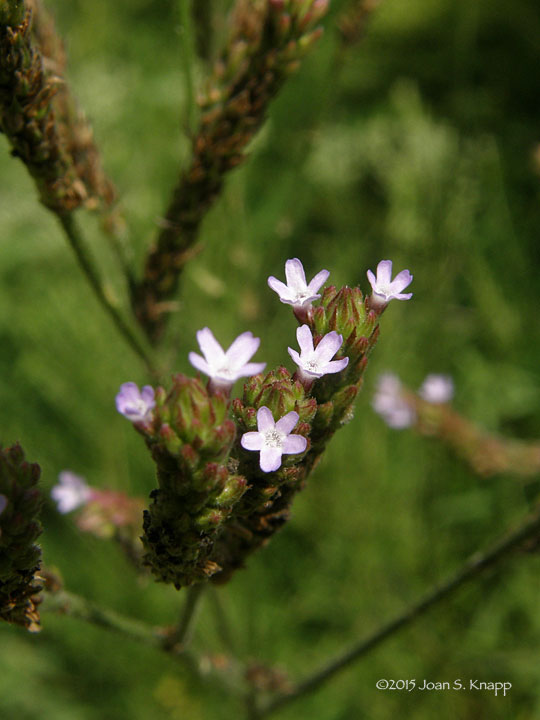

Brazilian Vervain (Verbena brasiliensis) had been blooming on the lower section of open trail for most of the summer.


The final treat of this walk was when I reached the Trumpetweed/Joe Pye Weed (Eutrochium fistulosum). I could see a couple of Eastern Tiger Swallowtails (Papilio glaucus) feeding high in the tall plant. The real treat was in the…


smaller plants, where I found six Eastern Tiger Swallowtails feeding, including a…


normal and a black female, as well as at least one…


male. A real treat!

Related posts:
- Summer On A Fort Yargo State Park Trail: Section B To The Dam, July 29th (Part 1)
- Spring Is In The Air: Fort Yargo State Park, Section B To The Dam, May 1st (Part 2)

Saturday, August 8, 2015

Summer On A Fort Yargo State Park Trail: Section B To The Dam, June 30th (Part 2)


June 30th. (Continued from…) When I visited Fort Yargo State Park in mid-February, there were few signs of Spring. The only wildflower plants that were obvious were the leaves of Cranefly Orchids (Tipularia discolor) that I found in many places.


The route… I’ve described it here, here, here, and here This walk doesn’t have the variety of wildflowers as my other walk from the Group A Shelter to the Old Fort but it does have some gems. One of the Smallflower Pawpaw (Asimina parviflora) had developed fruit that, unfortunately, it had lost; the Pink Lady’s Slipper (Cypripedium acaule) Orchids had bloomed, and some Green Adder’s-mouth (Malaxis unifolia) Orchids had bloomed and two were setting seeds. The occurrence of slime mold fruiting bodies added a new focus of interest for this walk.


The main flower head on the Hairy Angelica (Angelica venenosa) had finished blooming. The smaller flower head was in full bloom. It would be interesting to see if these set seed.


I stopped to check the mystery galls on the Blackjack Oak (Quercus marilandica) sapling. They were drying and hardening.


One of the leaves of the oak had been pierced by a pine needle. It’s amazing how these pine needles develop the force with to pierce a strong oak leaf when they fall.

I made my way off the trail and down into one of the gullies by the lake were a Green Arrow Arum (Peltandra virginica) had bloomed.

Several of the flower stalks had swollen at the tips, indicating that they were developing seeds.


One had been damaged and the developing seeds were visible through the wound. 


Indian Woodoats (Chasmanthium latifolium) were developing fruit along this section of the trail.


Further along the trail I found some Coral Slime (Ceratiomyxa fruticulosa vaar. fruticulosa) that had fruited on a fallen log.


For once, the Perfoliate Bellwort (Uvularia perfoliata) plant was bathed in sunlight.


The seed capsule was still developing


The Green Adder’s Mouth Orchids (Malaxis unifolia) was developing seed capsules.


Pipsissewa (Chimaphila maculata) plants were also developing seed capsules.


The trail just before the hill climb; it looks deceptively cool. 

I found a couple of lichens on a recently fallen branch.


The fruiting bodies on this lichen are in pristine condition;…


these fruiting bodies have ‘aged;’ the margins on these are worn compared with those on young fruiting bodies.


This fungus is a Brown-toothed Crust fungus (Hydnochaete olivacea). It’s dry and worn with time. It's fairly common but often overlooked.


Near the end of the trail, the Hoary Mountainmint (Pycnanthemum incanum) was still blooming.


Spurred Butterflypea (Centrosema virginianum) had just started to bloom on this trail; this was the first flower for this season.


The final sighting on this walk was some Aligatorweed (Alternanthera philoxeroides). A small patch of weed was growing just west of the bridge to the parking lot.

Related posts:
- Spring Is In The Air: Fort Yargo State Park, Section B To The Dam, May 1st (Part 2)