June 12th. When I visited Fort Yargo State Park in mid-February,
there were few signs of Spring. The only wildflower plants that were obvious
were the leaves of Cranefly Orchids (Tipularia discolor) that I found in many
places.

The route… I’ve described it here, here, here, and here This walk doesn’t have the variety of wildflowers as my other
walk from the Group A Shelter to the Old Fort but it does have some gems. One
of the Smallflower (Asimina parviflora) had developed fruit that,
unfortunately, it had lost; the Pink Lady’s Slipper (Cypripedium acaule)
Orchids had bloomed, and some Green Adder’s-mouth (Malaxis unifolia) Orchids
were blooming. The occurrence of slime mold fruiting bodies added a new focus of
interest for this walk.

Some of the Crown-tipped Coral fungus (Artomyces – formerly Clavicorona – pyxidatus) fruiting bodies were still present
on a fallen log by the trail near the entrance to the main woods. Another
fungal surprise were a…

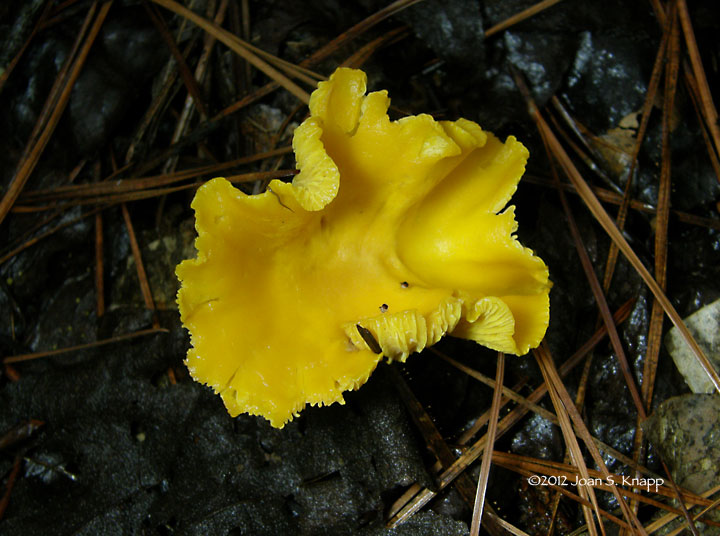
small patch of Chanterelles (Cantharellus cibarius)
mushrooms had sprung up by the trail were it turned to follow the lake shore.
During the previous week, I had heard a segment on the local NPR radio station
that the chanterelles would be up in ten days. I wasn’t so sure but here they
were…


Closer views of one of the mushrooms.

At the ‘Christmas Fern Grove.’ the Witch’s Butter (Tremella
mesenterica) jelly fungus that was thriving the previous week was starting to
dry up again.
I wanted to check the fallen log where I’d found the Red
Raspberry (Tubifera ferruginosa) slime mold the previous week. I’d
only found three small clusters of Chocolate Tube Slime (Stemonitis sp.) but I
didn’t expect to find much because it had been sunny and dry for several days.
But I was in for a surprise. I found that…

many more clusters of this slime mold had developed. These
included some…

new clusters that were just starting to release their
spores, and…

clusters that had shed most of their spores; all that was
left were the stalks and the sporangia, the network structures that hold the
spores.
Next to the Chocolate Tube slime sporangia were clusters of tiny
fruiting bodies of yet another slime mold. I’ve read that these may be Black
Pearl slime mold but I can’t find a scientific name associated with this common
name. These black fruiting bodies are truly tiny; probably only 1 to 2 mm high compared with the Stemonitis sp. fruiting bodies which are about 1.25 cm (0.5 inches) high.


A closer view of these indicates that they are small stalked
slime molds that I haven’t been able to identify.
The Red Raspberry slime molds from the previous week had
disappears but I found a few…

new ones on the other side of the log. I also found a small
patch of…


I continued up ‘The Hill’ to check the…

Tulip Poplar (Liriodendron tulipifera) fruit which were
still healthy. Nearby,…

Virginia Buttonweed (Diodia virginiana) were blooming.


Then towards the small pine woods with a final look…

back down the trail.

At the dam the Lanceleaf Coreopsis (Coreopsis lanceolata)
plants were still blooming and...


weevils were enjoying the flowers as well as each other.
(To be continued…)
Related posts: