Showing posts with label Beetle. Show all posts

Thursday, July 16, 2015

Margined Leatherwing (Chauliognathus marginatus)


June 17th. I spotted a number of these…
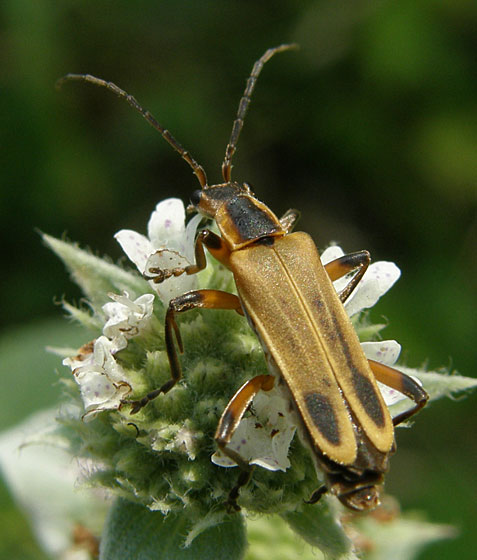

beetles feeding on flowers of the Hoary Mountainmint (Pycnanthemum incanum) at Fort Yargo State Park on June 17th. They weren’t colorful but were quite striking with their brown and black coloration. I submitted the images to Bug Guide where they were identified as the Margined Leatherwing (Chauliognathus marginatus).

The Margined Leatherwing is one of two species in the genus Chauliognathus; the second species is the Goldenrod Soldier Beetle (Chauliognathus pensylvanicus) also known as the Pennsylvania Leatherwing or Goldenrod Leatherwing. The Pennsylvania Leatherwing is more golden in color than the Margined Leatherwing. 


I realized that I had seen the Pennsylvania Leatherwing in October, 2012 in Stephens County. 

These species are similar in size, ½ to 5/8 inches long, and have tan to yellow-orange elytra. They may be differentiated physically by the markings on the pronatum and elytra. The Pennsylvania Leatherwing has a black spot in the center of the pronatum and two black spots near the tip of the elytra. The Margined Leatherwing has a dark band running from front to back of the pronatum and the patterns on the elytra may vary considerably.

The Margined Leathwerwing will be found in the spring in prairies and grasslands from New York state and Southern Ontario, west to Nebraska, and south to Texas, Mexico, Florida, and the Bahamas. The Pennsylvania Leatherwing will be found in the fall (mainly August-September) in open fields, prairies, grasslands, parks, roadsides, sand dunes and abadoned fields from New Brunwick to Mannitoba and south to Colorado, Texas, and Florida. Both species feed on nectar and pollen. The Margined Leatherwing may be found on a number of different species; the Pennsylvania Leatherwing, because of the time of year, mwy be found primarily on goldenrod. 

These are strikingly attractive beetles. I'm glad I saw the Margined Leatherwing this spring. I’ll be looking for the Pennsylvania Leatherwings closer to home in the fall.

Reference:
- Philips C., Fread E., and Tom Kuhar T. Department of Entomology, Virginia Tech. Leatherwing(Soldier) Beetles

Related posts: 

Tuesday, July 14, 2015

Spring Is In The Air: Fort Yargo State Park, Section B To The Dam, June 17th (Part 2)

June 17th. (Continued from…) When I visited Fort Yargo State Park in mid-February, there were few signs of Spring. The only wildflower plants that were obvious were the leaves of Cranefly Orchids (Tipularia discolor) that I found in many places.


The route… I’ve described it here, here, here, and here This walk doesn’t have the variety of wildflowers as my other walk from the Group A Shelter to the Old Fort but it does have some gems. One of the Smallflower (Asimina parviflora) had developed fruit that, unfortunately, it had lost; the Pink Lady’s Slipper (Cypripedium acaule) Orchids had bloomed, and some Green Adder’s-mouth (Malaxis unifolia) Orchids were still blooming.


The Hairy Angelica (Angelica venenosa) was still blooming.


The New Jersey Tea (Ceanothus americanus) seed capsules were still developing.


A Blue-fronted Dancer (Argia apicalis) was perched on a leaf, sunning itself.


Oak Apple Galls, one (Top) older than the other (Bottom) were still in good shape.


I was surprised to find a Pigeonwings (Clitoria mariana) plant blooming along this section of the trail.


The developing seed capsules on the Perfoliate Bellwort (Uvularia perfoliata) were still developing and healthy, and the…


spore packets on the Ebony Spleenwort (Asplenium playneuron) were still intact.


The Green Adder’s Mouth Orchids (Malaxis unifolia) had just about finished blooming, and…


seed capsules were developing. I counted 13 capsules developing on this plant.


Nearby, I found a couple of new Oak Apple galls on a sapling oak.


The developing seed capsules on Pipsissewa (Chimsphils maculata) plants by the trail still looked healthy.

I was hoping to find more slime molds on the logs near the…


top of ‘The Hill.’ All I found, however, were…

stalks remaining from three clusters of Chocolate Tube (Stemonitis sp.) slime mold.

On the open section of the trail back to the parking lot, I found…


the first Poorjoe (Diodia teres) flower of the season.


Brazilian Vervain (Verbena brasiliensis) plants were also blooming. There are a lot of these this year.


The Hoary Mountainmint (Pycnanthemum incanum) plants were still blooming.


Several Margined Leatherwing (Chauliognathus marginatus) beetles, one of the species of Soldier beetles, were feeding at the flowers. These beetles feed on pollen and nectar.


The final sighting on this walk was a handsome Red-spotted Purple (Limenitis arthemis) butterfly.


Related posts:  


Saturday, June 12, 2010

Metallic Wood-boring Beetle: Lined Buprestris (Buprestis lineata)

I noticed some movement on a tree trunk as I walked past. When I looked more closely, I could see a beetle; it blended well into the bark. It flew onto the ground where it was easier to see the markings. I’ve identified it as a metallic wood-boring beetle - Lined Bupestris (Buprestis lineata) - one of the less colorful of the these beetles.

On the tree bark; it really blends into the background of the bark. Only the movement gave it away.

A close-up. It has wonderful, big eyes

On the ground. It’s easier to see the markings.
Click on an image to view a larger image


Identification resources:

Bug Guide: Lined Buprestris (Buprestis lineata)

Tuesday, May 11, 2010

Eyed Click Beetle (Alaus oculatus)

I was photographing some wildflowers at Fort Yargo State Park when something flew straight at me and landed on my t-shirt. I was sorting myself out to pick it off and photograph it when it fell into the grass. I wasn’t able to find it but had gotten a good enough glimpse of it to know it was an Eyed Click Beetle (Alaus oculatus).

Although I couldn’t photograph this specific beetle, I had photographed one down by our creek a couple of years ago. Here it is…
I almost didn’t notice it in the grass-like Wartremoving herb (Murdannia keisak) that grows on the ledge above the creek. I moved out into the open to photograph it.


Even in the open - in the middle of the photograph - it's not very obvious. The ‘eyes’ on its thorax do, however, interfere with its ability to blend completely into its background.

A close up. It’s a handsome specimen
Click on an image to view a larger image


Identification resources:

- Bug Guide: Eyed Click Beetle (Alaus oculatus)

- Clemson University, Entomology: Eyed Click Beetle (Alaus oculatus)

Sunday, December 6, 2009

Bess Beetle: Horned Passalus (Odontotaenius disjunctus)

This post was submitted to An Inordinate Fondness #2. Visit Birder's Lounge to learn more about beetles.

This Horned Passalus was making its way very slowly and gracefully over a fallen tree branch by the path just opposite the pool. The temperature was about 45 F which probably explains why it was moving so slowly. It had lost one antenna. When I picked it up to photograph the remaining antenna, it doggedly continued its steady pace across my hand. When I placed it back on the log, it simply moved on to the leaf litter as if nothing had happened.


The beetle…

The antenna…
Click on an image to view a larger image

Identification resources:
- Bug Guide: Horned Passalus (Odontotaenius disjunctus) [Beetle] [Antenna]

Related posts:
- Woods in the Fall