This year the fall weather has been wetter and cooler than last year. Most of the wildflowers are ‘done’ for the season. There are a few dandelions, goldenrod and a couple of flowers left on the butterfly bush. This Common Eastern Bumblebee is among the last insects of the season.
 During the day, they are feeding on the few remaining wildflowers...
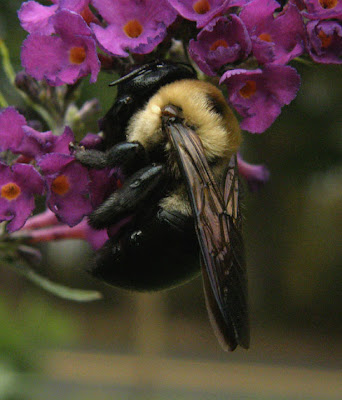 In the evening they settle where they can. This one has taken refuge in one of the last flowers on the butterfly bush.Click on an image to view a larger image
When the blueberries were in full bloom, the bushes seemed to be humming. At first glance, it looked like a mixture of just honey bees and bumblebees were responsible for the sound. Closer inspection showed that  European honey bee (Apis mellifera)
European honey bees (Apis mellifera) and 
 Eastern Carpenter bee (Xylocopa virginica)
Eastern Carpenter bees (Xylocopa virginica) – not bumblebees - were responsible for most of the activity.  Common Eastern Bumblebee (Bombus impatiens)
Common Eastern Bumblebees (Bombus impatiens) were in a minority compared with the other two.
A few halictid bees (Lasioglossum sp.) – ‘left over’ from their earlier pollination activities in the pear trees where they were the only bees working the flowers – and Northern Paper Wasps (Polistes fuscatus) were working the blueberries.
 Obviously they did a good job.
Click an image to view a larger image
 During the day, they are feeding on the few remaining wildflowers...
 In the evening they settle where they can. This one has taken refuge in one of the last flowers on the butterfly bush.
 European honey bee (Apis mellifera)
 Eastern Carpenter bee (Xylocopa virginica)
 Common Eastern Bumblebee (Bombus impatiens)
  Obviously they did a good job.