Showing posts with label Dockery Lake. Show all posts

Saturday, April 6, 2013

Early Spring At Dockery Lake

March 30th, 2013. Our first ‘major’ outing of the year was to Dockery Lake in the Chestatee Wildlife Management Area in the Chattahoochee National Forest. We had found interesting wildflowers along the road down last Fall and will revisit it during the year. We didn’t find many wildflowers blooming but it was interesting to spot evidence of wildflowers from last year and promises of wildflowers for this year.


The only wildflower we saw was the Common Periwinkle (Vinca minor). This is an non-native, invasive wildflower that we’ve seen in many areas in north Georgia and which spreads over large areas. It may start to bloom in January if the Winter is mild. Usually they have blue-purple flowers. This was a small patch near the day parking lot and I almost missed it because the flowers were…


white and blended into their background of brown leaves.


A close-up view.


We drove to where we had found wildflowers last year. We could see…


Leaves of the Cranefly Orchid (Tipularia discolor) on the embankment, with

Pipsissewa (Chimaphila maculata) in several places. There were several plants, some of which had seed pods.

We spotted seed pods of Downy Rattlesnake Plantain (Goodyera pubescens) and, upon close inspection of the area…

Quite a number of plants whose leaves were emerging.

The strangest thing we found was a cluster of grayish lime-green structures on the embankment. Upon close examination, they look like the skeletal mycelial remnants of stinkhorn fungi

The finest example showing the stalk and head, and

another specimen showing a head on a shorter stalk.

A view from the side that shows the skeletal structure of the stalk.  I would have liked to see these in their prime.


From this cove, we drove back up the road to where we had found the Pinesap (Monotropa hypopithys) last year.


We found a small cluster of flower stalks still present. These blend well into their background; it’s unlikely we would have seen these if we hadn’t known they were there.


A closer view. Photos of the blooms as we saw them last Fall. 
 
We spoke to rangers who passed by and they told us that the trilliums were blooming at Boggs Creek so we headed over there to take a look… 

Click on an image to view a larger image 

Identification Resources:
Southeastern Flora 
Natural and Naturalized Plants of the Carolinas and Georgia:


Distribution:
United States Department of Agriculture Plants Database:  
- Goodyera pubescens (Downy Rattlesnake Plantain)
 
- Pinesap (Monotropa hypopithys)

Saturday, September 29, 2012

Pinesap (Monotropa hypopithys)


September 1st, 2012. It was the Labor Day (US) holiday weekend so we took the opportunity to make an overnight trip into the Chattahoochee National Forest. Our first stop was a side trip down to Dockery Lake in the Chestatee Wildlife Management Area. We found interesting wildflowers and fungi along the road down to the lake and by the road near the lake.

As we drove along the level section of road before the climb back up to the highway, we spotted a nice specimen of coral fungus standing in an open area covered with fallen leaves. It begged to be photographed so I hopped out and made my way towards it. As I got near, I became aware of something else of interest; it was one of those ‘I think you’re going to want to see this’ moments. I’d found a small stand of Pinsap (Monotropa hypopithys). I knew about Indinapipes (Monotropa uniflora) although I’d never seen it but I didn’t know about Pinesap, its cousin. These were young plants; some were just emerging from the leaf litter.

There are only two species – M. uniflora and M. hypopithys – in the genus Monotropa. These plants are unusual in that they don’t contain chlorophyll and can’t produce energy by photosynthesis. They get energy by parasitizing fungi that grow in association with trees (mycorrhizal fungi). The ‘stems’ are not true stems but flower stems.

As a result the plants are not green but pale colors. According to Connecticut Wildflowers, flowers that grow in the summer are usually a pale lemon-green and those in the fall are reddish. Those we found were distinctly reddish.
 
A cluster of flowers in the leaf litter. These were growing in the shade but the sun would shine through fleetingly.

A closer view

A still closer view

A single flower stem showing the cluster of flowers at the top and the bracts

Looking down on flowers

A close-up view from the side

As we left, W spotted…

a cluster of flowers among the leaves

A closer view

*****
Close-up views of a couple of clusters

As we were photographing, a bumble bee flew up to feed on the flowers.

Monotropa hypopithys (Pinesap) is native to the United States where it’s been officially documented from all continental states except North and South Dakota, Utah and Nevada. In Georgia, it’s been officially documented in counties in far north Georgia as well as Greene, Barrow and Gwinnett counties. It has not been officially documented in Lumpkin County.

This was a totally serendipitous find. Although this flower wasn’t on our bucket list, it quickly made it on the list to be checked off. Now to keep an eye out for Monotropa uniflora (Indianpipes)
Click on an image to view a larger image

Identification resources:
Southeastern Flora:
- Monotropa uniflora (Indianpipe)
Name that Plant: Native and Naturalized Plants of the Carolinas and Georgia:
Connecticut Wildflowers: Pinesap (Monotropa hypopithys)     

Distribution:
United States Department of Agriculture Plants Database:

University of North Carolina Herbarium:

Related posts:

Thursday, September 27, 2012

Fungi At Dockery Lake


September 1st, 2012. It was the Labor Day (US) holiday weekend so we took the opportunity to make an overnight trip into the Chattahoochee National Forest. Our first stop was a side trip down to Dockery Lake in the Chestatee Wildlife Management Area. We found a variety of fungi at the bottom of the road and then stopped at various places along the road back to the highwayl


Coral fungus. This may be Ramariopsis kunzei. This one was young and still translucent.

An older specimen of the same fungus that has become opaque.

Specimens of the same fungus further back in the woods.

These yellow mushrooms were growing by the road. The caps were slighty slimy.

They were polypores but with pores that looked like a reticulated net rather than round pores

A closer view of the unusual pores on this mushroom

This looks like Ramaria botrytis

A nice bracket fungus; I have to confess that I didn’t check to see if it was gilled or a polypore. It’s unusual to find such fresh specimens.

The Red Chantarelle (Cantharellus cinnabarinus) I believe. The cap is only about 1 inch in diameter

*****
*****
*****
Various stages of a toothed polypore we found in several places beside the road between the lake and the highway. Possibly a Hydnellum species.

*****
An Amanita sp. with a wonderful chocolate color contrasting with the white warts.

*****
*****
*****
Various stages of another toothed polypore, possibly a Sarcodon species

We were a little surprised, but pleased, that we found quite a variety of fungi in this small area. Another area to visit again.
Click on an image to view a larger image

Identification resources:

Michael Kuo, Mushroom Expert.com
- Ramaria botrytis
- Cantharellus cinnabarinus
Related post:
- 

Wednesday, September 26, 2012

Wildflowers At Dockery Lake


September 1st, 2012. It was the Labor Day (US) holiday weekend so we took the opportunity to make an overnight trip into the Chattahoochee National Forest. Our first stop was a side trip down to Dockery Lake in the Chestatee Wildlife Management Area. We found interesting wildflowers along the road down to the lake and by the road near the lake.
Desmodium paniculatum (Panicledleaf Ticktrefoil)

The flower

The leaves

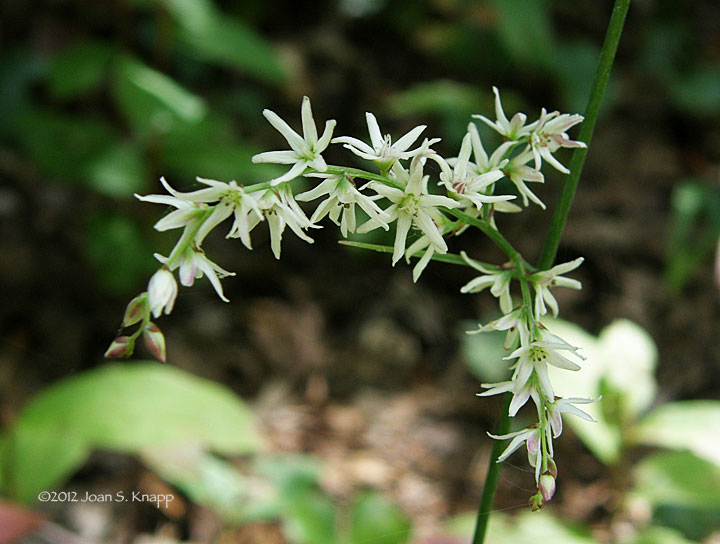
Stenanthium gramineum (Eastern Featherbells, Common Featherbells)
These plants were growing along the roadside in many areas. They were particularly obvious along the road down to the lake.

The flowerhead. The stem is often 12 to 18 inches tall.

The plant looks like a grass when it’s not in bloom.

A closer view of the flower stem, and an 

individual flower. The flowers are about ½ inches in diameter

Goodyera pubescens (Downy Rattlesnake Plantain)
The leaves of these plants are a dead giveaway. I’ve found a lot of plants from time to time but have never seen one in bloom. We didn’t this time either, but it was clear that a number of plants in this area had bloomed so we have a place to check on next year.

The plant: leaves and flower stalk developing seeds

The leaves

The developing seed pods

Hypoxis hirsuta (Common Yellowstar Grass, Common Goldstar, Yellow Stargrass, Hairy Yellow Stargrass, Common Stargrass)
Hypoxis hirsuta usually blooms in the Spring. I was lucky enough to spot a single plant that was blooming.

The bloom, photographed using artificial light

Chimaphila maculata (Pipsissewa, Striped Wintergreen, Spotted Wintergreen, Striped Prince’s Pine)
It’s easy to recognize this plant in the woods by their distinctive leaves and by the seedpods. I’ve posted photos of the flowers here and here

Developing seed pods.

Campanula divaricata (Small Bonny Bellflower, Southern Harebell, Appalachian Bellflower)
These plants were growing on the embankments by the road down to the lake. The flowers would be easy to overlook because they are so small.

The plant
*****
*****
Closer view of the individual flowers. It would have been easy to overlook these flowers because they are so small.

Aureolaria flava (Smooth Yellow False Foxglove)
These plants were growing on the embankments by the road down to the lake.

Buds

Open flowers

Collinsonia canadensis (Richweed)
These plants were growing on the embankments by the road down to the lake.

The plant

The branching flowerhead

An individual flower

We were surprised and delighted by the variety of wildflowers we found at Dockery Lake.
Click on an image to view a larger image

Identification resources:
Southeastern Flora:
- Hypoxis hirsuta (Common Yellowstar Grass)
- Campanula divaricata (Small Bonny Bellflower)
- Collinsonia canadensis (Richweed, Horse Balm) 
 
Name that Plant: Native and Naturalized Plants of the Carolinas and Georgia:
- Hypoxis hirsuta (Yellow Stargrass, Hairy Yellow Stargrass,Common Stargrass) 
- Chimaphila maculata (Pipsissewa, Striped Wintergreen, Spotted Wintergreen)
- Aureolaria laevigata (Appalachian Oak-leach, Smooth False-foxglove) 
Distribution:
United States Department of Agriculture Plants Database: