August 31st. (Continued from…). I started to walk again
at Fort Yargo State Park in Winder, Georgia. One of my favorite walks is from
the Group Shelter A to the Old Fort and back.This
is a rewarding walk for viewing wildflowers and I’ve This is a rewarding
walk for viewing wildflowers and I’ve been walking it every week and
documenting the wildflowers that I see.

The early spring wildflowers have finished blooming; it’s time to
watch the developing fruit. Summer wildflowers were still blooming but it was
time to turn attention to the fungi in the woods. There were quite a number on
this walk.


My
first stop when I rejoined the main trail to the Old Fort was at the Golden
Reishi (Ganoderma curtisii). This had
darkened considerably since the previous week.

Below
the Old Fort, several flowers were still blooming including the Sweet Autumn
Clematis (Clematis terniflora). These
included…

Groundnut
(Apios americana), and the…

Small
White Morning Glory (Ipomoea lacunosa).
There were a few small vines of…

Sweet Autumn Clematis vines blooming at the edge of the
woods, including some…

flowers that had been fertilized and were showing the first
steps in developing seeds.

Nearby, I found Snow Fungus (Tremella fuciformis) on a fallen tree trunk. Snow Fungus is found
growing in association with another fungus, an…

Annulohypoxylon (fomerly Hypoxylon) sp. Annulohypoxylon
sp. – and this may be A. thouarsianum
– look like ‘blobs of tar’ on a tree trunk or branch. When the fruit matures,
the surface of the blob is covered with tiny bumps.

Witch’s Butter (Tremella mesenterica) on a fallen log. A
small slug was nibbling on it; looks like this slug or others had been eating
the fungus for a while.

Further along the trail, I found…

seed capsules developing on a Cranefly Orchid (Tipularia discolor) plant.

I happened upon another Frost’s Bolete (Exudoporus frostii) that was more accessible than the one I’d seen
on the Rock Garden trail. These mushrooms have…

highly reticulated red stems. Another feature is that their pore
surfaces stain blue when bruised.
Nearby, I found some…

mature seed capsules on a Pipsissewa (Chimaphila maculata) plant.

An Appalachian Brown (Satyrodes
appalachia) butterfly teased me for quite some time, flitting from plant to
plant and across the trail until it settled long enough for me to take a
photograph.
I made my way back down the trail to the area under the
power lines.
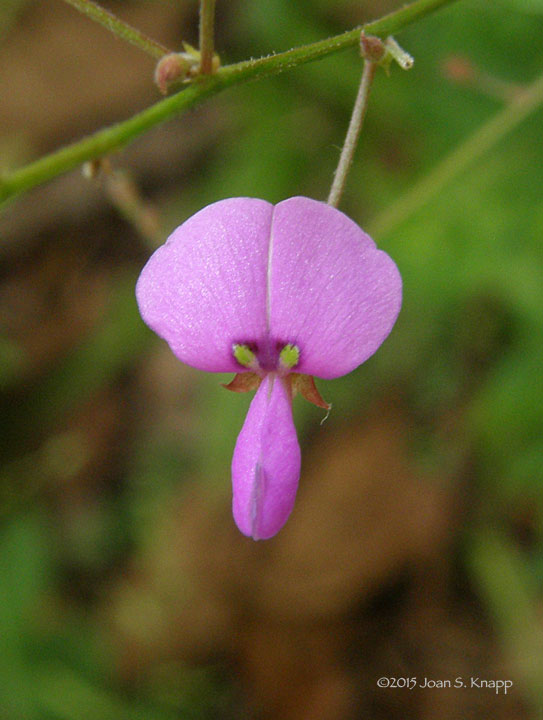

Tickt-trefoils
were starting to bloom. This one looks like the Panicled Tick-trefoil (Desmodium paniculatum).
In
the open woods beyond the power lines, I found another large log covered with…


small bracket fungi. From the top,
they looked like Turkey Tails (Trametes versicolor) but the…

underside looked superficially like
the Gilled Polypore (Lenzites betulina).
However, over time, I’ve become convinced that this is actually (Daedaleopsis septentrionalis) on the
basis of the bifurcated ‘gills’ compared with the simple gills of the Gilled
Polypore. I’ll be looking at again in late August, 2016, to follow it more
closely.

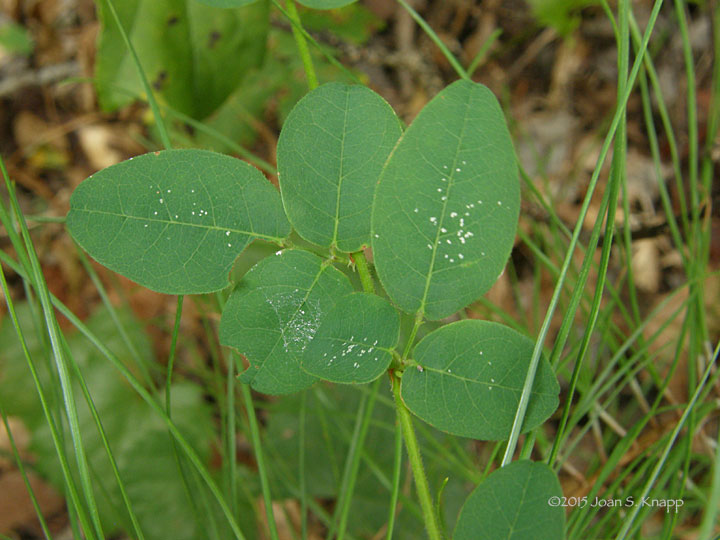
I found a different tick-trefoil,
the Hairy Small-leaved Tick-trefoil (Desmodium
ciliare), in the open woods on the trail back to the pine woods. This
species has not been documented widely in Georgia. This identification was made
through the assistance of a member on the Plant Identification group on
Facebook.

My
final spotting on this walk was another Shaggy Stalked Bolete (Heimioporus betula).
This mushroom had a small cap compared with the size of its stem.
References:
- Mushroom Observer: Ganoderma curtisii
- Mushroom Expert. Kuo, M. (2008 November): Tremella
fuciformis
- Mushroom Observer: Annulohypoxylon thouarsianum
- Mushroom Expert. Kuo, M.(2013 December): Exsudoporus
frostii (Boletus frostii)
- Butterflies and Moths of North America: Appalachian Brown (Satyrodes appalchia)
- Native and Naturalized Plants of the Carolinas and Georgia: Panicled Tick-trefoil (Desmodium paniculatum)
- Butterflies and Moths of North America: Appalachian Brown (Satyrodes appalchia)
- Native and Naturalized Plants of the Carolinas and Georgia: Panicled Tick-trefoil (Desmodium paniculatum)
- Messiah College: Daedaleopsis
septentrionalis
- Native and Naturalized Plants of the Carolinas and Georgia: Hairy Small-leaved
Tick-trefoil (Desmodium ciliare)
- Mushroom Expert. Kuo, M. (2010 March). Heimioporus betula
Related posts:


