We’ve been scouting locations to view and, hopefully, photograph Hymenocallis coronaria (Shoals Spider-lily), a lily considered to be a subspecies of Hymenocallis caroliniana (Carolina Spiderlily). Plants grow only in fast-flowing, shallow water currents in shoals on rivers in Alabama, Georgia, and South Carolina. The lily is known variously by the common names: Catawba lily, On Labor Day weekend, we wend to Landsford Canal State Park on the Catawba River in South Carolina. On October 21-22, we scouted locations at Flat Shoals and lower on the Flint River in Georgia. On November 7th, we visited the Cahaba River National Wildlife Refuge in Bibb County, Alabama.
 The Cahaba River NWR is at the south end of the glacial scarring that runs southwest from Tennessee into Alabama. The scarring is clearly visible in this map.
 Our first view of the Cahaba River, upstream, from CR-24.
 We approached the river from the east along Bibb County road, CR-24, also known as Cahaba River Drive. The entrance to the NWR is on the south side of the highway about one-half mile west of the river.
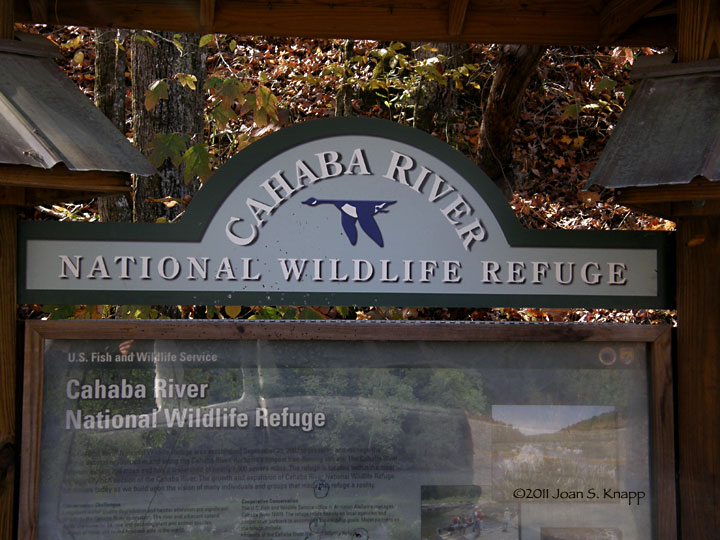
 Entrance to the Cahaba River NWR.
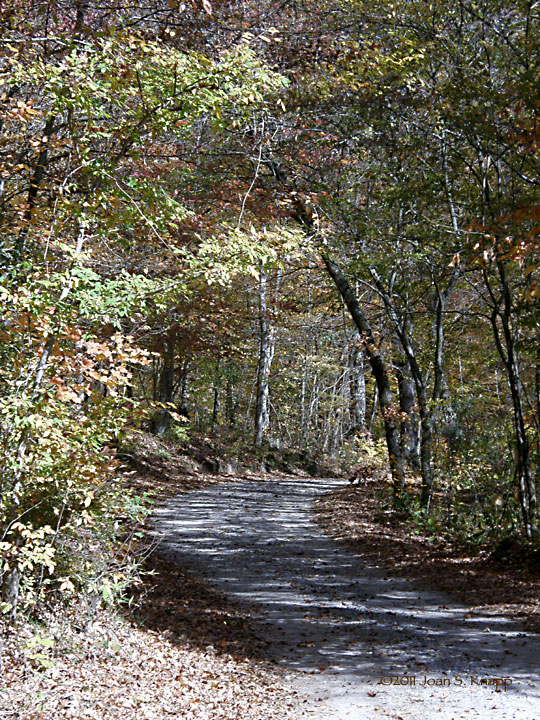
 The road runs along the river bank and is a well-maintained gravel road. In most places it is a one-car-width road with several small pull-outs.
 The river was crystal clear and green. The rocks exposed from the glacial scarring are clearly visible along the river. This shot was taken at the canoe launch.
 Looking north along the river. The top end of the upper lily bed. There’s nothing much to see in the way of lily vegetation at this time of year; the lilies will begin to emerge in mid April.
 Looking across the river. The east bank rises steeply to the ridge above.
 Looking north along the river from the south end of the upper lily bed. The lily bed comes almost to the road at this point.
 The rock ledge - the Pine Island Ford - that marks the south boundary of the upper lily bed.
 Looking to the south. The river has a series of swimming holes. A rope used to swing out over the river hangs from the branch of the tree at the right.
 *****
***** A section of the river south of the upper lily bed is filled with boulders and rock ledges.
The road ends where Caffee Creek empties into the river. There is a maintenance road on the south side of the creek but no public access. Any travel further south would have to be made by canoe or kayak.
 Looking up into Caffee Creek
 Looking out from Caffee Creek into the river.
 Symphyotrichum patens (Late Purple Aster) plants were blooming, as was a single…
 Oenothera fruticosa (Narrowleaf Evening-primrose) plant.
 Looking south towards the lower lily bed. Access to this bed would only be by water.
The Cahaba River NWR provides excellent access to a large bed of Hymenocallis coronaria plants. According to the information board at the NWR entrance indicates that the lilies bloom from mid May to mid June and the brochure available at the information board indicates that it’s easy to wade out to photograph them up close. Sounds like a field trip for next Spring.
Click on an image to view a larger image
Identification resources:
- Encyclopedia of Alabama: Hymenocallis coronaria (Cahaba Lily)
- James Allison: Bibb County, Alabama Wildflowers
Related posts:
- Flint River, Georgia: Woodbury Crossing to Sprewell Bluff State Outdoor Recreation Area
- Flint River, Georgia: Flat Shoals And The Red Oak Creek Covered Bridge
- Landsford Canal State Park, South Carolina: Wildflowers
 The plant. The leaves are diagnostic.
 The flower.