Showing posts with label Anolis carolinensis. Show all posts

Thursday, April 9, 2015

First Carolina Anole Sighting Of The Year


April 4th. I stopped to look at the developing Trumpet Honeysuckle (Lonicera sempervirens) flower buds. Out of the corner of my eye, I saw some movement. When I looked closer, I saw a large Carolina Anole (Anolis carolinensis). 


It realized it had been seen and flattened itself against the branch. I guess it thought it could merge with the branch and become invisible. 

Gradually it crawled further out on the branch. 


In flattening itself against the branch its body widened, making it look bigger than it was – although it was one of the biggest anoles I’ve every seen. 
  

A really handsome anole and a nice sighting for the first anole of the year.

Identification resource: 
 

Friday, August 1, 2014

Carolina Anole (Anolis carolinensis)


July 25th, 2014. 
Carolina Anole (Anolis carolinensis)  
Walton County, GA

It’s been a while since I’ve seen a Carolina Anole. This big male was climbing up a support post on the porch. He finally got a little irritated with me and displayed his dewlap quite impressively.
 
Related post:  

Wednesday, March 20, 2013

Green Anole (Anolis carolinensis): In Out Of The Cold

March 10th, 2013. I’ve been cleaning out the greenhouse, re-potting water plants, and planting new seeds. I was working quietly and not making much noise when, out of the corner of my eye, I noticed some movement. I looked down and spotted a Green Anole (Anolis carolinensis) on a concrete base for a support column. It was fairly early in the morning and still cool. The anole was brown, similar to another I had photographed in 2009. I backed away and went back to the house to get my camera. Too late. As I suspected, it had disappeared by the time I returned. But, it was likely that it had taken up Winter residence in the greenhouse and I’d have an opportunity to see it again. Time to start carrying my camera every time I go to the greenhouse.


I was in a greenhouse a few days later and, again, noticed movement out of the corner of my eye. This time on the edge of a water container.


A big, healthy anole – green this time - was basking on the edge of a large water container. It didn’t really seem to want to leave but it decided to put a little more distance between itself and me.


It made its way across the floor and up a bench support and onto a frame where it…


Watched me for a minute or so before it moved away out of sight.


I don’t think it appreciated me intruding on ‘its space’ in this warm greenhouse when it was relatively cold outside in the windy March weather.

Click on an image to view a larger image


Identification Resources:

University of Georgia Museum of Natural History: Green Anole(Anolis carolinensis)

Related posts:


Friday, April 22, 2011

And A Good Morning To You Too

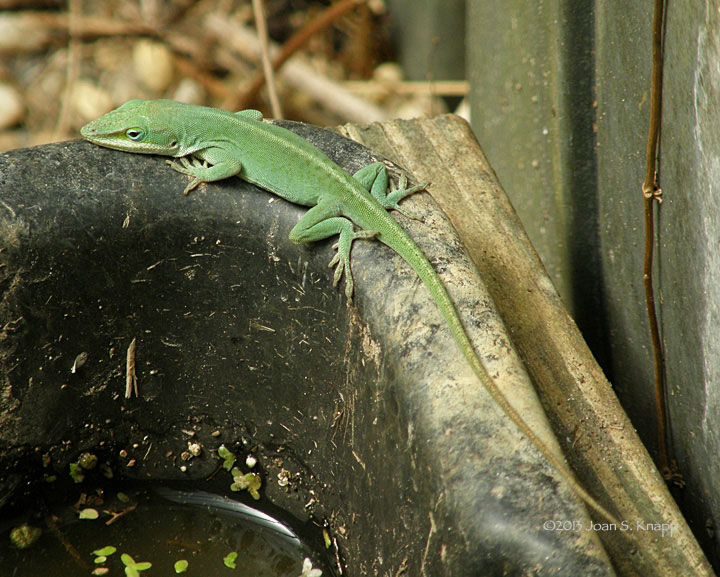
We walked out the front door and there he was – a Carolina Anole (Anolis carolinensis). The first one I’ve seen this year.

He was on the rim of a plastic container. He looked very comfortable because the rim was about an inch wide and he didn’t have to exert any energy to balance on it. At first I though he was simply sunning himself.

It was a little strange that he didn’t run off. He was only four to five feet from where we were standing looking down at him. Usually, an anole won’t hang around with a human so close. But he did.


And then he moved. He was looking around below him, not at us. He was ignoring us. Even when he was not moving, his eyes were constantly moving, surveying his surroundings.

And then it became obvious. He was staking out some some prime real estate..


He would raise his head and body.

And then he would do three to four ‘pushups’, bobbing his head up and down, followed by…


Extending his dewlap.

He repeated this display four times while we were watching. We couldn't see any other anoles in the area
.He was either threatening another male in the area or trying to attract a female. After all, it is Spring.
Click on an image to view a larger image


Identification and Distribution:

- Savannah River Ecology Laboratory, Herpetology Program: Green Anole (Anolis carolinensis)


Related posts:

- Green Anole: Anolis carolinensis

Sunday, November 14, 2010

Stowaway

As we were driving down to Lake Oconee last week, I suddenly realized that a young anole was clinging to the outside of the windshield. We were using a vehicle we don’t usually use – to tow the pontoon boat. Since it sits in the same place for long periods of time, anoles will sun themselves on it and, occasionally, will take up residence in crevices. Guess this one had crawled into the grill behind the wipers. I usually have my camera at the ready when we’re traveling and this was no exception. I didn’t really expect to get any photos but…

I managed to get a silhouette of it as we drove down the road.

I was struck by its sharp claws which are quite clear in this enlargement. I’d never seen their claws up close. These explain why it can travel up vertical surfaces so easily. Very impressive.

I didn’t think I’d get the opportunity to see it in the sun. But we turned a corner and there it was lit up. It looks cold but, perhaps, its also a little bewildered by hurtling down the road at 55 mph.
Click on an image to view a larger image

Thursday, October 14, 2010

Turning Green While You Wait

I heard a scrambling at the base of a tree beside the trail south from the Fishing area (segment 13) and turned around expecting to see an Eastern Fence lizard (Sceloporus undulates) or a Five Lined Skink (Eumeces sp). Not a Green Anole. But there it was. This was the first time I’d ever seen a Green Anole (Anolis carolinensis) at Fort Yargo State Park.


In the early morning, the temperature was still cool and the anole was quite brown. It had crawled up into the sunlight on the tree trunk to catch some rays.

Within a minute, it started to turn green. I waited for several minutes in the hope that it would turn completely green but it was still to cool and it stayed the same color. So I had to move on.

Click on an image to view a larger image


Identification resources:

- Savannah River Ecology Laboratory: Green Anole (Anolis carolinensis)

Sunday, June 7, 2009

Green Anole: ‘Cept She’s Brown

She was sitting on a dead Butterfly Bush (Buddleia davidii) flower. That’s why I didn’t see her. She must have moved and that movement caught my eye. She’s probably a Green Anole (Anolis carolinensis); she’s turned brown to adapt to her background.

She’s a female; she doesn’t have the pink dewlap that the male displays. She tried to threaten me anyway. I didn’t see the threat because of the sun’s glare on the camera viewer. I just took shots and hoped they’d come out. She gradually moved off along the stem to the cover of the bush.

She’s a beautiful creature.

Identification resource: Lizards of Georgia and South Carolina
Click on an image to view a larger image

Friday, May 1, 2009

Green Anole: Anolis carolinensis

We have a lot of green anoles around the house. They hibernate during the winter so we normally don’t see them from late fall until spring. This year, however, one has over-wintered in the greenhouse. I saw him one afternoon and, although I had a camera with me, I was busy watering plants and wasn’t able to get the camera turned on an focused before he disappeared. He was much bigger than most of the anoles we normally see. Possibly the result of being able to hunt insects during the winter.


A week or so later, I was making my regular rounds to check on wildflowers – camera in hand – when I encountered him on the outside wall of the greenhouse. He didn’t attempt to run off so I was able to get some shots of him. I normally take a lot when I get the opportunity so I followed him as he mover relatively slowly along the wall of the greenhouse. When he got to the corner, he stopped. He apparently had had enough of being stalked.

He puffed up his body, bobbed his head, and extended his dewlap a couple of times. I was lucky enough to get a shot of the extended dewlap. He’d been a good sport so I let him go about his business with no further interruptions.

Click an image to see a larger image.