Showing posts with label Bloodroot. Show all posts

Friday, May 12, 2017

Sanguinaria canadensis (Bloodroot)


March 10th. After several encounters with fungi, I reached the section of trail in the Oconee Heritage Park where I had seen a few early spring wildflowers last year. I was a week or so earlier than last year, so I wasn’t sure if I would be too early but… 

I was in luck. I found Bloodroot (Sanguiaria Canadensis) at two locations on the same short section of trail. The name ‘sanguinaria’ comes from the fact that the sap in the stem and roots of this plant is red, and has been used as a dye.


Several flowers were at their peak.


Each flower had its characteristic leaf folded around the base of the flower stem.


A few days later and I would have missed the flowers. Some had already dropped their petals and were starting to form seed capsules.

It’s always delightful to find these plants in the woods. 

References:
- Native and Naturalized Plants of the Carolinas and Georgia: Sanguinaria canadensis 
- USDA Plant Database: Sanguinaria canadensis (Bloodroot)

Tuesday, March 15, 2016

Early Spring Wildflowers At Oconee Heritage Park


March 14th, 2016. I went on a fungus hunt with a couple of mycophiles yesterday, hoping that we’d find some mushrooms after the recent rain. 


We walked along the equestrian trail to the creek and began to work our way back across county.


We explored one of the side drainages, and spent some time accessing areas to the side of one of the trails – circled in blue - that I had walked a couple of weeks ago. This area is a deciduous forest that hadn’t leafed out yet. I hadn’t expected to see many wildflowers but I was to be surprised.


Buckeyes (Aesculus sp.) were leafing and budding out throughout the area. I’m betting most of these are Painted Buckeyes (Aesculus sylvatica); this is a common species in this area. But time will tell…


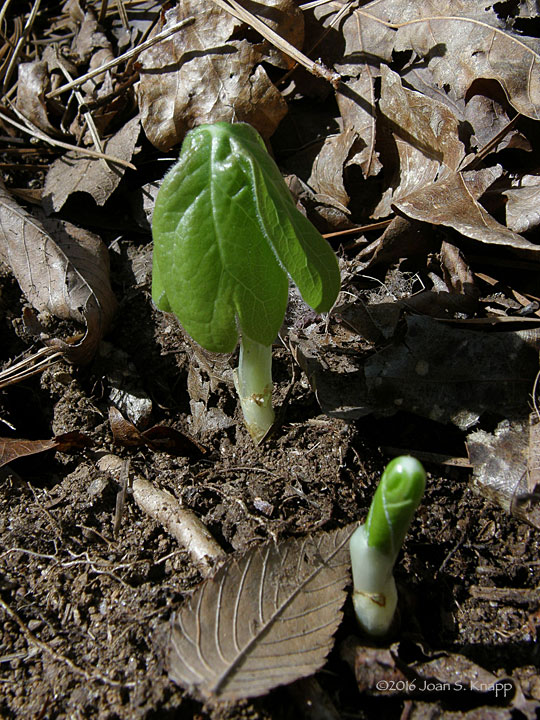
As I climbed from the creek bottom to the trail running along a ridge, I almost stepped on this Mayapple (Podophyllum peltatum) plant, looking like a little, lime-green torpedo, just pushing its way out of the ground. Just two plants in this location, in a small ‘gully’ where water ran down the hillside when it rained.


Beside the trail, I found a lone Wlld Geranium (Geranium maculatum) blooming. Judging by the number of geranium leaves in this area, this may be a mini-meadow of geranium blooms before too long. 


On the other side of the trail, down the hill in another small drainage gully, another pair of Mayapple plants making their appearance. 

When I first walked this trail, I’d seen a single Round-lobed Hepatica (Hepatica nobilis var. obtusa) blooming at the base of a tree. This particular plant had finished blooming, but I found…


several plants in full bloom, as well as… 


one that had new buds. 


Another surprise! One of several Bloodroot (Sanguinaria canadensis) plants in bloom along this section of trail. 


The final wildflower blooming along this section of the trail was Green-and-gold (Chrysogonum virginianum). 

We made our way from the trail back down to the main stream. As I worked my way along the steep hill above the creek, I was rewarded with finding another…


Bloodroot plant in bloom. This one looked like a ‘double.’ 


And finally, back to the main trail that led up the hill and back to the parking lot.
I was surprised by the variety of early wildflowers in this area that, a couple of weeks previously, was a forest floor covered with leaf litter with little sign of herbaceous plant life.

References:
Native and Naturalized Plants of the Carolinas and Georgia: Aesculus sylvatica 
Native and Naturalized Plants of the Carolinas and Georgia: Podophyllum peltatum 
Native and Naturalized Plants of the Carolinas and Georgia: Geranium maculatum 
Native and Naturalized Plants of the Carolinas and Georgia: Hepatica nobilis var. obtusa
Native and Naturalized Plants of the Carolinas and Georgia: Sanguinaria canadensis 
Native and Naturalized Plants of the Carolinas and Georgia: Chrysogonum virginianum

Sunday, March 13, 2016

Bloodroot (Sanguinaria canadensis)


March 10th, 2016. Spring has arrived! At least the temperatures have risen, and the early wildflowers are beginning to bloom. Bloodroot (Sanguinaria canadensis) is one of my favorite spring wildflowers. Several are blooming in the Dunstan Garden at the State Botanical Garden in Athens, Georgia.

I found this one blooming at the junction of the White and Green Trails in the woods. The leaf, as attractive as the flower, is just visible at the base of the stem.


A better view of the developing leaf. A few inches away, I found a couple more leaves just visible in the leaf litter.

Reference: 
Native and Naturalized Plants of the Carolinas and Georgia: Sanguinaria canadensis

Tuesday, May 13, 2014

Talullah River Road: Spring Wildflowers


April 3rd, 2014. On our way back from South Carolina, we detoured through Clayton to the Tate City Road on the Tallulah River that we had last visited in late 2012. At that time, we had found seeds of Jack-in-the-pulpit (Arisaema triphyllium) and the Strawberry Bush (Euonymous americanus) as well as blooms ofJewelweed (Impatiens capensis). 


Vicia caroliniana (Carolina Vetch, Wood Vetch, Pale Vetch) was growing on the embankments before we crossed the river.  


At first, the road runs along the river where the water is flowing over large boulders for some distance. We saw wildflowers on some of the steep embankments that were not easily accessible. 

Further up the river, the valley widens. The wildflowers were more accessible.  


Trillium cuneatum (Little Sweet Betsy, Purple Toadshade) were flowering on both sides of the road. The number of plants with the green form of the flower was striking. 


I counted one cluster of at least 11 plants of this form 


Sanguinaria canadensis (Bloodroot, Red Puccoon) plants in bloom were plentiful on many embankments. 

Some were starting to develop seedpods. 

In addition to the ‘normal’ Bloodroot flowers, we found quite a few ‘double’s. 

Thalictrum thalictroides (Rue Anemone, Windflower) were also plentiful on some embankments. 

Erythronium umbilicatum (Dimpled Troutlily, Dimpled Trout Lily, Dogtooth Violet). We found only two small patches of these lilies. It was surprising that they were still blooming. 

At the end of the road, we found a number of wildflowers, some just starting to blooms or finishing for the season. 

Arisaema triphyllum ssp. triphyllum (Jack-in-the-Pulpit) just leafing out. 

A white-flowered trillium just beginning to open. 

Hepatica nobilis var. acuta (Sharplobe Hepatica, Sharp-lobed Hepatica, Sharp-lobed Liverleaf). Although most plants had finished blooming, one or two plants were still blooming.

This is a rich botanical area for Spring wildflowers and well-worth a visit.

Related posts: 

Thursday, May 9, 2013

Wildflowers at Boggs Creek Recreation Area: Take Three - Other Wildflowers


April 20th, 2013. It was clear from our trip to Boggs Creek Recreation Area in the Chestatee Wildlife Management in Lumpkin County on March 30th that this would be an interesting place to follow through the Spring wildflower season. We visited a second time on April 13th to look at the mystery trillium and check on wildflowers that were developing on our previous visit. This was our third visit…

Actaea pachypoda (Doll’s-eyes or White baneberry, White Cohosh, Doll’s-eyes)
White Baneberry plants were scattered in the shade under the pine trees. On our previous visit, buds were developing or just starting to open. Now most were open.


Flower and leaves, and...


Flowers at various stages of opening

Tiarella cordifolia (Heartleaf Foamflower, Foamflower, Mountain Foamflower, False Miterwort)
Foamflowers were still flourishing.


Clusters of plants in the woods, and


an individual flower spike that still has unopened buds at the tip.

Waldsteineria fragaroides (Appalachian Barren Strawberry)
There are two species of Waldsteineria in this area: Waldsteinaria fragarioides (Appalachian Barren Strawberry) and Waldsteinaria lobata (Piedmont Barren Strawberry). These are differentiated by the leaves Which are trifoliate in both species. The lobes of W. fragarioides leaves are completely separated whereas those of W. lobata are not. W. fragarioides is distributed throughout many eastern states compared with W. lobata which occurs only in the Carolinas and Georgia. W. fragarioides is found more in north Georgia; W. lobata has been documented in fewer counties but over a wider geographic area.

A plant growing on the floor of the pine woods where the trilliums were growing.


A closer view of the plant showing that that lobes of the leaves were completely separated


A closer view of an individual flower which has lost some petals.

Pedicularis canadensis (Canadian Lousewort, Lousewort, Wood Betony, Eastern Lousewort, Fernleaf)
The ‘native’ form of this species has cream flowers; a form with maroon flowers is a variant of this species.


Most of the flowers we found were deep maroon, whereas some were…


intermediate between the original cream form and the deep maroon form. On this visit, we were able to get better photos of this lighter form.

Iris cristata (Dwarf Crested Iris)
This species is found mostly in the far north Georgia counties. We found a few plants near the lousewort plants; these wouldn’t flower for another couple of weeks. As we drove up the road, we found… 


a patch of plants at the edge of the road that had much greater sun exposure. Many of these plants were blooming.

Close up of one of the flowers.

Thalictrum thalictroides (Rue Anemone, Windflower)
We didn’t find many Rue Anemones in this area but there were a few

Close view of an individual flower

Sanguinaria canadensis (Bloodroot)
We had found Bloodroot plants along the embankments at Dicks Creek but hadn’t seen any previously at Boggs Creek. On this visit, just after turning around at the end of the road and starting back down the road, we spotted…


characteristic Bloodroot leaves near the base of a tree.


Closer views of the plants that are setting seed. Another site to view this wildflower.

Under normal conditions, we would have gone over to Dicks Creek again. However, we were travelling in a vehicle that probably would not have handled the rougher road very well, we headed over to Sosebee Cove – our first visit to this site – to see what was blooming…
Click on an image to view a larger image

Identification Resources:
Southeastern Flora
 
Natural and Naturalized Plants of the Carolinas and Georgia:


Distribution:
United States Department of Agriculture Plants Database:

Related post:
- Spring Wildflowers at Dicks Creek (Part 2)