September 25th, 2011. We’ve been following some asclpeias and matalea vines in a local wildlife management area. Unfortunately, hunting season has arrived. One of the preparations that the wildlife management folk make for the hunting season is to mow the roadsides and some meadows to allow hunters access. Mowing also lessens the chance that careless hunters, and others, will accidentally set the woods on fire, particularly since many areas are tinder-dry due to the drought we’ve endured for the last couple of years. We keep our fingers crossed that the areas we frequent won’t be mowed before plants go to seed but... Sometime between September 10th and September 25th, they mowed.

*****
 It looks neat but…
 We’d been following this Asclepias viridiflora (Green Comet Milkweed) plant since May or so when we first found it.
 Watching it bloom without developing seed pods until, finally...
 it developed a couple of pretty pods.
 This was all that was left of the plant. We hunted around and…
 found the remains of just one pod.
 Closer inspection showed that the mower blade had neatly sliced the pod and sheared the seeds from the silk. We only found one seed still attached to the silk. Hopefully the mower blade threw some of the seeds back into the woods where they can grow, bloom and develop seeds out of danger or the mowers.
 The second group of plants we’d been watching were vines of Matelea gonocarpa (Angularfruit Milkvine) further down the road.
 These vines had developed a few pods. We found a couple of pods lying on the ground under the vines. Only one had developed on a vine that had climbed up about a foot above the ground on another plant.
 This pod was sliced lengthwise and thrown several meters away.
 The pod had shriveled but was still slightly green
 The seeds and silk seemed to be mature and ready to be dispersed in the wind.
 One pod was still attached to a vine that hadn’t been cut by the mower. Hopefully, it will develop to maturity
 Another pod had split so we cut it open further. A single seed with its silk lies beside the pod
 Within a few minutes the silk fibers spread and the seed was ready to float away in the breeze.
 The seeds arranged in the pod. The raised circular section in the middle of each seed is the actual seed. The ‘serrated’ margin on each seed certainly would help them to catch on vegetation as they blew in the wind.
Mowing roadsides is a necessary evil to help prevent forest fires and some plants pay the price. Hopefully, seeds from these plants survived and will develop into new plants.
Click on an image to view a larger image
Distribution:
- United States Department of Agriculture Plants Database: Asclepias viridiflora (Green Comet Milkweed)
- United States Department of Agriculture Plants Database: Matelea gonocarpa (Angularfruit Milkvine)
Identification resources:
- Southeastern Flora: Asclepias viridiflora (Green Comet Milkweed)
- Southeastern Flora: Matelea gonocarpa (Angularfruit Milkvine)
From: Clasping Milkweed (Asclepias amplexicaulis): Flowers
Asclepias amplexicaulis is known by the common names Clasping Milkweed, Blunt-leaved Milkweed, Blunt-leaf Milkweed, or Sand milkweed. Asclepias sp. are perennial and are among the last perennials to emerge in the Spring. Plants may grow from seed or from rhizomes in a single stalk as high as 3-4 feet tall. Flowers form in a terminal umbel. Flowers may be pink, purple, or maroon or even a brownish pink.
Asclepias flowers appear ‘clean’ because they don’t have loose pollen grains that dust the flowers. Asclepias flowers are unusual; diagrams of the anatomy of the flowers may be found here. The pollen is contained in sacs called pollinia that are located between the anthers. Two pollinia are connected by a ‘thread’ called a translator to a body called a corpusculum. Pollination only occurs if an insect is strong enough to hook the corpusculum and pull the pollinia from their sacs and deposit them on the stigmatic disk of another flower. You can see a photograph of the pollinia here.
Only a small proportion of flowers are fertilized.
 The first sign that a flower has been fertilized is the thickening of the flower stem while other flowers and stems gradually wither. Two stems on this umbel have thickened noticeably; the swelling of the ovary at the end of one of the stems is visible in the center of the photo.
 This young seed pod is about an inch long. A few unfertilized flowers are still attached.
 Another young seed pod, about 1.5 inches long; the dried flower is still attached to the tip of the pod. Unfertilized flowers are still attached but completely dried.
 Several pods – three in this case - may develop on a single plant. We’ve seen a maximum of 4 pods develop to maturity on an individual plant.
 Several pods may begin to develop but some, as the small pod in the center of this photo, do not succeed.
 These pods are 3 to 4 inches long - with another pod that didn't develop..
When the seeds have matured, the pod will split along a seam and open to release the seeds.
 When plants grow in full sun, the pods remain hardened. The pod splits to release seed.
 The silky hairs on the seeds in the pod are compressed tightly. These seeds will not travel far.
 This scene is typical of plants that grow in partial shade. The pod skin is thin and the pod feels hollow. The seeds are released and float off in the breeze.
 A closer view of a pod that developed in partial shade. The seeds are packed in the pod with hairs aligned neatly. As the seeds are released the hairs open out, and the seeds float away.
 Closer views of the pod showing the alignment of the seeds.
 At first seeds are released from the opened side of the pod and those ‘at the back’ are retained.
 This photo, taken last Fall, shows the seeds escaping the pod in ‘layers’
 The pod curls back as it continues to dry and releases the remainder of the seeds. This is all that is left when all seeds have been released.
 The seeds are very buoyant and float away on the slightest breeze. It’s very difficult to photograph individual seeds if there is any breeze. Some had caught on nearly vegetation. They will be washed down to the ground below to, perhaps, grow into a new plant next season.
The silky ‘floss’ of milkweed plants is very buoyant – 5 to 6 times more buoyant than cork - and provides excellent insulation. The history of using the floss to stuff pillows dates back to the 1860s in Salem, Massachusetts. During World War II, floss was collected and used as a substitute for kapok in life preservers. Floss is still used as a hypoallergenic filling for pillows.
Click on an image to view a larger image
Distribution:
- United States Department of Agriculture Plants Database: Asclepias amplexicaulis (Clasping milkweed)
- University of North Carolina Herbarium: Asclepias amplexicaulis
Identification resources:
- Southeastern Flora: Clasping milkweed (Asclepias amplexicaulis)
- Missouri Plants: Asclepias amplexicaulis
- Kansas Wildflowers and Grasses: Blunt-leaf Milkweed
- Natural and Naturalized Plants of the Carolinas and Georgia: Asclepias amplexicaulis (Blunt-leaved Milkweed, Clasping Milkweed)
- Wikipedia: Asclepias
- Plant of the Week: Milkweed, Latin: Asclepias speciosa
- Wellesley College: Landscape Nature Walks Directory. Common Milkweed (Asclepias syriaca)
Related posts:
- 2010: Year Of The Wildflower – Wildflower Index
- Clasping Milkweed (Asclepias amplexicaulis): Shoots, Leaves And Flower Buds
- Clasping Milkweed (Asclepias amplexicaulis): Flowers

 It looks neat but…
 We’d been following this Asclepias viridiflora (Green Comet Milkweed) plant since May or so when we first found it.
 Watching it bloom without developing seed pods until, finally...
 it developed a couple of pretty pods.
 This was all that was left of the plant. We hunted around and…
 found the remains of just one pod.
 Closer inspection showed that the mower blade had neatly sliced the pod and sheared the seeds from the silk. We only found one seed still attached to the silk. Hopefully the mower blade threw some of the seeds back into the woods where they can grow, bloom and develop seeds out of danger or the mowers.
 The second group of plants we’d been watching were vines of Matelea gonocarpa (Angularfruit Milkvine) further down the road.
 These vines had developed a few pods. We found a couple of pods lying on the ground under the vines. Only one had developed on a vine that had climbed up about a foot above the ground on another plant.
 This pod was sliced lengthwise and thrown several meters away.
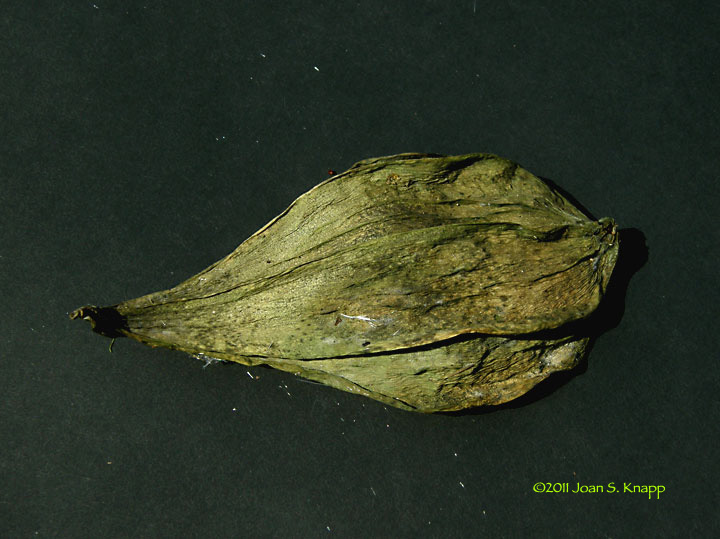 The pod had shriveled but was still slightly green
 The seeds and silk seemed to be mature and ready to be dispersed in the wind.
  One pod was still attached to a vine that hadn’t been cut by the mower. Hopefully, it will develop to maturity
 Another pod had split so we cut it open further. A single seed with its silk lies beside the pod
 Within a few minutes the silk fibers spread and the seed was ready to float away in the breeze.
 The seeds arranged in the pod. The raised circular section in the middle of each seed is the actual seed. The ‘serrated’ margin on each seed certainly would help them to catch on vegetation as they blew in the wind.


