Phemeranthus teretifolius is one of two Phemeranthus sp. that may be found in the Piedmont area of Georgia and the Carolinas. Phemeranthus teretifolius is known by several common names: Quill Fameflower, Appalachian Rock-pink, Appalachian Fameflower, or Rock Portulaca. We’d read that this flower could be found at the Rock and Shoals Outcrop Natural Area.
The lure of the Appalachian Fameflower is that each flower only opens for a few hours late in the afternoon. If the flower is not fertilized by a passing insect while it is open, it will self-fertilize. Since we made our visits in the early to mid-afternoon, I never thought I’d see this fameflower in bloom. But fate stepped in…
On April 29th, we arrived at the trailhead a little later than usual and met a DNR staff member who was making sure the mailbox was well stocked with trail maps and doing some repairs to the area beside the steps descending to the trail. We got to talking and time passed. So we were a little late getting started on the trail although we were a lot better informed about the area. Thanks.
 *****
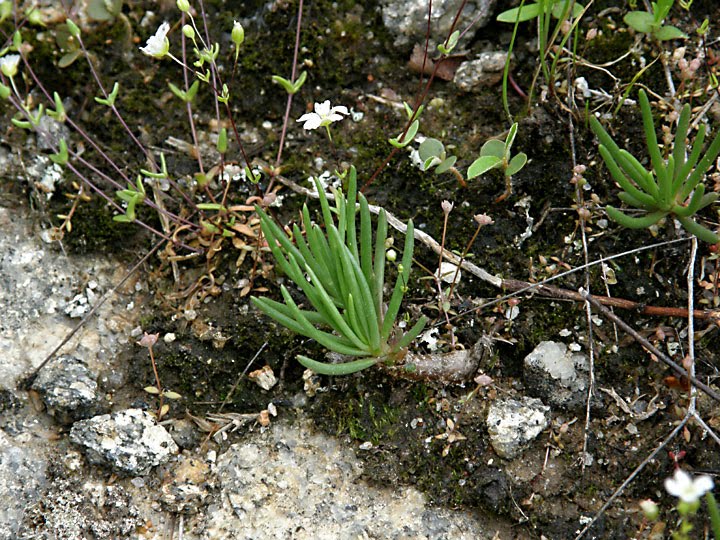
***** We’d noticed some succulent leaves on short stout stems during our visit in mid-April. Clearly, these plants were perennials but, since I hadn’t done my homework on fameflowers – that they belonged to the family Portulacaceae – I didn’t realize that these were fameflower plants.
 *****
***** We arrived at the upper rock at the outcrop at about 4:30 pm. A number of the succulent plants had, or were developing buds.
 *****
***** At 4:36 pm, we thought the best we could hope for were photographs of partly opened blooms.
 But as we were photographing the blooms, they appeared to open a little, almost imperceptibly. But it was real!
 At 4:41 pm, the bloom opened a little more….
 And a little more still…
 *****
***** *****
***** Until, at 4:43 pm, the bloom had opened completely.
Of course, as the blooms began to open, we knew that we were witnessing the opening of the Appalachian Fameflower. Something I didn’t think I’d be fortunate enough to see. It was quite extraordinary to sit and watch a bloom open before one’s eyes.
 As we made our way down over the lower stone outcrop to leave, we found that many fameflowers had opened in the area between the two outcrops.
Phemeranthus teretifolius is native to the United States: From Pennsylvania, Maryland, West Virginia, Kentucky, Tennessee, the Carolinas, Georgia and Alabama. Phemeranthus teretifolius is distributed more widely in the Piedmont in Georgia than is Phemeranthus mengesii.
Click on an image to view a larger image
Distribution Map:
- United States Department of Agriculture Plants Database: Phemeranthus teretifolius (Quill Fameflower)
Compare with: Phemeranthus mengesii (Menges' fameflower)
- University of North Carolina Herbarium: Phemeranthus teretifolius
Compare with: Phemeranthus mengesii
Identification resources:
- Natural and Naturalized Plants of the Carolinas and Georgia: Phemeranthus teretifolius (Appalachian Rock-pink, Appalachian Fameflower, Rock Portulaca)
Compare with: Large-flowered Rock-pink, Menges' Fameflower, Large-flowered Fameflower, Menges' Rock Pink (Phemeranthus mengesii)
- Carolina Nature: Appalachian Rock-pink, Talinum - Phemeranthus teretifolius
Related posts:
- Rock and Shoals Outcrop Natural Area; Part 1, Blue Trail- 2010: Year Of The Wildflower – Wildflower Index
Podophyllum peltatum is called by the common names Mayapple, May-apple, American Mandrake, Devil's Apple, Hog-apple, and Indian Apple. We saw a ‘grove’ of Mayapples on the creek side of the trail at the Rock and Shoals Natural Area on March 19th. I’d never seen Mayapples before so I was looking forward to looking for blooms.
 The plants were just emerging from their Winter hibernation in mid-March.
 Just out of the ground; leaves are folded against the stalk
 Leaves are just starting to unfold
 Leaves are starting to open out
 Leaves are fully opened. These plants are easy to recognize.
 The grove was well-developed in mid-April
 In natural light, we could just spot one or two plants that had bloomed.
 Some artificial light made them easier to see.
 A close view of the bloom in profile. The delicate veins in the petals are visible.
 A close view of the younger of two flowers. Flowers last for only a day or two.
 A close view of a slightly older flower. The ovary is already enlarged indicating that this flower was probably fertilized. We will have to check back to see if the fruit, called a Mayapple apple or an ‘Ozark’ lime, develop.
Podophyllum peltatum (Mayapple) is native to North America and is found in open woods in the eastern United States and Canada.
Click on an image to view a larger image
Distribution Map:
- United States Department of Agriculture Plants Database: Podophyllum peltatum (Mayapple)
- University of North Carolina Herbarium: Podophyllum peltatum
Identification resources:
- Southeastern Flora: Mayapple (Podophyllum peltatum)
- Natural and Naturalized Plants of the Carolinas and Georgia: May-apple, American Mandrake (Podophyllum peltatum)
- Missouri Plants: Mayapple (Podophyllum peltatum)
Related posts:
- 2010: Year Of The Wildflower – Wildflower Index
- Rock and Shoals Outcrop Natural Area; Part 1, Blue Trail
- Rock and Shoals Outcrop Natural Area: Plants Along The Stream
- Rock and Shoals Outcrop Natural Area: Mid-April Wildflowers
Trillium catesbaei is known by several common names: Catesby's Trillium, Rosy Wake-robin, Bashful Trillium, Rose Trillium, Bashful Wakerobin. We found them by the trail along the creek at Rock and Shoals Outcrop Natural Area in Athens-Clarke County, Georgia, in mid-April. The plants were on the uphill side of the trail not far from a tree with a large hollow at the base of its trunk.
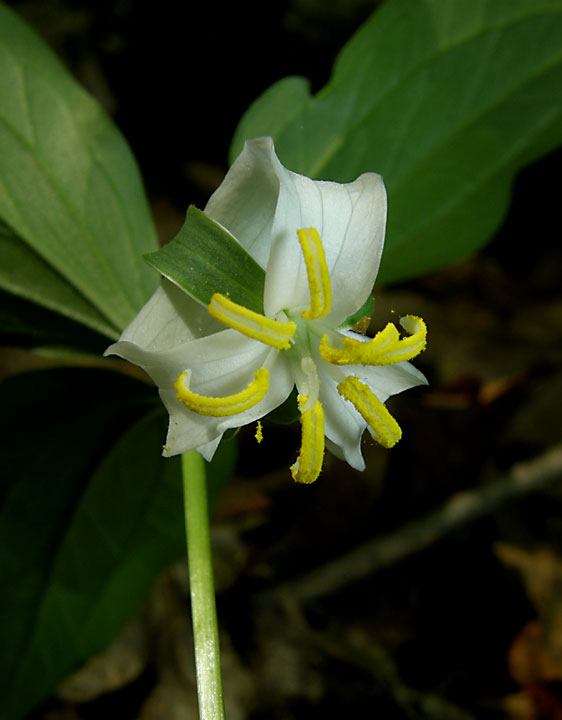
 Catesby’s Trillium flowers hang below the leaves in contrast to most Trillium sp. whose flowers stand above the leaves. This plant was growing in deep shade and was only 6 to 7 inches tall.
 Young flowers are white.
 This plant was growing in a more open area. It was about 12 to 15 inches tall.
 A closer view
 *****
***** Flowers turn pink as they age.
Trillium catesbaei is native to the southeastern United States: North and South Carolina, Georgia, Alabama and southeast Tennessee.
Click on an image to view a larger image
Distribution Map:
- United States Department of Agriculture Plants Database: Trillium catesbaei (Bashful Wakerobin)
- University of North Carolina Herbarium: Trillium catesbaei
Identification resources:
- Southeastern Flora: Bashful Wakerobin (Trillium catesbaei)
- Natural and Naturalized Plants of the Carolinas and Georgia: Catesby's Trillium, Rosy Wake-robin, Bashful Trillium, Rose Trillium (Trillium catesbaei)
Related posts:
- 2010: Year Of The Wildflower – Wildflower Index
- Rock and Shoals Outcrop Natural Area; Part 1, Blue Trail
- Rock and Shoals Outcrop Natural Area: Mid-April Wildflowers
We first explored the Rock and Shoals Natural Area on March 19th. It was clear that the trail held great promise for unusual wildflowers, both along the creek and up on the hill at the stone outcrop. We weren’t sure when many of the wildflowers would bloom so we returned on April 15th to check out the trail.
 It was a cloudy day which gave the woods a slightly eerie feeling. Not an auspicious start to our walk but...
 We found many Rattlesnake Ferns (Botrychium virginianum). This one is just starting to fruit.
 A couple of Wild Ginger (Hexastylis arifolia; Little Brown Jug) plants were also blooming. Unfortunately something had nibbled on the flowers but you can see some nice blooms here.
 The first major find of the day. A Catesby’s Trillium (Trillium catesbaei). We hadn’t seen any hint of these on our previous visit. We knew they were here but we didn't know if we were too early or too late in mid-March. Now we know. Just a taste here; more pictures soon.
 Another major find. Mayapples (Podophyllum peltatum) in bloom. On our previous visit, the plants were just emerging from their winter dormancy. Now a couple were in bloom. More pictures of these soon too.
 Painted Buckeye (Aesculus sylvatica) plants were just beginning to bloom in mid-March. Most had finished blooming but these strikingly colored flowers were on a tree deep in the shade of the woods.
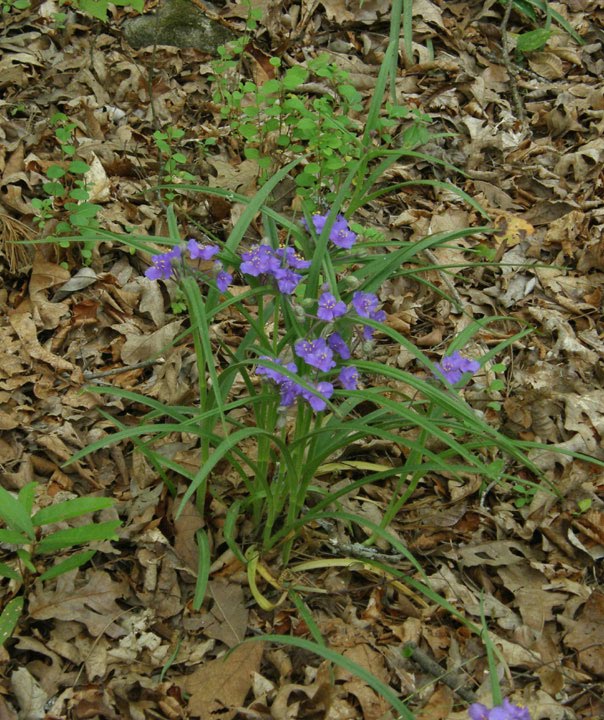
 Hairy Spiderwort (Tradescantia hirsuticaulis). Another surprise. We probably had seen the first sign of these plants in mid-March. I believe we called them ‘grassy things’ then. Now we know what they were. We found plants in various stages of blooming along the trail before we crossed the creek. Then we found them growing abundantely on the hillside by the trail leading up to the stone outcrop.
 A special treat also. We didn’t see the spiders (Harvestmen; Opiliones) when we were photographing the flowers. Is this why these flowers are called spiderworts? No. See the origin for the name spiderwort here. More pictures soon.
 On the top of the hill and around the stone outcrop, we found False Garlic (Nothoscordum bivalve) plants in full bloom. A treat.
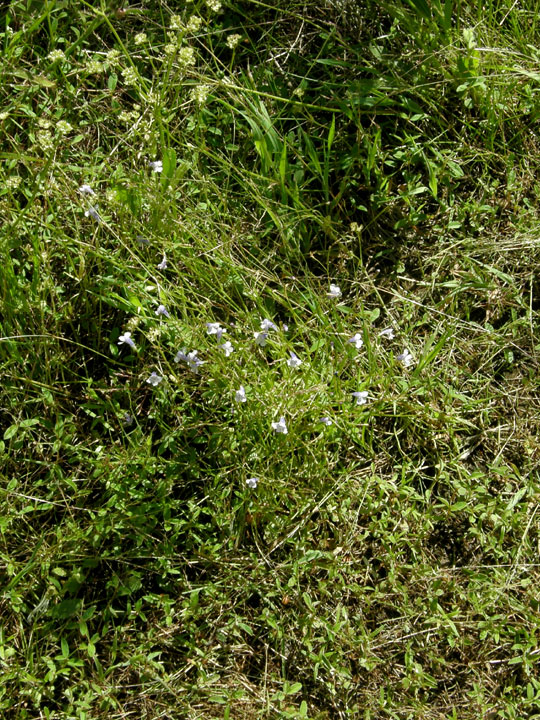
 Oneflower Stitchworts (Minuartia uniflora) were only beginning to bloom in mid-March – literally only one or two blooms. Now they were carpeting the area around the stone outcrop.
 Amur Honeysuckle (Lonicera maackii). At least I think that’s what it is based on photographs of its leaves and flowers. This was a surprise. This plant, unlike its vine cousins, Japanese Honeysuckle (Lonicera japonica) and Trumpet Honeysuckle (Lonicera sempervirens), was a tree about 8 to 10 feet tall. A single tree stands against the cedars on the north side of the stone outcrop.In addition to these plants, we found Yellow Woodsorrel (Oxalis stricta), Field madder (Sherardia arvensis), Low-hop clover (Trifolium campestre), Yellow Sunnybell (Schoenolirion croceum), and Purple Deadnettle (Lamium purpureum)
.
 Occasionally the sun broke through the clouds and gave the woods a totally different feel. Even if the sun hadn’t shone, the wildflower finds this day alone would have brightened our spirits.
Click on an image to view a larger image
Distribution Map:
- United States Department of Agriculture Plants Database: Trillium catesbaei (Bashful Wakerobin)
- University of North Carolina Herbarium: Trillium catesbaei
- United States Department of Agriculture Plants Database: Podophyllum peltatum (Mayapple)
- University of North Carolina Herbarium: Podophyllum peltatum
- United States Department of Agriculture Plants Database: Tradescantia hirsuticaulis (Hairy Spiderwort)
- University of North Carolina Herbarium: Tradescantia hirsuticaulis
- United States Department of Agriculture Plants Database: Aesculus sylvatica (Painted Buckeye)
- University of North Carolina Herbarium: Aesculus sylvatica
- United States Department of Agriculture Plants Database: Lonicera maackii (Amur Honeysuckle)
- University of North Carolina Herbarium: Lonicera maackii
Identification resources:
- Southeastern Flora: Bashful Wakerobin (Trillium catesbaei)
- Natural and Naturalized Plants of the Carolinas and Georgia: Catesby's Trillium, Rosy Wake-robin, Bashful Trillium, Rose Trillium (Trillium catesbaei)
- Southeastern Flora: Mayapple (Podophyllum peltatum)
- Natural and Naturalized Plants of the Carolinas and Georgia: May-apple, American Mandrake (Podophyllum peltatum)
- Southeastern Flora: Hairy Spiderwort (Tradescantia hirsuticaulis)
- Natural and Naturalized Plants of the Carolinas and Georgia: Hairy Spiderwort (Tradescantia hirsuticaulis)
- Southeastern Flora: Painted Buckeye (Aesculus sylvatica)
- Natural and Naturalized Plants of the Carolinas and Georgia: Painted Buckeye (Aesculus sylvatica)
- Missouri Plants: Amur or Bush Honeysuckle (Lonicera maackii).
- Natural and Naturalized Plants of the Carolinas and Georgia: Amur Bush-honeysuckle or Amur Honeysuckle (Lonicera maackii)
Related posts:
- 2010: Year Of The Wildflower – Wildflower Index
- Rock and Shoals Outcrop Natural Area; Part 1, Blue Trail
- Rock and Shoals Outcrop Natural Area: Plants Along The Stream
- Rock and Shoals Outcrop Natural Area: Plants Up The Hill
 *****
***** The blooms. The spots are light but visible.
 The raceme arrangement of blooms on the stem.
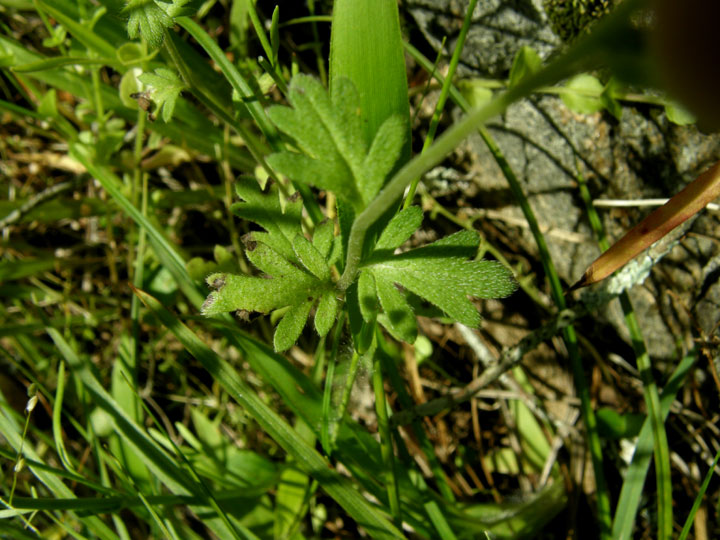 The leaves