Showing posts with label Tiarella cordifolia. Show all posts

Wednesday, May 1, 2013

Spring Wildflowers at Dicks Creek (Part 2)

April 13th, 2013. The rangers at Dockery Lake had told us that trilliums were blooming at Dicks Creek in the Chestatee Wildlife Management Area. After it proved that Boggs Creek Recreation Area would be a productive site for wildflowers, we wanted to go over the Dicks Creek and check out the trilliums there. We had started along the road to Dicks Creek previously but abandoned that trip in favor of


The road into Dicks Creek passes through a lot of privately owned land before it reaches the wildlife management area. At first, the road paralleled the creek and relatively close to it. After the road forded Dicks Creek it climbed up the side of the hills to parallel the creek at a slightly higher elevation.


I was on the ‘upper’ side of the road on the way up. I began to see…


Small cream flowers along the embankment. It would be easy to miss these flowers.

A closer view of a plant with a single flower, and…

A closer view of a plant with two flowers.


These are either Uvularia sessilifolia (Sessileleaf Bellwort, Wild Oats, Sessile-leaf Bellwort, Straw-lily) or Uvularia puberula (Mountain Bellwort, Appalachian Bellwort, Pale Yellow Bellwort). Name That Plants indicates that plants of U. puberula occur in tight clumps with 1” to 3” between the stems whereas U. sessilifolia plants may also occur in clumps with 5’ to 10” between the stems. The plants we found occurred in loose clumps more reminiscent of U. sessilifolia than U. puberula.


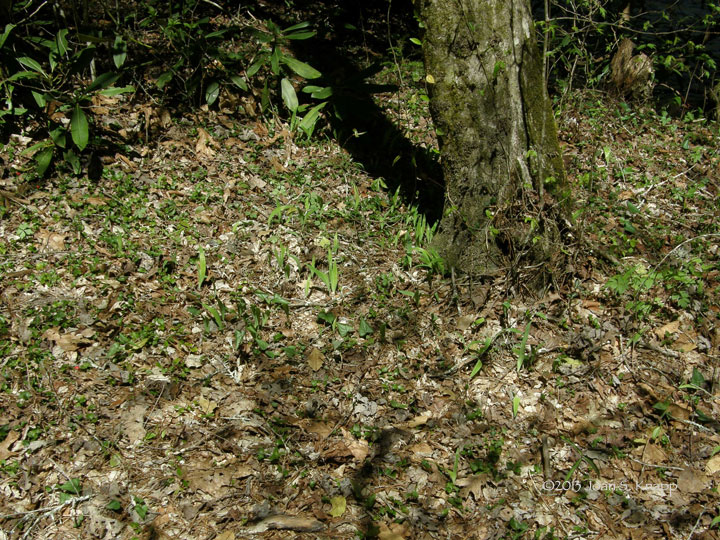
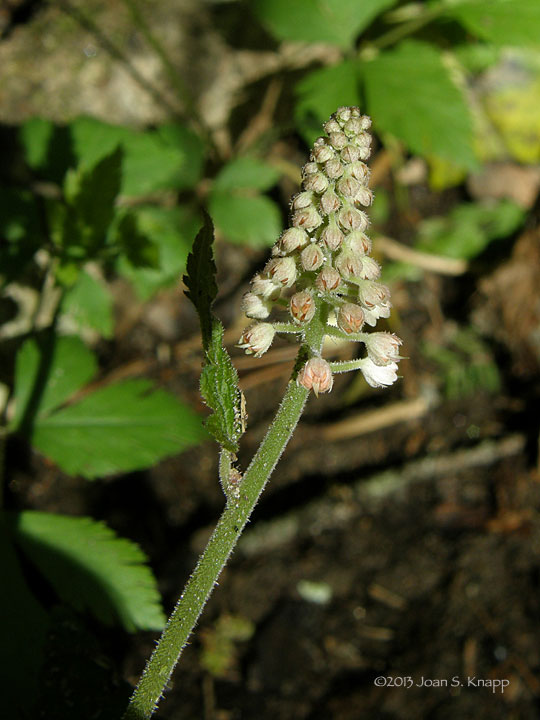
We also started to see Tiarella cordifolia (Heartleaf Foamflower) plants in bloom.


A close view
 
We followed the road to its end and then retraced the route. I was on the ‘down’ side of the road that fell away steeply to the creek.


In the area where we had seen the bellworts, I spotted some Trillium cuneatum (Little Sweet Betsy, Purple Toadshade) plants at the edge of the road.


And then I spotted…


A single plant of the green form of Trillium cuneatum (compare with Alan Cressler's photo).


A close view. This is the first time that I’ve seen the green form in all of the different locations where I’ve seen this species.


I looked over the edge of the road down towards the creek. Plants of Trillium cuneatum were scattered over the hillside. At the bottom of the hill, I spotted…


a cluster of trilliums with large, ‘soft’ green leaves – similar to those we had seen at Boggs Creek. From a distance we couldn’t see the blooms but it was clear as we approached that they had white flowers


A closer view of plants in bud, and


close views of the flowers. These appear to be Trillium simile (Jeweled Wakerobin, Confusing Trillium, Sweet White Trillium), a species that is found only in far north counties in Georgia.


There was one final ‘reword’ for spending time at this spot as the light faded. A little further along the roads edge nearby, we found a…


a cluster of Sanguinaria canadensis (Bloodroot, Red Puccoon) plants.

Many of these had seed capsules indicating that they should provide an impressive display when they bloom.


In spite of the inauspicious introduction to the Dicks Creek Road, this area proved to be a rich area for spring wildflowers. I’m sure we’ll revisit this area in the future.

Click on an image to view a larger image


Identification Resources:

Southeastern Flora


Natural and Naturalized Plants of the Carolinas and Georgia:


Distribution:

United States Department of Agriculture Plants Database:


Related post:


Wednesday, April 24, 2013

Wildflowers at Boggs Creek Recreation Area: Take Two (Part 2)


April 13th, 2013. It was clear from our trip to  Boggs Creek RecreationArea in the Chestatee Wildlife Management in Lumpkin County on March 30th that this would be an interesting place to follow through the Spring wildflower season. Particularly, a couple of developing wildflowers – a trillium and a plant with fern-like leaves – had piqued our interest and we wanted to identify them. We crossed the road to where we had seen the Viola hastata plants in bloom to see if there were new wildflowers in bloom.

The creek bank where we found the Viola hastata blooms on our previous visit.

Iris
This looks like a dwarf iris but time will tell.

 We found a patch of iris plants had emerged during the previous two weeks.

A closer view

An individual plant.

Tiarella cordifolia (Heartleaf Foamflower, Foamflower, Mountain Foamflower, False Miterwort)


An individual plant in bloom


Young buds


Just starting to open; none of the flowers has opened fully.


Flowers at the bottom of the spike have opened.


A closer view of individual flowers


The leaves of most plants were an even green but a leaves of some plants had darker patches at their centers.

Pedicularis canadensis (Canadian Lousewort, Lousewort, Wood Betony, Eastern Lousewort, Fernleaf)
The ‘native’ form of this species has cream flowers; a form with maroon flowers is a variant of this species.


Most of the flowers we found were deep maroon, whereas some were


Intermediate between the original cream form and the deep maroon form.


An individual flower

From here we drove up to the end of the road…
Click on an image to view a larger image

Identification Resources:
Southeastern Flora

Natural and Naturalized Plants of the Carolinas and Georgia: 

Distribution:
United States Department of Agriculture Plants Database:

Related post: