Showing posts with label Fabaceae. Show all posts

Monday, September 17, 2012

Bigpod Sesbania (Sesbania herbacea)


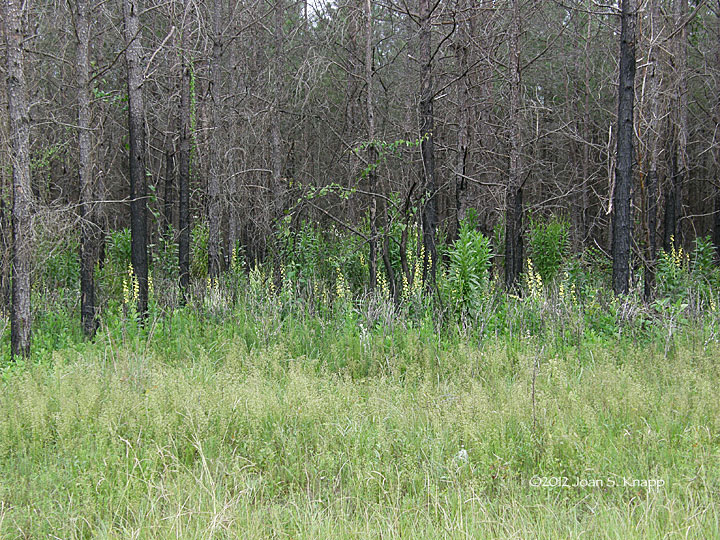
August 25th, 2012. We found this plant - Bigpod Sesbania (Sesbania herbacea) – flowering beside the road just opposite the turn to the road to pond 2A in the Piedmont National Wildlife Refuge in Jones County. It’s a little north of where it’s been officially documented.

The plant. It stood approximately 7 feet tall.

The lower ‘branch’ with multiple compound leaves

An upper flowering ‘branch’

The joint with leaf and flower stem

*****
Views of flower stems including a bud

*****
*****
*****
Various view of an individual flower

The bract

Sesbania herbaceae (Bigpod Sesbania, Hemp Sesbania, Danglepod, Coffeeweed, Sesban, Coffee-weed, Indigo-weed) is native to North America. In the United States, it’s found in coastal states from Connecticut and New York state, Maryland, Virginia, West Virginia to Illinois, Missouri, and Kansas and then south to Texas; it also occurs in California and Arizona. In Georgia, it’s only been formally documented in Richmond County and counties along the coast and bordering Florida.
Click on an image to view a larger image

Identification resources:
- Southeastern Flora: Sesbania herbacea (Hemp Sesbania)
- Name that Plant: Native and Naturalized Plants of the Carolinas and Georgia: Sesbania herbacea (Sesban, Coffee-weed, Indigo-weed)

Distribution:
- United States Department of Agriculture Plants Database: Sesbania herbacea (Bigpod Sesbania)
- University of North Carolina Herbarium: Sesbania herbacea

Tuesday, September 11, 2012

Velvetleaf Ticktrefoil (Desmodium viridiflorum)?


August 25th, 2012. Another visit to the Piedmont National Wildlife Refuge. As we were driving down Starr Road from GA-83 through the Oconee National Forest in Jasper County, we saw a leafless stem covered with flowers. The flowers were still in good shape so we stopped to take a closer look. It was a Desmodium species but which one? There are so many. I came to the conclusion that this is Desmodium viridiflorum (Velvetleaf Ticktrefoil) but welcome any correction.
This was a very robust plant. The stem reached about 4 feet from the vegetative part of the plant which stood about 2 feet high.

The tip of the stem which was quite thick and strong.

The leaves were about 1-1/2 inches long and roughly ‘velvety’

Flowers of the Desmodium species have ‘clear’ pink petals, in contrast to the opaque, ‘streaky’ pink and white flowers of the Lespedeza species and  have two ‘eye spots’ at the base of the banner petal.

This view gives a better view of the ‘eye spots’ and shows the fused stamens. A free stamen is also visible

An even better view of the fused and free stamens and the calyx.

Seed pods of a Desmodium species (not D. viridiflorum) showing the typical branch or chain that gives the genus its name. The seed pods have hooks that act like Velcro and stick to the fur of passing animals or clothing on humans

A sock to which desmodium seed pods have attached showing how effective this method of seed dispersal is. It takes quite a while to pick these off.

Desmodium viridiflorum (Velvetleaf Ticktrefoil, Velvety Tick-clover) is native to the United States, where it’s found in states southeast of a line from Connecticut-Pennsylvania west to Missouri and southwest to Oklahoma and Texas. In Georgia, it’s been documented in several counties throughout the state.
Click on an image to view a larger image

Identification resources:
- Name that Plant: Native and Naturalized Plants of the Carolinas and Georgia: Desmodium viridiflorum (Velvety Tick-clover)
- Missouri Plants: Desmodium viridiflorum
- Virginia Tech Weed Identification Guide: Desmodium viridiflorum

Distribution:
- United States Department of Agriculture Plants Database: Desmodium viridiflorum (Velvetleaf Ticktrefoil)
- University of North Carolina Herbarium: Desmodium viridiflorum

Tuesday, September 4, 2012

Partridge Peas (Chamaecrista fasciculata & Chamaecrista nictitans)


August 18th, 2012. With the rainfall we’ve had recently, roadsides in many counties in the Piedmont are lined by forests of partridge pea plants that are blooming profusely. Two species, Chamaecrista fasciculata and Chamaecrista nictitans, occur in this area.
Chamaecrista fasciculata is the showier of the two species – sometimes called the Showy Partridge Pea - and is responsible for most of the roadside displays.  
 
The flowers open completely.

Chamaecrista nictitans has smaller flowers, that…

rarely open completely so that it’s not as showy as its cousin, C. fasciculata.

*****
The seedpods, green and ripe.

Chamaecrista fasciculata (Partridge Pea, Common Partridge Pea, Showy Partridge Pea) is native of the United States, where it’s found in states southeast of a line from Massachusetts to Wisconsin and South Dakota and southwest to Texas and New Mexico. In Georgia, it’s found in many counties throughout the state.

 Chamaecrista nictitans (Sensitive Partridge Pea) is native of the United States, where it’s found in states southeast of a line from Maine to Wisconsin and Illinois and southwest to Kansas, New Mexico and Arizona. In Georgia, it’s found in many counties throughout the state.
Click on an image to view a larger image

Identification resources:
Southeastern Flora:
Name that Plant: Native and Naturalized Plants of the Carolinas and Georgia:

Distribution:
United States Department of Agriculture Plants Database:
University of North Carolina Herbarium:

Wednesday, August 29, 2012

Showy Rattlebox (Crotolaria spectabilis)

August 17th, 2012. We spotted Showy Rattlebox (Crotolaria spectabilis) plants – we didn’t know what they were at the time - blooming on the south side of GA-16 east of Sparta in Hancock County. GA-16 is a major highway crossing the county from east to west and it’s sometimes difficult to pull off the road and park, particularly if the traffic is heavy. We lucked out with light traffic and found a convenient place to park. The plants were growing at the edge of pine woods.


A view of the plants from the edge of the road


A little closer


Close to the edge of the woods. The plants were 4 to 5 feet tall.


The leaves. At first glance the flowers looked like baptisias but the leaves were quite different, arranged singly compared with the 3-leaf arrangement of Baptisia sp.


The top of the flower stalk.


A closer view

*****

Closer views of individual flowers.


Another close view.


Developing seed pods. These are reminiscent of baptisia seedpods.


Green seed pods, up close, and...


ripening seed pods.

Crotolaria spectabilis (Showy Rattlebox) is a native of the ‘Old World Tropics.’ In the United States it’s found in states southeast of a line from Virginia to Illinois and southwest to Texas. In Georgia, it’s found in many counties throughout the state. Interestingly it has not been documented from Hancock County, Georgia.
Click on an image to view a larger image

Identification resources:
- Name that Plant: Native and Naturalized Plants of the Carolinas and Georgia: Crotolaria spectabilis (Showy Rattlebox)
- Missouri Plants: Crotolaria spectabilis

Distribution:
- United States Department of Agriculture Plants Database: Crotolaria spectabilis (Showy Rattlebox)
- University of North Carolina Herbarium: Crotolaria spectabilis

Sunday, August 26, 2012

Maryland Or Wild Senna (Senna marilandica)

August 11th, 2012. We’d seen this plant in the Fishing Creek Wildlife Management Area in Wilkes County previously but hadn’t stopped to take a closer look. This time we did. The plant was a little taller than 6 feet. It was in bud but with only one flower actually open. I didn’t manage to get a good shot of the entire plant but it was about 6 feet tall.


 The top of the plant with the single, open flower at the bottom right.


A closer view of the buds at the top of the stem


The compound leaves


A close-up view of the flower and buds.

*****
*****
*****

 Close views of the flower.


Ants were clustered around the base of the leaf and flower stem.


These plants have extra-floral nectaries - glands that may be dome-shaped and dark gray-purple, with or without a short stalk at their base. The gland on this plant was sessile (no stalk) and dark green in color.

Senna marilandica (Maryland or Wild Senna) is native of the United States where it’s found in states east of a line from Illinois to Kansas south to Texas. In Georgia, it’s only been documented in a few counties, including Wilkes County, in north, central and southern Georgia.

Another species, the American or Northern Wild Senna (Senna hebecarpa), has only been documented in Fulton and DeKalb counties in Georgia. The extra-floral nectaries in this species appear to be located further along the leaf stem rather and in the axil between the leaf and stem.
Click on an image to view a larger image

Identification resources:
- J. Pippen, Duke University: Senna marilandica (Maryland or Wild Senna)
- Illinois Wildflowers: Maryland Senna (Senna marilandica)

Distribution:
- United States Department of Agriculture Plants Database: Senna marilandica (Maryland Senna)

Wednesday, August 1, 2012

Centrosema virginianum (Spurred Butterfly Pea) & Clitoria mariana (Atlantic Pigeonwings)


July 21st, 2012. Both Centrosema virginianum (Spurred Butterfly Pea) and Clitoria mariana (Atlantic Pigeonwings) grow at Fort Yargo State Park. The first time I saw Clitoria mariana, I didn’t look really closely. I thought it was a color variant of Centrosema virginianum. When I did look closer, I assumed that it was a different species of the same genus. A little research revealed, however, that these plants belonged to different genera.
After that, I kept an eye out for both species. I’ve seen Centrosema virginianum quite frequently on our travels but have rarely seen Clitoria mariana. Then, on July 21st, we saw both species in Greene County. Centrosema virginianum was growing in drier areas including the pine forests. The only place we saw Clitoria mariana was in a relatively shaded area on the embankment opposite the embankment on which we found the Amanita jacksonii (American Caesar’s) mushrooms.
 
Centrosema virginianum (Spurred Butterfly Pea)


Growing at the edge of a pine forest in Greene County. This was photographed in the late afternoon.


The plant was starting to develop seed pods.

*****

I took these photographs at Fort Yargo State Park in 2010.

Clitoria mariana (Atlantic Pigeonwings)


Growing on the embankment opposite where we found the Amanita jacksonii mushrooms


A closer view

*****

I took these photographs at Fort Yargo State Park in 2010


When we were at Fort Yargo State Park last Monday evening, we walked the trail along the lake at Picnic Area #1 and found many plants blooming and some with ripe seeds. This photograph was taken using flash illumination.

It’s interesting that both species are fairly widely distributed in Georgia. We’ve seen the Centrosema virginianum plants more frequently and in relatively dry areas. By contrast, this is the first time that we’ve seen Clitoria mariana outside Fort Yargo State Park. I get the impression that Clitoria mariana requires more humid conditions than Centrosema virginianum.
Click on an image to view a larger image

Identification resources:
Southeastern Flora:
- Clitoria mariana (Pigeonwings) 
Name that Plant: Native and Naturalized Plants of the Carolinas and Georgia:
- Clitoria mariana (Butterfly Pea) 
Alabama Plants: Centrosema virginianum (Spurred Butterfly Pea) 
Missouri Plants: Clitoria mariana

Distribution:
United States Department of Agriculture Plants Database:
University of North Carolina Herbarium:

Related posts: