Showing posts with label Poronidulus conchifer. Show all posts

Sunday, January 31, 2016

Summer On A Fort Yargo State Park Trail: Section B To The Dam, September 11th (Part 3)


September 11th. (Continued from…). When I visited Fort Yargo State Park in mid-February, there were few signs of Spring. The only wildflower plants that were obvious were the leaves of Cranefly Orchids (Tipularia discolor) that I found in many places.


The route… I’ve described it here, here, here, and here This walk doesn’t have the variety of wildflowers as my other walk from the Group A Shelter to the Old Fort but it does have some gems. One of the Smallflower Pawpaw (Asimina parviflora) had developed fruit that, unfortunately, it had lost; the Pink Lady’s Slipper (Cypripedium acaule) Orchids had bloomed, and some Green Adder’s-mouth (Malaxis unifolia) Orchids had bloomed and two were setting seeds. For the moment, some wildflowers we still blooming but there was a lull between seasons. I had thought that the slime mold fruiting was done for the year, but I was in for a surprise. There were new fungi to be found too. 

This next section of trail is on a north-facing slope above the reservoir. It’s protected from full sun and remains shaded and humid. It turns out that it’s a good place to find fungi.


I found more Violet-toothed Polypores (Trichaptum biforme). These had richer brown concentric coloring on their caps compared with those I had seen earlier on this walk.


Their undersides were a richer violet-purple than the ‘earlier’ ones too.


A little further along the trail, on the ‘lake’ side of the trail I was surprised to see Orange Sponge Polypre (Pycnoporellus alboluteus) fruiting on the underside of a large conifer log. I had seen this fungus fruiting earlier in the year on the trail from the picnic shelter to the Old Fort; I was surprised to see it fruiting so much later on this trail.


False Turkey Tail (Stereum ostrea) fruits along this section of trail. It is unusual to see algae colonizing the False Turkey Tails at this park so these caught my eye. The algae were on both the upper and undersides of the brackets. 

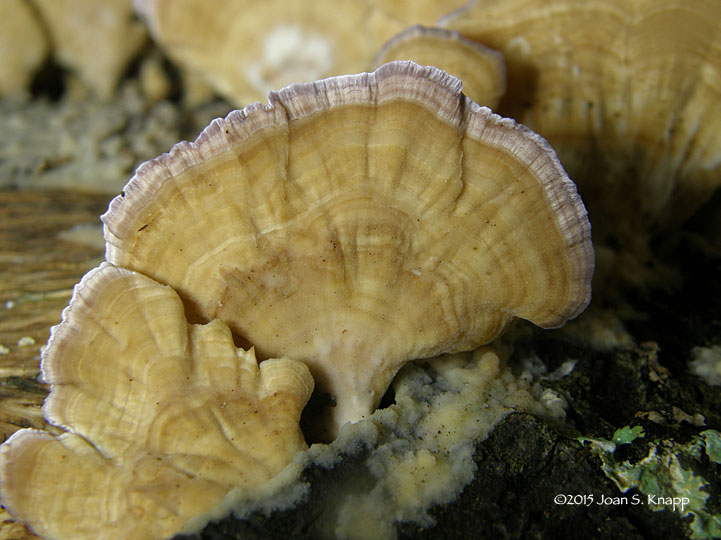
When I found the Little Nest Polypores (Poronidulus conchifer) on a branch that had fallen during a storm, I placed it by the trail where I could follow it over time.


The large caps, and their little ‘nests,’ were deteriorating.


In contrast, the nests that weren’t associated with larger caps were in much better shape and had more vibrant patterns and colors.


I was surprised to find two sections of fallen branches with brackets of Daedaleopsis septrionalis on them. The branch had broken into two pieces. One section (upper photo) had lodged in a hole in the ground and the brackets were layered up it; the second (lower photo) was lying flat on the ground, with its brackets growing horizontally.


The bifurcated gills were easily visible on some of the brackets.


The gills on other brackets had matured and broken at the points of bifurcation. The ‘ridges’ created by the breaks were quite visible and serve as a way to identify this species with older specimens.


I found just a few Tetrapyrgos nigripes mushrooms fruiting on a small twig. These mushrooms are easy to identify because they grow directly on wood or leaves but have no visible mycelium at their base. They had been plentiful a couple of month earlier so it was surprising to find just a few now.
(To be continued) 

Identification references:  
Messiah College: Trichaptum biforme 
Kuo, M. Mushroom Expert.com: Pycnoporellus alboluteus  
Kuo, M. Mushroom Expert.com: Stereum ostrea 
Kuo, M. Mushroom Expert.com: Poronidulus conchifer 
Messiah College: Daedaleopsis septrionalis
Kuo, M. Mushroom Expert.com: Tetrapyrgos nigripes 
Anybody Seen My Focus?:  Mushroom: Tetrapyrgos nigripes

Related posts:  
- Summer On A Fort Yargo State Park Trail: Section B To The Dam, July 29th (Part 1) 
- Spring Is In The Air: Fort Yargo State Park, Section B To The Dam, May 1st (Part 2) 

Monday, January 11, 2016

Summer At Fort Yargo State Park: Shelter A To The Old Fort, September 9th, 2015 (Part 3)


September 9th. (Continued from…).  I started to walk again at Fort Yargo State Park in Winder, Georgia. One of my favorite walks is from the Group Shelter A to the Old Fort and back.This is a rewarding walk for viewing wildflowers and I’ve This is a rewarding walk for viewing wildflowers and I’ve been walking it every week


The route, which I described here, here, and here.

The early spring wildflowers have finished blooming; it’s time to watch the developing fruit. Summer wildflowers were still blooming but it was time to turn attention to the fungi in the woods. There were quite a number on this walk.


The fruit on the Buttonbush (Cephalanthus occidentalis) were still unchanged from the previous week. These take a long time to mature.


As I crossed the Fishing Area picnic ground, I spotted a couple of small yellow flowers; Pencil-flowers (Stylosanthes biflora). It was a very small plant and the first time I’ve seen it here.


A Broadleaf Arrowhead (Sagittaria latifolia) had just about finished blooming and was already setting fruit In the swampy area in the cove in the Fishing Area.


At the north end of the picnic area, some fallen logs were hosting healthy colonies of the Violet-toothed Polypore (Trichaptum biforme)


A small, strikingly beautiful mushroom with a yellow-gold cap and white stem was growing in the leaf litter near the logs. This was Hymenopellis sinapicolor, a mushroom that grows on buried deadwood, explaining why It looked like it was growing in soil.


As I entered the woods along the Rock Garden trail, I found some a beautiful Coker’s Amanita (Amanita cokeri). It’s not unusual to find these mushrooms with veil material still attached to the stem. This particular mushroom had a strongly sculptured cap.


As I turned back to the trail, I caught sight of a white ‘bump’ on a fallen log. I knew immediately what it was, but had to make my way around the log to confirm that it was a Lion’s Mane (Hericium erinaceus) – the first I had ever seen. It was a young specimen, only four to five inches long; it’s teeth were just starting to grow out. This would require another visit in a few days, not another week, to photograph again.


The Resurrection Fern (Pleopeltis polypodioides) had remained ‘re-hydrated’ for several weeks.


The seed capsules on the Wild Yam (Dioscorea villosa) vine just below the Resurrection Fern had clearly matured but they hadn’t opened yet.


Further along the Rock Garden trail, I stepped over another striking fungus. I had been stepping over it for a couple of weeks, trying to resist the urge to be drawn into identifying fungi. But, on this day, it got the better of me. It was growing against an exposed tree root and with no space between it and the ground. I removed a portion of it and was rewarded with the first…


toothed fungus I’d ever found. It was Hydnellum concrescens, commonly called the Zoned Tooth Fungus. By the time I photographed it, the cap was quite tough and ‘woody.’

Since I was paying more attention to bracket fungi, I stepped off the trail to investigate a fallen branch. I found that these fungi were…


Little Nest Polypores (Poronidulus conchifer). These fungi were…


old compared with the ones I had found previously on the trail to the dam, but there was no mistaking them. What did surprise me was the…


excellent condition of the pore surface of these fungi. I’ll be keeping an eye on this branch next year to see if new brackets develop.


As I returned to the trail, I found more Snow Fungus (Tremella fuciformis). I’d been finding this fungus on fallen logs along this section of trail repeatedly for several months


My final stop before I reached the Old Fort was at the Golden Reishi (Ganoderma curtisii). The cap surface appeared to have oxidized a little since the previous week. And then I noticed that…  


Another ganoderma, also G. curtisii, had grown on the other side of the tree. This one was almost completely yellow compared with the brighter colors of the first one. In this instance, however, I was able to photograph the…


pore surface of this fungus.
(To be continued…)


References: 
- Native and Naturalized Plants of the Carolinas and Georgia: Buttonbush (Cephalanthus occidentalis) 
- Native and Naturalized Plants of the Carolinas and Georgia: Pencil-flower (Stylosanthes biflora) 
- Native and Naturalized Plants of the Carolinas and Georgia: Broadleaf Arrowhead (Sagittaria latifolia) 
- Messiah College: Trichaptum biforme 
- Mushroom Expert. Kuo, M. (2014, November). Hymenopellis sinapicolor 
- Mushroom Expert. Kuo, M. (2013, March). Amanita cokeri 
- Mushroom Expert. Kuo, M. (2013, March). Hericium erinaceus 
- Native and Naturalized Plants of the Carolinas and Georgia: Resurrection Fern (Pleopeltis polypodioides) 
- Native and Naturalized Plants of the Carolinas and Georgia: Wild Yam (Dioscorea villosa) 
- Mushroom Expert. Kuo, M. (2009, April). Hydnellum concrescens 
- Mushroom Expert. Kuo, M. (2010, March). Poronidulus conchifer 
- Mushroom Expert. Kuo, M. (2008, November). Tremella fuciformis 
- Wikipedia: Ganoderma curtisii