Showing posts with label Parasola plicatilis. Show all posts

Tuesday, August 11, 2015

Summer At Fort Yargo State Park: Shelter A To The Old Fort, July 6th, 2015 (Part 2)


July 6th. (Continued from…) I started to walk again at Fort Yargo State Park in Winder, Georgia. One of my favorite walks is from the Group Shelter A to the Old Fort and back.This is a rewarding walk for viewing wildflowers and I’ve been trying to walk it weekly and document the wildflowers I see.


The route, which I described here, here, and here.
The early spring wildflowers have finished blooming; it’s time to watch the developing fruit. A few late spring/summer wildflowers are blooming now.


As I made my way over to the ‘Rock Garden,’ I found a lone Starry Rosinweed (Silphium astericus) blooming. It’s unusual to find this plant near the Fishing Area.


A dead Eastern Red Cedar (Juniperus virginiana) had been cut down. The…


cut was fresh; the colors of the wood were vibrant and the scent of cedar filled the air in the immediate area.


The Resurrection Fern (Pleopeltis polypodioides) on a tree trunk in the Rock Garden, dry the week previously, has been ‘resurrected’ yet again.


The Wild Yam (Dioscoria villosa) with seed capsules, and the…


Eastern Sweetshrub (Calycanthus floridus) both look healthy.


Smooth Yellow False Foxglove (Aureolaria flava) plants were ‘between’ blooms but there are many buds still to open.


The Perfoliate Bellwort (Uvularia perfoliata) still had its seed capsule.


One of several Nakedflower Ticktrefoil (Desmodium nudiflorum) plants in this area was blooming, with a tiny seed pod already forming from a ‘spent’ flower.


Near the end of the Rock Garden trail, I found clusters of tiny white mushrooms on dead wood. Their caps were only about 0.5 inches in diameter and 1 to 2 inches tall.

I walked over to the main trail towards the Old Fort.


The fallen log that had previously had Snow Fungus (Tremella fuciformis), had some new fungus, and I found a few...


young pink Wolf’s Milk (Lycogala epidendrum) slime mold fruiting bodies on a more-decayed log nearby.

In the grass by the footpath along the edge of the lake, I found a couple of…
 
Pleated Inkcap (Parasola plicatilis) mushrooms. 

The Swamp Rosemallow (Hibiscus moscheutos) bush was in…


full-bloom, and was already...


developing seed capsules.


A Bigroot Morning-glory (Ipomoea pandurata) was blooming just inside the edge of the woods. This isn’t a robust vine and these were the only blooms I’ve seen here; this isn’t a good spot to look for these. 

I had been keeping my eye open for Cranefly (TIpularia discolor) orchid blooms. Since the leaves have ‘disappeared’ before the orchids bloom, it’s a case of trying to remember where I’d seen the leaves. This day was ‘the’ day. I found…


flower stalks just emerging in a couple of locations. It’s be a week or so before blooms would appear. 

Just south of the Fishing Area, I found another…


Dog Vomit (Fuligo septica) slime mold fruiting body forming. 

A little further south, I happened to look further up a gully from the trail and spotted many mushrooms growing on a decaying log. It was about 30 to 40 feet from the trail. I had to decide if it was worth navigating my way across to it and possibly sitting – inevitably – in the wet leaves to photograph them. I’m glad I decided to.

A colony of mushrooms. They were in good condition.


A cluster of the mushrooms, and an…


individual mushroom. I identified this mushroom as the Golden-gilled Gerronema mushroom (Gerronema strombodes). 


Rather than walk back to the trail from the direction I’d come, I decided to leave the gully from its south side. As I reached the top of the gully, I spotted…


fungi on another decaying log. They were…


Crown-tipped Coral fungi (Artomyces pyxidatus; formerly Clavicorona pyxidata). These fungi, also, were in pristine condition and I spent many more minutes sitting in wet leaves to photograph these. But they were worth it. 


The final sighting for the walk was a cluster of Turkey Tail (Trametes versicolor) bracket fungi on the end of a log. 

It’s interesting that, although I anticipate just checking on fruits of various plants and the ‘usual suspect’ wildflowers, I seem to find things that I didn’t expect. That’s what makes these walks interesting.

Reference:
- Mushroom Expert: Gerronema strombodes 

- Related posts:

Saturday, June 20, 2015

Spring Is In The Air: Fort Yargo State Park, Section B To The Dam, June 4th (Part 1)


June 4th. When I visited Fort Yargo State Park in mid-February, there were few signs of Spring. The only wildflower plants that were obvious were the leaves of Cranefly Orchids (Tipularia discolor) that I found in many places.


The route… I’ve described it here, here, here, and here This walk doesn’t have the variety of wildflowers as my other walk from the Group A Shelter to the Old Fort but it does have some gems. One of the Smallflower (Asimina parviflora) had developed fruit that, unfortunately, it had lost; the Pink Lady’s Slipper (Cypripedium acaule) Orchids had bloomed, and some Green Adder’s-mouth (Malaxis uniflora) Orchids were blooming. 

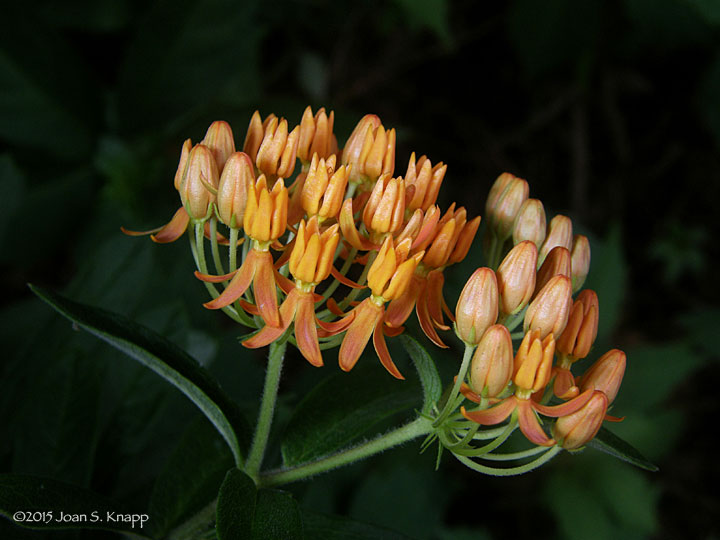
My previous walk on this trail had bordered on boring. The only ‘new’ wildflower was the Butterfly Milkweed (Asclepias tuberosa) that had set buds, but this walk would be very interesting. 


Many of the Butterfly Milkweed flower buds had opened. Luckily, I photographed them on this walk. They had disappeared before my next walk. Deer had eaten them; they had nipped the stems just below the flowers. I used to hear that deer wouldn’t eat milkweeds. If I believed it once, I don’t now. Deer at home have nipped the tops from our Green Comet Milkweed (Asclepias viridiflora) plants in the past. It was disappointing to see that these flowers had been eaten. They were putting on a small, but impressive show.


On the flat section of trail just beyond the trees, Elderberry bushes (Sambucus nigra) were in full bloom.


Cutleaf Evening Primroses (Oenothera laciniata) were blooming. There were only a few plants this year and the flowers are usually closed by the time I walk the trail. This one was blooming in the shade and not so quick to close.


A few Pleated Inkcap Mushrooms (Parasola – formerly Coprinusplicatilis) were growing along the trail.
 
A few Plumeless Nodding Thistles (Carduus nutans) were blooming in the grass beside the trail. 


Things started to get interesting when I entered the main woods after crossing the gas pipeline right-of-way. I found, by chance,…


Crown-tipped Coral fungi (Artomyces – formerly Clavicorona – pyxidatus)
 fruiting on a fallen log in a relatively open area. Scuppernongs were growing around that log and probably helped maintain the humidity that would be necessary for these fungi to grow. I was lucky to get a glimpse of them; it would have been very easy to miss them.


The Witch’s Butter (Tremella mesenterica) jelly fungus near the ‘Christmas Fern Grove’ was still re-hydrated and, in fact, appeared to grow further (lower image) while I was on the trail.


I made my way along the trail to the approach to ‘The Hill.’ Off to my right, I saw some…


red spots on a fallen log. I’d seen them before but had never investigated further. Now I took a closer look. I expected them to be a nondescript fungus but, to my delight, found that they were the…


Red Raspberry (Tubifera ferruginosa) slime mold. 

I continued up ‘The Hill’ and then made my way over to the…


Tulip Poplar (Liriodendron tulipifera) where two fruit were still developing, and then on to the Outer Loop. I was walking along the Outer Loop when, out of the corner of my eye, I noticed a shape that didn’t belong. I almost ignored it but turned and walked over to take a closer look. It was a…


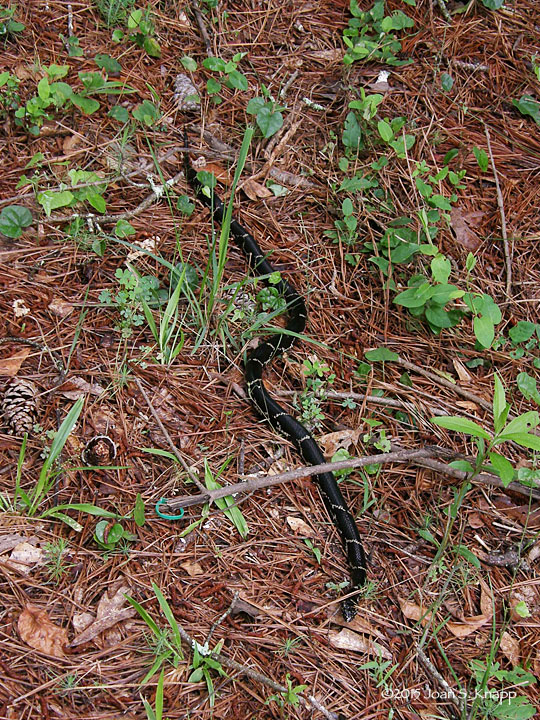
young Eastern Kingsnake (Lampropeltis getula getulaL). It was about 2 feet long and lying in the grass against the woods at the side of the trail. It wasn’t moving when I went over to take a closer look. I don’t know whether it had sensed the vibrations of my footsteps and stopped moving or was simply lying in wait for some hapless prey.
Down at the dam, I found a clump of…


Lanceleaf Coreopsis (Coreopsis lanceolata) plant in bloom, and a few…
Queen Anne’s Lace (Daucus carota) plants just starting to bloom. 


Then on to the return trail…
(To be continued…) 

Related posts: