Tuesday, July 22, 2014

Piedmont National Wildlife Refuge: Golden-winged Skimmer (Libellula auripennis)


July 17th, 2014. 
Golden-winged Skimmer (Libellula auripennis) on sedge stem at Pond 6A 
Piedmont NWR, Jasper County, GA

This is the first time that I’ve seen a Golden-winged Skimmer. They may be found throughout Georgia from May through September.
 
Related posts:  

Monday, July 21, 2014

Piedmont National Wildlife Refuge: Green Lynx Spider (Peucetia viridans) on Rosepink (Sabatia angularis)


July 17th, 2014. 
Green Lynx Spider (Peucetia viridans) on Rosepink (Sabatia angularis) 
Piedmont NWR, Jasper County, GA

I was clearing grass blades away from the plant and almost missed this Green Lynx spider which was nicely camouflaged.
 
Related posts: 

Sunday, July 20, 2014

Piedmont National Wildlife Refuge: Rosepink (Sabatia angularis)

July 17th, 2014. 
Rosepink (Sabatia angularis)
Piedmont NWR, Jasper County, GA


Plants were in bloom along the roadside and in many open meadows
More information on this flower here.

Related post:
- Piedmont National Wildlife Refuge: Pond 6A

Saturday, July 19, 2014

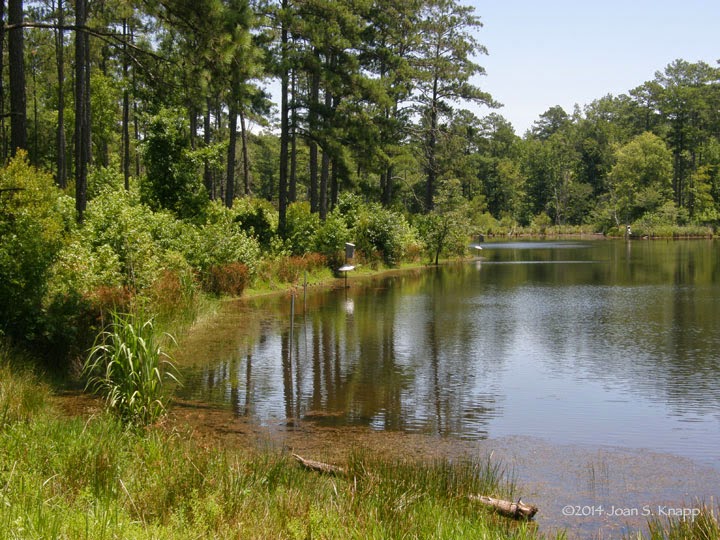
Piedmont National Wildlife Refuge: Pond 6A


July 17th, 2014.
North shore, Pond 6A 
Piedmont NWR, Jasper County, GA


Tuesday, May 13, 2014

Talullah River Road: Spring Wildflowers


April 3rd, 2014. On our way back from South Carolina, we detoured through Clayton to the Tate City Road on the Tallulah River that we had last visited in late 2012. At that time, we had found seeds of Jack-in-the-pulpit (Arisaema triphyllium) and the Strawberry Bush (Euonymous americanus) as well as blooms ofJewelweed (Impatiens capensis). 


Vicia caroliniana (Carolina Vetch, Wood Vetch, Pale Vetch) was growing on the embankments before we crossed the river.  


At first, the road runs along the river where the water is flowing over large boulders for some distance. We saw wildflowers on some of the steep embankments that were not easily accessible. 

Further up the river, the valley widens. The wildflowers were more accessible.  


Trillium cuneatum (Little Sweet Betsy, Purple Toadshade) were flowering on both sides of the road. The number of plants with the green form of the flower was striking. 


I counted one cluster of at least 11 plants of this form 


Sanguinaria canadensis (Bloodroot, Red Puccoon) plants in bloom were plentiful on many embankments. 

Some were starting to develop seedpods. 

In addition to the ‘normal’ Bloodroot flowers, we found quite a few ‘double’s. 

Thalictrum thalictroides (Rue Anemone, Windflower) were also plentiful on some embankments. 

Erythronium umbilicatum (Dimpled Troutlily, Dimpled Trout Lily, Dogtooth Violet). We found only two small patches of these lilies. It was surprising that they were still blooming. 

At the end of the road, we found a number of wildflowers, some just starting to blooms or finishing for the season. 

Arisaema triphyllum ssp. triphyllum (Jack-in-the-Pulpit) just leafing out. 

A white-flowered trillium just beginning to open. 

Hepatica nobilis var. acuta (Sharplobe Hepatica, Sharp-lobed Hepatica, Sharp-lobed Liverleaf). Although most plants had finished blooming, one or two plants were still blooming.

This is a rich botanical area for Spring wildflowers and well-worth a visit.

Related posts: 

Saturday, May 10, 2014

Luna Moth (Actias luna) At Station Cove


April 2nd, 2014. Sighting a Luna Moth (Actias luna) was a bonus while hiking the Cove Falls trail. 

The moth was clinging to a small stem.


It was a female. (Compare the antennae of the female with those of the male).

Judging by the size of the abdomen, this female emerged from the pupa not too long before I spotted it. She will excrete much of the fluid before she is ready to fly.

It’s unusual to find Luna moths in the Spring. They are much more common in the Fall so this was a lucky sighting
 
Related posts:
- Wildflowers at Oconee Station Historic Site and Station Cove Falls (Part 1)  
- Oconee Station Historic Site andStation Cove Falls 
- Another Luna Moth  
- Luna Moth (Actias luna)

Saturday, May 3, 2014

Wildflowers At Oconee Station Historic Site and Station Cove Falls (Part 2)


April 2nd, 2014. Continued from Oconee Station Historic Site and Station Cove Falls: Wildflowers (Part 1). We made a short trip over to Devil’s Fork State Park, South Carolina in search of Shortia galacifolia (Oconee Bells, Southern Shortia) and Monotropsis odorata (Pygmy Pipes, Appalachian Pygmy Pipes, Sweet Pinesap). While we were there we made a side trip to Oconee Station Historic Site and the Station Cove Falls. 

Map of the trails from the Oconee Station Historic Site to the falls. We parked at the historic site and walked down to the pond. The main trail stays on the highway side of the pond and follows the creek up to the highway. Although the map shows a trail around the pond, it is quite primitive. It was late in the day so we decided to hike to the falls the following morning. 

The vegetation changed about half-way along the trail. It was moister than the first part of the trail. 


There were several large areas covered with Mayapples (Podophyllum peltatum). 


Some had buds that will develop white flowers


There were clusters of these plants standing by themselves and among the Mayapples. I knew I should know what they were, but it wasn’t until I saw the Perfoliate Bellwort that I realized they were Sessileleaf Bellwort (Uvularia sessilifolia) that will produce flowers like these (photographed by Hugh Nourse).  


Halberd-leaf Yellow Violets (Viola hastata) were blooming along the bank beside the trail. 

Rue Anemone (Thalictrum thalictroides)  

Foamflower (Tiarella cordifolia). Most were still in bud but a couple had opened flowers. 

Wood Anemone (Anemone quinquefolia). This was the first Wood Anemone I had seen, and the only one I saw along the trail. 


A promise of dwarf iris blooms to come. My guess is the Dwarf Crested Iris (Iris cristata) although they could be the Dwarf Iris (Iris verna). 

Lousewort (Pedicularis canadensis) were just starting to bud at the very edge of the trail. We saw these in full bloom at Boggs Creek.  

I think this might be Spotted Mandarin (Prosartes maculata) that will produce flowers like these (photographed by Hugh Nourse in North Carolina). Another guess. This plant, and I only found one,  was growing quite near to the crossing to the final approach to Station Falls. It’s not been officially documented in South Carolina but occurs in surrounding states.

On the final approach to Station Cove Falls looking back to the crossing over Station Creek. The vegetation here was different from the drier areas along the trail on the other side of the creek. There were Mayapples which we had seen earlier on the trail but then several plants that appeared to be unique here.

Canadian white violet (Viola canadensis). Some are visible in the photo above but they carpeted the area to the left of the trail moving towards the falls.

The area to the right of the path was covered with Mayapples. Among the Mayapples the ground was covered with Sharplobe Hepatica (Hepatica nobilis var. acuta) plants. They had finished blooming for the season.  The flowers are similar to those of the Round-lobed Hepatica (Hepatica nobilis var. obtusa). 

Blue Cohosh (Caulophyllum thalictroides). The final gem on the trail was a single Blue Cohosh, and in bloom.

This is a rich botanical area for Spring wildflowers that would require several trips at different times to fully appreciate the variety of flowers that could be viewed.

Related posts: