Friday, May 12, 2017

Sanguinaria canadensis (Bloodroot)


March 10th. After several encounters with fungi, I reached the section of trail in the Oconee Heritage Park where I had seen a few early spring wildflowers last year. I was a week or so earlier than last year, so I wasn’t sure if I would be too early but… 

I was in luck. I found Bloodroot (Sanguiaria Canadensis) at two locations on the same short section of trail. The name ‘sanguinaria’ comes from the fact that the sap in the stem and roots of this plant is red, and has been used as a dye.


Several flowers were at their peak.


Each flower had its characteristic leaf folded around the base of the flower stem.


A few days later and I would have missed the flowers. Some had already dropped their petals and were starting to form seed capsules.

It’s always delightful to find these plants in the woods. 

References:
- Native and Naturalized Plants of the Carolinas and Georgia: Sanguinaria canadensis 
- USDA Plant Database: Sanguinaria canadensis (Bloodroot)

Wednesday, May 10, 2017

Fuscoporia gilva (Mustard Yellow Polypore)


March 10th.  Still at Oconee Heritage Park (OHP). I found…


these old brackets on a tree by the trail. I knew, from experience, what they were: Fuscoporia gilva (Mustard Yellow Polypore), formerly called Phellinus gilvus. Although these brackets were old, they were quite beautiful.


A close-up of one of the brackets, and its…


pore surface. This fungus has very small pores. 

F. gilva brackets don’t always look like the above as as they age.


I found these older brackets on a fallen log at OHP on the same hike. 

I’ve only found fresh F. gilva with mustard yellow margins on one occasion, at Fort Yargo State Park, where I found them on a…


fallen tree trunk.


The tops of fresh brackets were a deep brown with a mustard yellow margin, hence, their common name, Mustard Yellow Polypore.


Their pore surface was also a deep purple-brown, with…
 

 very fine pores.


The mustard color faded to brown within a week.


Yet another cluster of F. gilva, growing on a tree at the State Botanical Gardens of Georgia, south of Athens, Georgia.


Even very small, developing brackets lacked the mustard yellow margins. They did, however, have very small pores characteristic of this species.

In this area, F. gilva brackets are usually approximately 2 – 2.5 inches wide, but they can grow up to 6 inches wide. They may grow as single, or clusters of overlapping brackets.

References:
- Messiah College: Phellinus gilvus (now Fuscoporia gilva) 
- Discover Life: Phellinus gilvus (now Fuscoporia gilva)

Monday, May 8, 2017

Hedgehog Gall Wasp (Acraspis erinacei)


March 10th. I was sitting on the ground at the Oconee Heritage Park, photographing some fungi when something caught my eye.


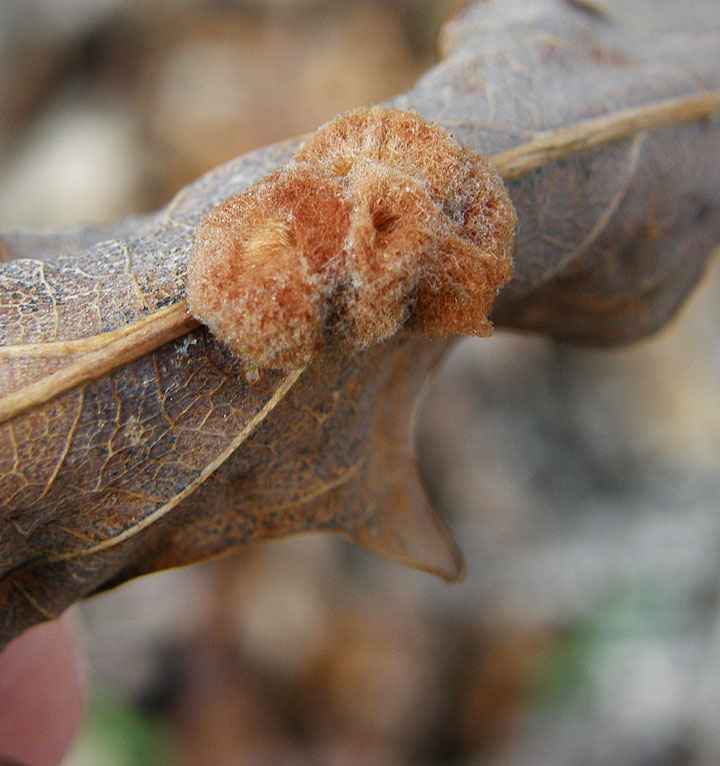
Several of the leaves – White Oak (Quercus alba) leaves – had small ‘furry’ galls on them.


They were approximately 0.5 inches long, and located the central vein on the undersides of the leaves.

A little bit of research identified them as belonging to the Hedgehog Gall wasp (Acraspis erinacei). This wasp has an interesting life cycle. 

Males and females mate in the spring, and the female lays eggs on various white oak species. The hatching eggs irritate cells on the tree, which forms a gall that protects the as many as five larval cells. The larvae feed and mature in the gall, which becomes the distinctive hedgehog gall. The gall is covered with red hairs when young and ages to the brown gall that I found.

Only female wasps emerge from the galls in the fall and, without mating, lay eggs in the buds. The eggs overwinter and hatch in the spring. The larvae develop in a thin-walled ‘blister’ on the inner face of a bud scale appears when the buds open in the spring. Male and female wasps emerge from this gall, mate, and produce the eggs to complete the life cycle. 

References:
- MO Bugs: Hedgehog Gall 
- Backyard and Beyond: Hedgehog Gall

Sunday, May 7, 2017

Trichaptum biforme (Violet-toothed Polypore)


March 10th. On a hillside above a small creek at Oconee Heritage Park, I found a hardwood tree with… 

 
clusters of small bracket fungi at chest height and at its base.


These brackets were similar in size to Turkey Tail (Trametes versicolor) brackets and had faded to be almost uniformly white.


The undersides of these brackets were dark with age, and had a maze-like appearance but lacking the radial orientation that I’d seen on the Trametes villosa brackets. These brackets were Trichaptum biforme, the Violet-toothed Polypore, yet another Turkey Tail look-alike.

It was a little surprising to find the maze pores still intact. Frequently, the pores of T. biforme break down into…


tooth-like structures. It’s not unusual to find them like this. 

If you’re lucky, you might find young Violet-toothed Polypores. I found these last December at Fort Yargo State Park.


The caps were brown with distinctly purple margins.


Their undersides were also a rich purple, from which they get their common name, Violet-toothed Polypore.


Their pores have a zig-zag appearance.


As they age, the purple margin fades from the caps, and the…


pores lose their purple color.

The key to field identification of Trichaptum biforme, and differentiation from Trametes versiolor, is the characteristic pore surface. Even better, if you find young specimens with the distinctive violet coloration. 

References:
- Michael Kuo, Mushroom Expert: Trichaptum biforme 
- Messiah College: Trichaptum biforme

Saturday, May 6, 2017

Trametes villosa


March 10th. I went over to the Oconee Heritage Park off US-441 south of Bishop, Georgia, to look for early wildflowers that I’d seen last year. I decided to look for fungi in the woods along the way.


I noticed a log with some small, cream-colored bracket fungi that resembled the almost ubiquitous Turkey Tails (Trametes versicolor). These brackets were the same size as T. versicolor, about 1.4 inches across, and ‘paper-thin.’ They were growing in overlapping clusters on the side of, or in rosettes on top of the log. They were a little unusual in being so light colored. I almost dismissed them as being T. versicolor but they were pretty and I stopped to photograph them.

They resembled young…


T. versicolor brackets that I had found at home some years ago. Turkey Tails are identified by the fact that they have distinct zones of color on their caps, and…


white-to-light-tan undersides with small pores (holes).


I took a photo of a cluster on the side of the log, and a…


closeup of one of them, that showed the finely hairy surface characteristic of these small Trametes sp. 

I almost left without photographing the undersides of one of the brackets. In the bright sunlight, I couldn’t really see the detail on the undersides. In fact, it was so bright, that I depended on the camera to focus on the pores without my being able to see them clearly. I didn’t see the pore structure detail until I got home and was processing the images.


I was very surprised, and excited, when I found that they had maze-like pores rather than the near circular pores of T. versicolor. This was the first time that I had found a Trametes sp. like this. It was one of the Turkey Tail ‘look-alikes.’ 

Two Trametes sp., T. villosa and T. pubescens, were suspects. Both are light-colored, without the stronger color zones characteristic of T. versicolor. T. pubescens appear to be sturdy brackets – up to 2.5 inches across and 0.5 inches thick – with angular pores (3-5/mm). T. villosa are described as up to 2.5 inches across, but only a few mm thick, and with pores that elongate as they age.

I have concluded that the brackets I found are T. villosa. This was an exciting find; this species is not reported frequently. I was lucky to find it. And I guess the moral of the find is, always to look at anything slightly out of the usual, and always look, and photograph, the undersides. 

References:
- Michael Kuo, Mushroom Expert: Trametes villosa 
- Michael Kuo, Mushroom Expert: Trametes pubescens 
- Messiah College: Trametes pubscens

Friday, May 5, 2017

Acer rubrum (Red Maple)


March 3. One tree had bloomed before the Serviceberry tree. The Red Maple (Acer rubrum) had bloomed. I’d seen the blooms, but they were high up, and in the shade. No way to hook them and bring them down for a close-up shot. But the clusters of samaras – their seeds – were a different matter.


They were a bright red and, at the right time of day, were caught in the sunlight.
Although there are several Red Maples along this trail, this tree put on the best show this year.

References: 
- Native and Naturalized Plants of the Carolinas and Georgia: Acer rubrum 
- USDA Plant Database: Acer rubrum (Red Maple)

Thursday, May 4, 2017

Amelanchier arborea (Serviceberry)


Time to get back to the blog, sadly neglected for a couple of months. Too much time on the internet, but learning new things, and more about old friends.

March 3rd. The Serviceberry tree is one of the earliest to bloom at the lake. The first time I saw it, I was rowing and was surprised to see clusters of white flowers on a tree on the lakeshore. I was able to find a low branch with flowers, and identify it. Since then, I always keep an eye out for them.

This tree, approximately 25 feet tall, was growing right on the lakeshore. I wasn’t sure that I could reach flowers to photograph. That’s where my snake hook comes in handy. I was able to hook a lower branch and carefully pull it down to eye height.

Only one of the flowers was open; most were still at the bud stage.

I didn’t have much hope that I’d find opened flowers on March 8th when I passed this site again. I was lucky. I found that there were several young tress, about 7-8 feet tall, growing around the taller tree. These had flowers too, and I was able to find…


clusters (racemes) with most of the flowers opened.

‘Locals’ have an explanation for the common name, Serviceberry. During the winter, mountain roads would often be in such poor condition and the weather so cold and inclement, that circuit-riding preachers would suspend church services for several months. Since the ground was hard, graves could also not be dug, The blooming of the Serviceberry indicated that the ground had thawed sufficiently for graves to be dug, and burial services conducted. Since the name was applied to English and New World trees in the 16th century, the local etymology is unlikely, although it would have been practical.

References:
- Native and Naturalized Plants of the Carolinas and Georgia: Amelanchier arborea 
- Wikipedia: Amelanchier