Wednesday, February 18, 2015

Ice Day


February 17th. Ice was predicted but we weren’t supposed to get any; we were on the edge of the rain/ice zone. The cold kept moving in and the ice began to form at about dusk. Just a millimeter or so. We lost power (and water) at about 10:30 pm. Power was restored at about 1:00 am but we lost it again 15 minutes later. It was about 2 pm before power was finally restored. Luckily, we have a wood stove to keep us warm. 


In the morning, icicles were hanging off the branches near the house.


The ‘locals’ -  a Chipping Sparrow, and a male and female Purple Finch - didn’t seem too happy about it. 

Usually, we would just rug up and wait it out but I had an appointment and had to go out. Luckily the roads were clear and it was a great excuse to take a camera. 


It was clear, even as I drove down the drive, that it was going to be interesting. The ice really weighed down the needles on the Eastern Red Cedars, and… 


thoroughly coated the blueberry bushes.


As with the cedars, the ice was thick on the pines along the road. Most of the damage was to the pines. The weight of the ice was too much and branches littered the roads in many places.

After my appointment. It was overcast except for short bursts of sunshine, and the temperatures showed no signs of rising. I was somewhat surprised that little melting had occurred so I went home by a different route to see more of the countryside 

Ice decorated many of the fence wires.
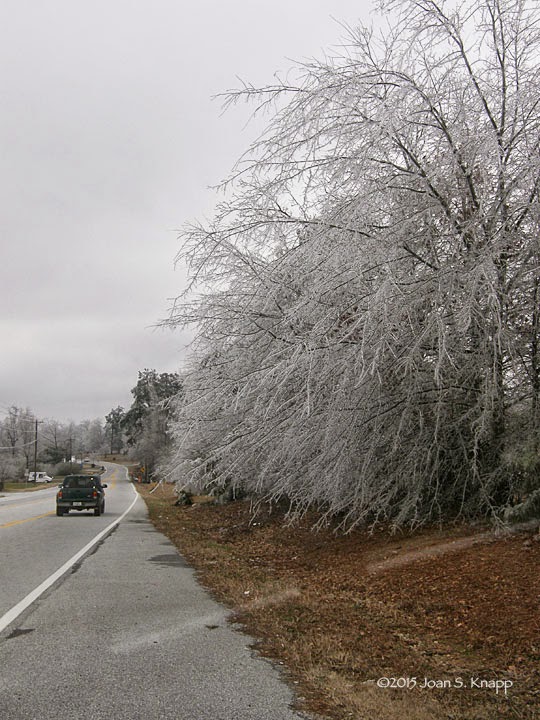


Deciduous trees were sprays of ice.


More pines and their cones were coated thickly. 
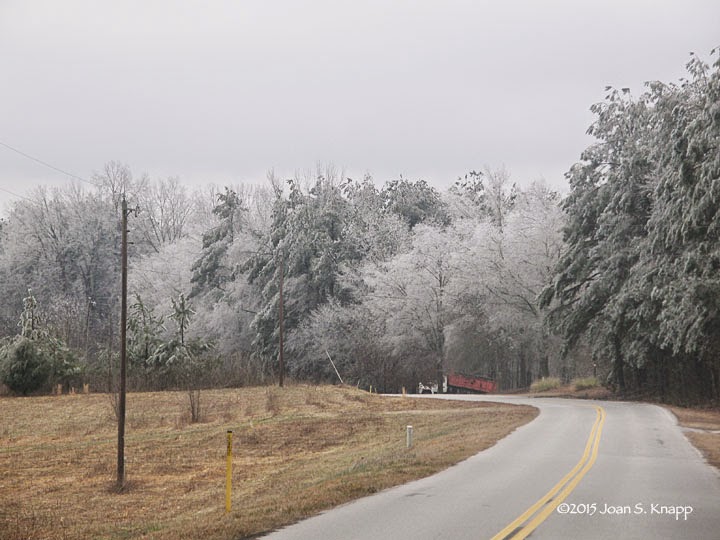

The countryside looked forlorn in the overcast conditions. From a distance, it looked as the trees were covered with snow, but at close range,


I was reminded it was actually ice

Fortunately, the weather conditions that result in ice accumulations are rare in our area. The temperatures are predicted to remain low for another day or so and the ice is still clinging to trees in protected areas. It’s nice to be able to enjoy them for a short time but it’ll be good when things return to normal again.

Tuesday, February 17, 2015

Winter Walk: Fort Yargo State Park – Group Shelter A To The Old Fort (Part 3)


February 6th. (Continued from…) I haven’t been to Fort Yargo for a few years and decided to intersperse walks in the park with my trike rides. In previous years, I’ve both walked some of the trails and rowed the lake. If you know where to look, the park has quite a variety of wildflowers. 


I decided to walk from the Group Shelter A to the Old Fort and back. There isn’t much in the way of plants at the moment but I enjoy the scenery and this was a particularly pretty day. 


Starting back down the trail from the Old Fort. It’s fascinating how much darker this section of trail looks walking it this way. Some of the darkness is due to lighting; some of the darkness is attributable to the soot remaining on some of the tree trunks from a controlled burn several years ago. 


A little further along the upper trail back to the Fishing Area 


I always check this tree. Cranefly Orchids grow in the shelter of the trunk of the tree. These plants usually bloom. Even if I don’t see them in bloom, it’s not unusual to see the empty seedpods in the fall.  


Arriving back at the Fishing Area. 
  
The Fishing Area parking lot 


Back to the bridge out of the Fishing Area. 


An American Beech tree in the woods.


The trail just south of the Fishing Area. A couple of Pink Lady’s Slipper Orchids (Cypripedium acaule) bloom just to the right side of the trail. I think most people walk past them without even seeing them.

Nearby are some Pipsissewa plants.  These often bloom and set seeds.


Looking south along the lake. I’d never thought much about it but these benches are located at strategic intervals along the trail. 

The trails in the park are color coded; often the trails are marked on tree trunks. 


Almost back to the cliff. 

Markers are also placed at 1/10-mile intervals. I’m not sure if this is encouraging or discouraging. 


Looking along the fence above the cliff. 


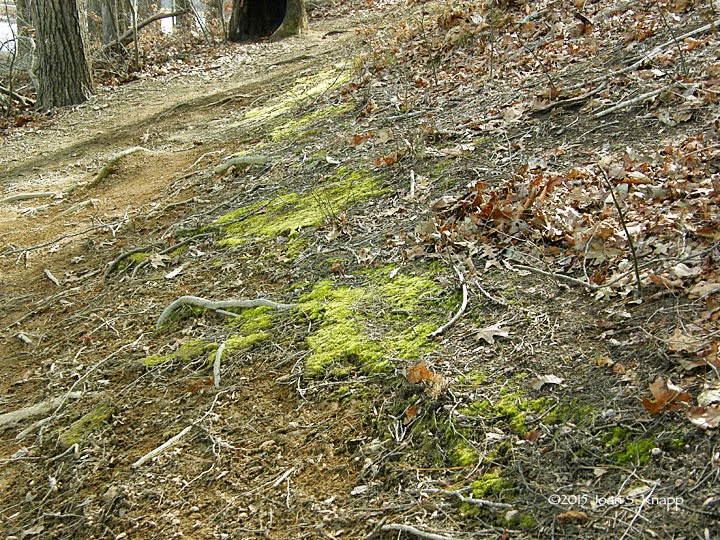
Small patches of moss above the trail. 


Some tree roots have been worn down over the years. It’s easy to trip on these roots and nearby Lespedeza bushes (Lespedeza sp.) lie in wait to deposit seeds on socks and pants if you do. 

Just past this point, there’s a small open area that is overgrown at the moment but which probably be cleared in the spring. I’ve found Butterflypea (Centrosema virginianum), Perennial Wildbean (Strophostyles umbellata) and Helmet Flower (Scutellaria integrifolia), Hairy Angelica (Angelica venenosa)  in this open area. 


The park boasts a Disc Golf Course near the picnic area. This ‘hole’ is on the trail. Several Redring Milkweed (Asclepias variegata) plants grow at the edge of the ‘fairway’ near this hole.  

Tree roots form steps along the trail back into the woods and the picnic area.


The wildflowers that I’ve mentioned here are those that I remember clearly; there are more. This walk can be rewarding at many times of the year.

Related posts:

Monday, February 16, 2015

Winter Walk: Fort Yargo State Park; Shelter A To The Old Fort (Part 2)


February 6th. (Continued from…) I haven’t been to Fort Yargo for a few years and decided to intersperse walks in the park with my trike rides. In previous years, I’ve both walked some of the trails and rowed the lake. If you know where to look, the park has quite a variety of wildflowers.


I decided to walk from the Group Shelter A to the Old Fort and back. There isn’t much in the way of plants at the moment but I enjoy the scenery and this was a particularly pretty day. 

Looking across the lake from the Fishing Area. At full pool, the ‘beach’ in the foreground will be under water. 


A couple of Hazel Alders (Alnus serrulata) are already beginning to bloom.


Empty seedpods of a small bush next to the alders. I don’t know what this is.


A lone acorn seems to remain untouched. Wonder how the squirrels missed this one?

There are two trails from the Fishing Area to the Old Fort. The main trail parallels the shoreline well above the water. The second trail follows the shoreline next to the water; it’s known as the Rock Garden because of the boulders that litter the area. At one time, mountain bikers would ride this precarious trail but, mostly, it is used by fishermen. 

Originally, I walked the Rock Garden out of curiosity but it proved to be an interesting section for wildflowers. Cankerweed (Prenanthes serpentaria), Smooth Yellow False Foxglove (Aureolaria flava), Strawberry Bush (Euonymus americanus), Eastern sweetshrub (Calycanthus floridus), Perfoliate Bellwort, Little Brown Jug/Arrowleaf Heartleaf (Hexastylis arifolia), and Pipsissewa bloom along this section of trail. I usually walk towards the Old Fort along the Rock Garden and return on the upper formal trail.

Looking north along the shoreline and the Rock Garden trail. I was a little taken aback to find the trail deep in leaves but I walked it anyway.


Looking back towards the Fishing Area from the Rock Garden trail. The Southern Magnolia (Magnolia grandiflora) is one of the few along the trails but I’ve never seen it bloom. Another that is located near the entrance to the parking area at the Old Fort does bloom and produces seed.

Little Brown Jug/Arrow Heartleaf grows and blooms in several locations along this trail. Here some are located in the shelter of a large boulder. Pipsissewa plants also grow and bloom near the wild ginger but they were covered by leaves. 


Looking along the Rock Garden trail. I had to ‘cross-country’ from the Rock Garden trail back to the main trail because the trail was deep in leaves. Luckily I found the main trail at the correct place.

Just as I rejoined the main trail I found a very large patch of Cranefly Orchid (Tipularia discolor) leaves, probably the largest I’ve seen in the area.


A closer view of the Cranefly Orchid leaves.


The trail out to the Old Fort.


The road bridge from the main park entrance to the picnic area. I didn’t walk up to the Old Fort on this visit.

Related post: