Elf Orpine (Diamorpha smallii) and its cousin Puck’s Orpine (Granite Stonecrop, Dwarf Stonecrop Sedum pusillum) are succulents that grow on stone outcrops in the Southeastern United States. Elf Orpine stems and leaves are uniformly red. It’s easy to spot patches of them at a distance on stone outcrops in this area. In contrast, stems and leaves of Puck’s Orpine are usually green; some red coloration may be present if they grow in the sun but this is not uniform as it is in Elf Orpine.
Elf Orpine seems to grow on bare ground. It will grow sparsely and in almost ‘pure culture’ in very shallow sand or soil. The patches will appear deep red at a distance until they bloom at which point the patches appear pink rather than red. Occasionally a few Onefllower Stitchwort (Minuartia uniflora) plants will grow in these patches.
These plants were photographed on the Bradley Mountain Trail at the Davidson-Arabia Mountain Nature Preserve in DeKalb County, Georgia.
 Patches of Elf Orpine growing in then layers of sand on top of Bradley Mountain in the Davidson-Arabia Mountain Nature Preserve in DeKalb County, Georgia. In addition to growing in these thin layers of sand or soil, plants will thrive on the margins of deeper dish gardens. See other photos of dish gardens here, here, and here.
 A closer view of plants growing in patches.
 Plants also grow in cracks in the rocks where sand and soil have accumulated.
 A closer view of plants growing in cracks in the rocks
 A plant just getting started in a crack in the rock.
 I almost missed these plants just getting a start in a patch of Grimmia sp. moss. There are at least four plants in this patch of moss.
 A closer view. This plant has just a few leaves
 A close up of buds.
 Individual plants in bloom
 *****
 Close ups of individual flowers.
Diamorpha smallii (Elf Orpine) is native to the southeastern states – Virginia, Tennessee, North and South Carolina, Georgia, and Alabama. In contrast, Sedum pusillum (Puck's Orpine) is found only in North and South Carolina and Georgia.
Click on an image to view a larger image
Distribution Map:
- United States Department of Agriculture Plants Database: Diamorpha smallii (Elf Orpine)
Compare with Sedum pusillum (Granite Stonecrop)
- University of North Carolina Herbarium: Diamorpha smallii
Compare with Sedum pusillum
Identification resources:
- Southeastern Flora: Elf Orpine (Diamorpha smallii)
- Natural and Naturalized Plants of the Carolinas and Georgia: Elf Orpine (Diamorpha smallii)
Compare with Puck's Orpine, Granite Stonecrop (Sedum pusillum)
- US Army Corps of Engineers: Threatened and Endangered Species of the Upper Savannah River Basin (Granite Stonecrop or Dwarf Stonecrop - Sedum pusillum)
Related posts:
- 2010: Year Of The Wildflower – Wildflower Index
- Davidson-Arabia Mountain Nature Preserve: Bradley Mountain Trail (Part 1)
- Davidson-Arabia Mountain Nature Preserve: Bradley Mountain Trail (Part 2)
- Davidson-Arabia Mountain Nature Preserve: Bradley Mountain Trail (Part 3)
We walked the Bradley Mountain Trail at the Davidson-Arabia Mountain Nature Preserve. The first section of the walk was over an almost level trail to the base of Bradley Mountain. The trail went almost straight up the mountain. We planned to contour around the rock but were enticed to go upwards when we saw dish gardens on the side of the mountain. We climbed to the summit.
Rather than go back down from the summit by the way we climbed up, we decided to walk a little further north and then contour back along the east side of the rock and rejoin the trail where we started the climb up.
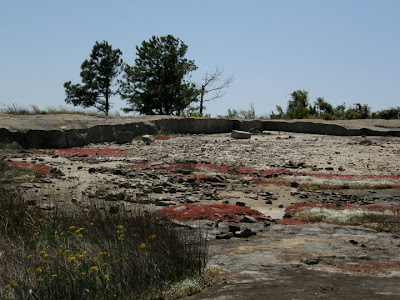 As we moved north from the summit, we saw more evidence of the quarrying on the mountain showing how the rock was removed in relatively ‘thin’ layers of 1 to 2 feet deep. Elf Orpine (Diamorpha smallii) is growing in patches in the very shallow sand/soil that has accumulated. Elf Orpine is an annual. As the plants die, they will contribute nutrients to the sand or cracks where the plants take root.
 Another view showing the edge of quarried rock, more patches of Elf Orpine and a couple of small trees that have managed to root and grow on the rock. The tree on the right is covered with Yellow Jessamine (Gelsemium sempervirens)
 Looking northwest. The Loblolly Pine (Pinus taeda) woods border the rock. Rock gardens are mainly grass and Hairy Groundsel (Packera tomentosa).
 A Blue Corporal (Ladona deplanata). We had seen a couple of dragonflies on the lower trail from the parking lot but they were constantly on the move. In this area, we saw more than a dozen. Most were skittish and, although they settled on grass blades, they would fly off as we approached. This female settled and posed for several shots.
 Looking north-north-east from where we photographed the dragonfly towards Arabia Mountain. Arabia Mountain is not as tall as Bradley Mountain – and Bradley Mountain is a grand climb of 154 feet above the parking lot.
 Looking east from the same spot over a private lake just east of the preserver border to the woods beyond.
 Some small patches of Grimmia moss. There wasn’t much moss on the rock compared with other more-sheltered areas. The rock in this area is exposed to the sun and gets very not in the summer – probably too hot to support moss in spots other than dish gardens or in the shelter of trees as these were.
 A passenger jet passes by the mountain. The mountain is under the flight path of passenger jets landing at Hartsfield-Jackson Atlanta International Airport. Several jets were coming in on the approach to the airport while we were climbing the mountain. A few flew directly over us.
 Some quarrying hardware - plug-and-feathers - remains in the rock. These had been used to split the rock ‘vertically’ from summit towards the base of the mountain. Then the rock was split horizontally and slabs of rock removed. It is fascinating that layers were removed from various places around the mountain rather than creating a deep quarry on one side of the mountain.
 The woods to the east and southeast are a mixture of Loblolly Pine and deciduous trees. The Deciduous trees were just beginning to leaf out.
We contoured back around the mountain until we reached the trail from the parking lot and then retraced our path back to the car. It is easy to keep one’s orientation up on the mountain but the relatively flat lower part of the trail can be a little disorienting. The cairns provide direction back among the myriad of dish gardens.
 We were amused by this sign that had been painted on the path. Someone had felt inspired to add an additional pointer back towards the parking lot. We wondered why since it was easy to follow the cairns along this trail.
I'd heard that 'Arabia Mountain' was impressive but it takes a lot to impress me. But the Bradley Mountain Trail is impressive in the Spring. There are an incredible number of dish gardens along the lower section of the trail showing the progression from the most shallow gardens containing only Elf Orpine to slightly deeper gardens with a mixture of Elf Orpine and Oneflower Stitchwort (Minuartia uniflora), to deeper dish gardens with moss, Hairy Groundsel and Oldfield Toadflas (Nutallanthus canadensis) and margins of Elf Orpine and Oneflower Stitchwort.
From the base of the mountain, the rock appears to be bare. What we found as we climbed to the summit were a large number of dish gardens with similar vegetation as the lower gardens, In addition, an impressive number of trees have taken root and are growing on the summit. This trail is certainly worth the effort to visit and climb.
Click on an image to view a larger image.
Resource:
- Hugh and Carol Nourse. Favorite Wildflower Walks in Georgia. University of Georgia Press, Athens, Georgia
- Arabia Mountain Heritage Area
Related posts:
- Davidson-Arabia Mountain Nature Preserve: Bradley Mountain Trail (Part 1)
- Davidson-Arabia Mountain Nature Preserve: Bradley Mountain Trail (Part 2)
I was wandering around the trailhead at the Rock and Shoals Outcrop Natural Area. Chickweed (Stellaria media) was just starting to bloom. Then I spotted some blue flecks among the chickweed plants. Immediately, I recognized them as speedwells and thought they were Bird-eye Speedwell (Veronica persica) that I had seen previously at Fort Yargo State Park. Upon closer inspection, these were different.
Veronica hederifolia is known by the common names Ivyleaf Speedwell. This species is one of four Veronica species that may grow in the Piedmont area of Georgia. Similar to the Bird-eye Speedwell, Veronica hederifolia flowers are less than 1/4-inch in diameter. In contrast to Veronica persica, the leaves and stems of Veronica hederifolia have prominent hairs.
 The patch of Chickweed (Stellaria media) with Ivyleaf Speedwell (Veronica hederifolia) flowers appearing as specks of blue.
 An individual flower.
 A stem, approximately 6 inches high, with leaves and buds.
 Closeup view of the leaf. The hairs on the stem and leaf are prominent.
 Closeup of a bud starting to open.
Similar to Bird-eye Speedwell (Veronica persica), Ivyleaf Speedwell (Veronica hederifolia) is native to Eurasia. In contrast to the Veronical persica which grows throughout the U.S. and Canada, Veronica hederifolia grows throughout most of the eastern United States, the British Columbia and the U.S. Pacific states and .Utah. It has only been documented in a five counties in Georgia: Elbert, Madison, Clarke, Oconee, and Floyd.
Click on an image to view a larger image
Distribution Map:
- United States Department of Agriculture Plants Database: Veronica hederifolia (Ivyleaf Speedwell)
compare with Veronica persica (Birdeye Speedwell)
- University of North Carolina Herbarium: Veronica hederifolia
Identification resources:
- Southeastern Flora: Ivyleaf Speedwell (Veronica hederifolia)
- Compare with Bird-eye Speedwell (Veronica persica)
Related posts:
- 2010: Year Of The Wildflower
- Bird-eye Speedwell (Veronica persica)
 Patches of Elf Orpine growing in then layers of sand on top of Bradley Mountain in the Davidson-Arabia Mountain Nature Preserve in DeKalb County, Georgia. In addition to growing in these thin layers of sand or soil, plants will thrive on the margins of deeper dish gardens. See other photos of dish gardens here, here, and here.
 A closer view of plants growing in patches.
 Plants also grow in cracks in the rocks where sand and soil have accumulated.
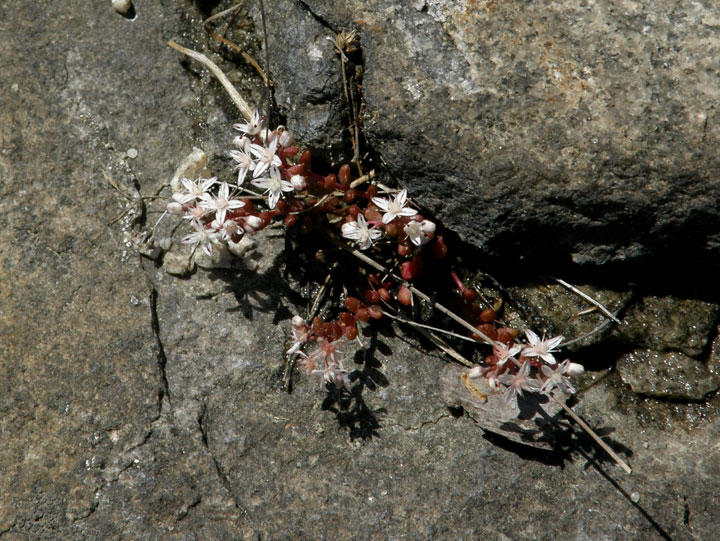 A closer view of plants growing in cracks in the rocks
 A plant just getting started in a crack in the rock.
 I almost missed these plants just getting a start in a patch of Grimmia sp. moss. There are at least four plants in this patch of moss.
 A closer view. This plant has just a few leaves
 A close up of buds.
 Individual plants in bloom
 *****
 Close ups of individual flowers.


